エピソード

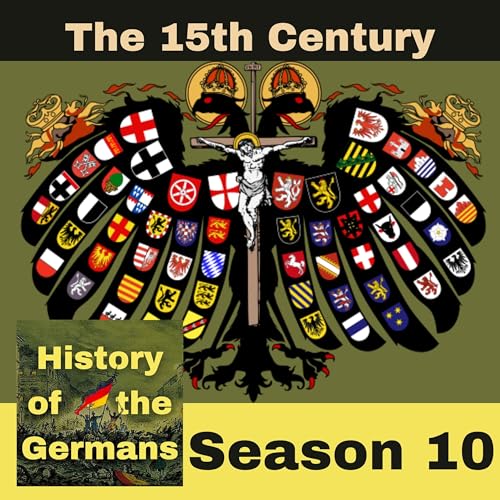
  • The Empire in the 15th Century - Season Opener
    2025/09/09

    Many German histories skip over this period in order to get to the Reformation, which is a shame. Because the 15th century did not just shape the physical appearance of the country, but much of its geographical and mental make-up.

    he music for the show is Flute Sonata in E-flat major, H.545 by Carl Phillip Emmanuel Bach (or some claim it as BWV 1031 Johann Sebastian Bach) performed and arranged by Michel Rondeau under Common Creative Licence 3.0.

    As always:

    Homepage with maps, photos, transcripts and blog: www.historyofthegermans.com

    If you wish to support the show go to: Support • History of the Germans Podcast

    Facebook: @HOTGPod

    Threads: @history_of_the_germans_podcast

    Bluesky: @hotgpod.bsky.social

    Instagram: history_of_the_germans

    Twitter: @germanshistory

    To make it easier for you to share the podcast, I have created separate playlists for some of the seasons that are set up as individual podcasts. they have the exact same episodes as in the History of the Germans, but they may be a helpful device for those who want to concentrate on only one season.

    So far I have:

    The Ottonians

    Salian Emperors and Investiture Controversy

    Fredrick Barbarossa and Early Hohenstaufen

    Frederick II Stupor Mundi

    Saxony and Eastward Expansion

    The Hanseatic League

    The Teutonic Knights

    The Holy Roman Empire 1250-1356

    The Reformation before the Reformation

    続きを読む 一部表示
    12 分
  • Johannes Gutenberg’s Pressing Matters
    2025/09/16

    It is the invention of the printing press we discuss here, nothing more and nothing less. How did it come about, how did it work and why?

    he music for the show is Flute Sonata in E-flat major, H.545 by Carl Phillip Emmanuel Bach (or some claim it as BWV 1031 Johann Sebastian Bach) performed and arranged by Michel Rondeau under Common Creative Licence 3.0.

    As always:

    Homepage with maps, photos, transcripts and blog: www.historyofthegermans.com

    If you wish to support the show go to: Support • History of the Germans Podcast

    Facebook: @HOTGPod

    Threads: @history_of_the_germans_podcast

    Bluesky: @hotgpod.bsky.social

    Instagram: history_of_the_germans

    Twitter: @germanshistory

    To make it easier for you to share the podcast, I have created separate playlists for some of the seasons that are set up as individual podcasts. they have the exact same episodes as in the History of the Germans, but they may be a helpful device for those who want to concentrate on only one season.

    So far I have:

    The Ottonians

    Salian Emperors and Investiture Controversy

    Fredrick Barbarossa and Early Hohenstaufen

    Frederick II Stupor Mundi

    Saxony and Eastward Expansion

    The Hanseatic League

    The Teutonic Knights

    The Holy Roman Empire 1250-1356

    The Reformation before the Reformation

    続きを読む 一部表示
    44 分
  • What Has Printing Ever Done For Us?
    2025/09/23
    “We should note the force, effect, and consequences of inventions which are nowhere more conspicuous than in those three which were unknown to the ancients, namely printing, gunpowder and the compass. For these three have changed the appearance and the state of the world.” wrote Francis Bacon in 1620. And almost everybody agreed.Printing changed everything, but how exactly did it change everything? That is a question nobody posed properly until Elisabeth L. Eisenstein got on the academic stage in the 1970s and the debate has not yet stopped. In this episode I will try to take you through some of Eisenstein’s ideas on the how of the change and, in the end, attempt a raincheck on what we can learn from it for the information revolution we are living through right now. No worries, this is still the History of the Germans, so we will talk facts and dates and processes, with only occasional attempts at breaking into the ivory tower…he music for the show is Flute Sonata in E-flat major, H.545 by Carl Phillip Emmanuel Bach (or some claim it as BWV 1031 Johann Sebastian Bach) performed and arranged by Michel Rondeau under Common Creative Licence 3.0.As always:Homepage with maps, photos, transcripts and blog: www.historyofthegermans.comIf you wish to support the show go to: Support • History of the Germans PodcastFacebook: @HOTGPod Threads: @history_of_the_germans_podcastBluesky: @hotgpod.bsky.socialInstagram: history_of_the_germansTwitter: @germanshistoryTo make it easier for you to share the podcast, I have created separate playlists for some of the seasons that are set up as individual podcasts. they have the exact same episodes as in the History of the Germans, but they may be a helpful device for those who want to concentrate on only one season. So far I have:The OttoniansSalian Emperors and Investiture ControversyFredrick Barbarossa and Early HohenstaufenFrederick II Stupor MundiSaxony and Eastward ExpansionThe Hanseatic LeagueThe Teutonic KnightsThe Holy Roman Empire 1250-1356The Reformation before the Reformation
    続きを読む 一部表示
    37 分
  • Origin Stories - Mainz and Hessen
    2025/09/30
    This week we are setting off on our tour of the empire for real. And where better to start than with the most senior, most august of the seven prince Electors, the archbishop of Mainz, archchancellor of the empire, and holder of the decisive vote in imperial elections. We have already encountered a number of archbishops of Mainz in this podcast, from the treacherous Frederick who tried to overthrow Otto the Great (ep.3), to Willigis, the eminence grise of the empire under Otto II, Otto III and Henry II (ep.10-19) , Adalbert, first advisor and then adversary of Henry V (ep. 40), Peter von Aspelt, the man who put the Luxemburgs on the Bohemian throne (ep. 145) and lots more. But this series is not about grand imperial politics, but about the grimy territorial skullduggery inside the empire. And for Mainz this is a story that is deeply entangled with the history of Hessen. Where Mainz is ancient, tracing its’ eminence back to a saint who had come across the water, Hessen was a new kid on the block amongst the imperial princes. But a very successful one. And at its beginning stood the 24 year-old daughter of a saint holding up her baby son to be acclaimed lord by the people, or some such thing. Maps of Mainz, the Landgraviate of Thuringia and Hessen: Maps • History of the Germans Podcasthe music for the show is Flute Sonata in E-flat major, H.545 by Carl Phillip Emmanuel Bach (or some claim it as BWV 1031 Johann Sebastian Bach) performed and arranged by Michel Rondeau under Common Creative Licence 3.0.As always:Homepage with maps, photos, transcripts and blog: www.historyofthegermans.comIf you wish to support the show go to: Support • History of the Germans PodcastFacebook: @HOTGPod Threads: @history_of_the_germans_podcastBluesky: @hotgpod.bsky.socialInstagram: history_of_the_germansTwitter: @germanshistoryTo make it easier for you to share the podcast, I have created separate playlists for some of the seasons that are set up as individual podcasts. they have the exact same episodes as in the History of the Germans, but they may be a helpful device for those who want to concentrate on only one season. So far I have:The OttoniansSalian Emperors and Investiture ControversyFredrick Barbarossa and Early HohenstaufenFrederick II Stupor MundiSaxony and Eastward ExpansionThe Hanseatic LeagueThe Teutonic KnightsThe Holy Roman Empire 1250-1356The Reformation before the Reformation
    続きを読む 一部表示
    41 分
  • The Count Palatine on the Rhine
    2025/10/07

    This week it is back to the political landscape of the empire. We will travel upriver from Mainz via Worms and the not yet existent cities of Mannheim and Ludwigshafen to Heidelberg, my old hometown.

    And there we will meet the man who held one of the empire’s most confusing titles, the count Palatinate of the Rhine, Elector and High Steward of the Empire. His name is Friedrich, Friedrich der Siegreiche, Frederick the Victorious, and being victorious is barely half of what is interesting about him.

    he music for the show is Flute Sonata in E-flat major, H.545 by Carl Phillip Emmanuel Bach (or some claim it as BWV 1031 Johann Sebastian Bach) performed and arranged by Michel Rondeau under Common Creative Licence 3.0.

    As always:

    Homepage with maps, photos, transcripts and blog: www.historyofthegermans.com

    If you wish to support the show go to: Support • History of the Germans Podcast

    Facebook: @HOTGPod

    Threads: @history_of_the_germans_podcast

    Bluesky: @hotgpod.bsky.social

    Instagram: history_of_the_germans

    Twitter: @germanshistory

    To make it easier for you to share the podcast, I have created separate playlists for some of the seasons that are set up as individual podcasts. they have the exact same episodes as in the History of the Germans, but they may be a helpful device for those who want to concentrate on only one season.

    So far I have:

    The Ottonians

    Salian Emperors and Investiture Controversy

    Fredrick Barbarossa and Early Hohenstaufen

    Frederick II Stupor Mundi

    Saxony and Eastward Expansion

    The Hanseatic League

    The Teutonic Knights

    The Holy Roman Empire 1250-1356

    The Reformation before the Reformation
    続きを読む 一部表示
    37 分
  • A (very) brief History of the German Universities
    2025/10/14

    Between the time the first Nobel Prize was awarded in 1901 and 1933, a total of 31 were awarded to German scientists and politicians. To name just a few, Wilhelm Röntgen (1901), Max Planck (1918), Albert Einstein (1921) and Werner Heisenberg (1932) for Physics, Emil Fischer (1902), Fritz Haber (1918), Walther Nernst (1920) and Hans Fischer (1930) for chemistry, Emil von Behring (1901), Robert Koch (1905) and Otto Warburg (1931) for medicine, Theodor Mommsen (1902), Gerhart Hauptmann (1912) and Thomas Mann (1929) for literature and Gustav Stresemann for peace.

    The UK and France received 17 and 15 respectively, whilst the US picked up just 6 during that same period.

    How could German universities rise to such dominance during the 19th and early 20th century from very humble beginnings? That is what we will look at in this episode.

    he music for the show is Flute Sonata in E-flat major, H.545 by Carl Phillip Emmanuel Bach (or some claim it as BWV 1031 Johann Sebastian Bach) performed and arranged by Michel Rondeau under Common Creative Licence 3.0.

    As always:

    Homepage with maps, photos, transcripts and blog: www.historyofthegermans.com

    If you wish to support the show go to: Support • History of the Germans Podcast

    Facebook: @HOTGPod

    Threads: @history_of_the_germans_podcast

    Bluesky: @hotgpod.bsky.social

    Instagram: history_of_the_germans

    Twitter: @germanshistory

    To make it easier for you to share the podcast, I have created separate playlists for some of the seasons that are set up as individual podcasts. they have the exact same episodes as in the History of the Germans, but they may be a helpful device for those who want to concentrate on only one season.

    So far I have:

    The Ottonians

    Salian Emperors and Investiture Controversy

    Fredrick Barbarossa and Early Hohenstaufen

    Frederick II Stupor Mundi

    Saxony and Eastward Expansion

    The Hanseatic League

    The Teutonic Knights

    The Holy Roman Empire 1250-1356

    The Reformation before the Reformation

    続きを読む 一部表示
    47 分
  • The Margraviate of Baden
    2025/10/21
    What is it like to be a prince? Well, not quite what it is set out to be, in particular when you are a smaller prince, not in stature, but in land.The margraves of Baden are such princes. In the 15th century their main territory, a slither of South-West Germany, just 60km long was too small to play on the European, even on the German stage, but too big to escape the need of massive palaces and warfare.What makes Baden so fascinating is that despite its handicap, it managed to become a medium sized state, one half of Baden-Württemberg. The way there was a long one, involving friendship and loyalty to the death, piratical princesses, alchemy, someone called the Türkenlouis, a sun-shaped city and some skilled diplomacy. Hyperlink to map of Baden: HABW_06_01.jpg (5750×6500)he music for the show is Flute Sonata in E-flat major, H.545 by Carl Phillip Emmanuel Bach (or some claim it as BWV 1031 Johann Sebastian Bach) performed and arranged by Michel Rondeau under Common Creative Licence 3.0.As always:Homepage with maps, photos, transcripts and blog: www.historyofthegermans.comIf you wish to support the show go to: Support • History of the Germans PodcastFacebook: @HOTGPod Threads: @history_of_the_germans_podcastBluesky: @hotgpod.bsky.socialInstagram: history_of_the_germansTwitter: @germanshistoryTo make it easier for you to share the podcast, I have created separate playlists for some of the seasons that are set up as individual podcasts. they have the exact same episodes as in the History of the Germans, but they may be a helpful device for those who want to concentrate on only one season. So far I have:The OttoniansSalian Emperors and Investiture ControversyFredrick Barbarossa and Early HohenstaufenFrederick II Stupor MundiSaxony and Eastward ExpansionThe Hanseatic LeagueThe Teutonic KnightsThe Holy Roman Empire 1250-1356The Reformation before the Reformation
    続きを読む 一部表示
    42 分
  • Württemberg, or How to Build a Success
    2025/11/07
    The counts, dukes and ultimately kings of Württemberg had risen to the top by winning the genetic lottery. Their eldest sons tended to be competent, some even extremely so, their wives brought in dowries and sometimes entire counties, and they ruled for long enough that the next generation took over when they were ready.But all that falls apart in the 15th century. They are suddenly afflicted with the disease of dynasties, states inherited by babies and buffoons, some of them managing to be both. That would normally be the death nail for a noble House, but not this time. The Landtag, the Estates of Württemberg step in to protect the fledgling state, deposing buffoons when necessary and ruling on behalf of the babies. This is one of the lesser known and even more extraordinary political histories in europe and well worth listening to.And as a bonus we also investigate why the regions around Stuttgart, Mannheim, Karlsruhe and Freiburg have become hubs of technology and precision engineering, an area where there was no coal, no mining or any other natural advantage – except for the wine – no seriously, it was the wine. Can Winegrowing Cause Rural Development? Evidence from Baden-Württemberg | European Review of Economic History | Oxford Academic (https://academic.oup.com/ereh/advance...) he music for the show is Flute Sonata in E-flat major, H.545 by Carl Phillip Emmanuel Bach (or some claim it as BWV 1031 Johann Sebastian Bach) performed and arranged by Michel Rondeau under Common Creative Licence 3.0.As always:Homepage with maps, photos, transcripts and blog: www.historyofthegermans.comIf you wish to support the show go to: Support • History of the Germans PodcastFacebook: @HOTGPod Threads: @history_of_the_germans_podcastBluesky: @hotgpod.bsky.socialInstagram: history_of_the_germansTwitter: @germanshistoryTo make it easier for you to share the podcast, I have created separate playlists for some of the seasons that are set up as individual podcasts. they have the exact same episodes as in the History of the Germans, but they may be a helpful device for those who want to concentrate on only one season. So far I have:The OttoniansSalian Emperors and Investiture ControversyFredrick Barbarossa and Early HohenstaufenFrederick II Stupor MundiSaxony and Eastward ExpansionThe Hanseatic LeagueThe Teutonic KnightsThe Holy Roman Empire 1250-1356The Reformation before the Reformation
    続きを読む 一部表示
    47 分