『The Early Habsburgs』のカバーアート

The Early Habsburgs

The Early Habsburgs

著者: History of the Germans
無料で聴く

今ならプレミアムプランが3カ月 月額99円

2026年5月12日まで。4か月目以降は月額1,500円で自動更新します。

概要

The House of Habsburg once ruled Spain, Benelux, Austria, Hungary, Czechia, most of Italy, at times Portugal and all of Latin America, the Philippines and of course, the Holy Roman Empire. Most histories of the Habsburgs start out with Maximilian I, his marriage alliances that brought together this empire. But he was not the first Habsburg emperor, and by no means the first Habsburg ruler of the Holy Roman Empire. Their history goes back to the 13th century when they almost established their dynasty on the throne, had it not been for John Parricida murdering his uncle. In this show we follow the dramatic events that saw this dynasty rising and then falling hard, its struggles to recover, the feats and forgeries, the victories and terrible defeats that shaped this family and its lore. We take the story from Rudolf of Habsburgs’ ascent to the throne in 1273 to the election of Charles V in 1519. This podcast is part of the broader History of the Germans podcast that aims to track the history of the German people from the Early Middle Ages to Reunification in 1991. If you enjoy this show, check out any of the other seasons or follow the main show. So far I have the following seasons: The Ottonians (919 AD-1024 AD) Salian Emperors and Investiture Controversy (1024 AD-1125 AD) Fredrick Barbarossa and Early Hohenstaufen (1125-1190) Frederick II Stupor Mundi (1190-1268) Saxony and Eastward Expansion The Hanseatic League The Teutonic Knights The Holy Roman Empire (1250 AD -1356 AD) The Reformation before the Reformation (1356AD -1439 AD) The Empire in the 15th Century The Fall and Rise of the Habsburgs (1439AD -1519 AD)Copyright 2026 History of the Germans 世界 社会科学
エピソード
  • Ep. 205: Habsburg Dukes (1308-1437) – Sempach, Birth of a Nation - History of the Germans
    2025/09/04
    On July 9th, 1386 in a field near the Sempach lake., the armies of archduke Leopold of Austria line up against the forces of the city of Lucerne and the men of Uri, Schwyz and NidwaldenMuch of what hads been told about this batte, the backstory of the Swiss Confederation and the objectives of the Habsburgs have been drenched in myth. Myths that are in the main debunked. That being said, the story is still dramatic and hugely important.The music for the show is Flute Sonata in E-flat major, H.545 by Carl Phillip Emmanuel Bach (or some claim it as BWV 1031 Johann Sebastian Bach) performed and arranged by Michel Rondeau under Common Creative Licence 3.0.As always:Homepage with maps, photos, transcripts and blog: www.historyofthegermans.comIf you wish to support the show go to: Support • History of the Germans PodcastFor do it yourself merchandise go to: Merchandise • History of the Germans PodcastFacebook: @HOTGPod Threads: @history_of_the_germans_podcastBluesky: @hotgpod.bsky.socialInstagram: history_of_the_germansTwitter: @germanshistoryTo make it easier for you to share the podcast, I have created separate playlists for some of the seasons that are set up as individual podcasts. they have the exact same episodes as in the History of the Germans, but they may be a helpful device for those who want to concentrate on only one season.So far I have:The OttoniansSalian Emperors and Investiture ControversyFredrick Barbarossa and Early HohenstaufenFrederick II Stupor MundiSaxony and Eastward ExpansionThe Hanseatic LeagueThe Teutonic KnightsThe Holy Roman Empire 1250-1356The Reformation before the ReformationThe Empire in the 15th centuryThe Fall and Rise of the Habsburgs
    続きを読む 一部表示
    38 分
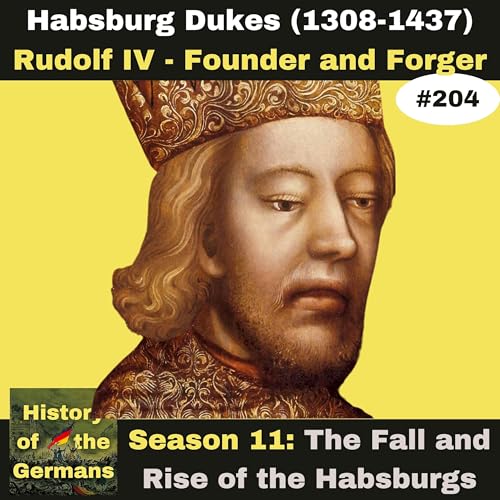
  • Ep. 204: Habsburg Dukes (1308-1437) – Rudolf IV, Founder and Forger - History of the Germans
    2025/08/28
    Rudolf IV of Habsburg (1339–1365), son of Albrecht “the Wise,” reigned as Duke of Austria for just seven years but left a lasting mark. Born when the dynasty seemed close to extinction, Rudolf secured Austria’s survival and prestige. Politically, he sought to elevate Vienna by founding the University of Vienna (1365) and beginning construction of St. Stephen’s Cathedral. Though he fulfilled his father's ambition to gain the Tyrol, the family fell behind their rivals, namely the Luxemburgs.Rudolf’s most audacious act was the Privilegium Maius, a set of forged charters claiming ancient Roman emperors had granted Austria near-sovereign status, primogeniture, and the unique title of Archduke. Though denounced by Petrarch as absurd, the documents shaped Habsburg identity for centuries and underpinned later power.By creating myths of divine and heroic origins, Rudolf forged a sense of Habsburg exceptionalism. Though dying young without heirs, he truly was “the Founder.”The music for the show is Flute Sonata in E-flat major, H.545 by Carl Phillip Emmanuel Bach (or some claim it as BWV 1031 Johann Sebastian Bach) performed and arranged by Michel Rondeau under Common Creative Licence 3.0.As always:Homepage with maps, photos, transcripts and blog: www.historyofthegermans.comIf you wish to support the show go to: Support • History of the Germans PodcastFor do it yourself merchandise go to: Merchandise • History of the Germans PodcastFacebook: @HOTGPod Threads: @history_of_the_germans_podcastBluesky: @hotgpod.bsky.socialInstagram: history_of_the_germansTwitter: @germanshistoryTo make it easier for you to share the podcast, I have created separate playlists for some of the seasons that are set up as individual podcasts. they have the exact same episodes as in the History of the Germans, but they may be a helpful device for those who want to concentrate on only one season.So far I have:The OttoniansSalian Emperors and Investiture ControversyFredrick Barbarossa and Early HohenstaufenFrederick II Stupor MundiSaxony and Eastward ExpansionThe Hanseatic LeagueThe Teutonic KnightsThe Holy Roman Empire 1250-1356The Reformation before the ReformationThe Empire in the 15th centuryThe Fall and Rise of the Habsburgs
    続きを読む 一部表示
    32 分
まだレビューはありません