『The Decision Dividend』のカバーアート

The Decision Dividend

The Decision Dividend

著者: Greenspring Advisors
無料で聴く

A podcast specifically focused on helping every person live their ideal life by helping them make better decisions around their finances, relationships, and life.Copyright 2026 All rights reserved. マネジメント・リーダーシップ リーダーシップ 個人ファイナンス 経済学
エピソード
  • 5 Tools for Better Decisions
    2026/05/26
    Practical frameworks for separating process from outcome. A good outcome can make a bad decision look smart. A bad outcome can make a good decision look foolish. In Episode 34 of The Decision Dividend, we look at how to separate the quality of your decision from the luck of the result. To do that, we walk through five practical tools for making better decisions before, during, and after uncertainty shows up. You’ll learn: How a decision memo can help you judge your process without being fooled by the outcomeWhy scorecards and base rates can make tradeoffs clearer and forecasts more realisticHow if-then rules and defaults can help turn better decisions into repeatable behavior Chapters 00:00 5 Tools for Better Decisions How to separate the quality of a decision from the luck of the result. 01:11 Trust the Evidence Why better decisions start with process, data, science, and evidence. 02:00 When a Decision Needs a Framework How to decide when a choice deserves structure and when an incremental step is enough. 03:48 Why Gut Instinct Can Mislead Investors How the same instincts that helped humans avoid danger can hurt decision-making under uncertainty. 05:59 The Five Decision Tools Decision memos, scorecards, base rates, if-then rules, and defaults. 06:48 Decision Memos and Journals (1) Why writing down your reasoning in advance can help you audit decisions later. 09:12 Scorecards and Tradeoffs (2) How a one-page scorecard can make tradeoffs clearer when there is no single right answer. 12:16 Base Rates (3, 8) Why the first question should be what usually happens in similar situations. 15:35 If-Then Rules and Guardrails (4) How pre-deciding your trigger and response can reduce improvisation under stress. 18:36 Defaults and Precommitment (5, 6, 7) Why making a decision once can be more effective than re-deciding every month. 21:48 Decision vs. Outcome (1) Why a bad decision can be rewarded by luck and a good decision can still disappoint. 26:33 The Decision 2x2 (1) A practical way to separate good and bad decisions from good and bad outcomes. 30:02 When Several Things Matter (2) How weighing multiple criteria can help compare financial and life decisions. 34:56 The Outside View (3, 10) Why personal experience can distort expectations for returns, risk, and future outcomes. 40:34 Learning from Wins and Losses (1,9) Why early success can create overconfidence, and why bad outcomes can sometimes teach useful lessons. 42:49 Win or Learn How better decision-making compounds when you review the process, not just the result. Sources Jonathan Baron and John C. Hershey, “Outcome Bias in Decision Evaluation,” Journal of Personality and Social Psychology, 1988. https://bear.warrington.ufl.edu/brenner/mar7588/Papers/baron-hershey-jpsp1988.pdfSamuel D. Bond, Kurt A. Carlson, and Ralph L. Keeney, “Generating Objectives: Can Decision Makers Articulate What They Want?,” Management Science, 2008. https://pubsonline.informs.org/doi/10.1287/mnsc.1070.0754Roger Buehler, Dale Griffin, and Michael Ross, “Exploring the ‘Planning Fallacy’: Why People Underestimate Their Task Completion Times,” Journal of Personality and Social Psychology, 1994. https://web.mit.edu/curhan/www/docs/Articles/biases/67_J_Personality_and_Social_Psychology_366%2C_1994.pdfPeter M. Gollwitzer and Paschal Sheeran, “Implementation Intentions and Goal Achievement: A Meta-Analysis of Effects and Processes,” Advances in Experimental Social Psychology, 2006. https://www.researchgate.net/publication/37367696_Implementation_Intentions_and_Goal_Achievement_A_Meta-Analysis_of_Effects_and_ProcessesBrigitte C. Madrian and Dennis F. Shea, “The Power of Suggestion: Inertia in 401(k) Participation and Savings Behavior,” NBER Working Paper, 2000. https://www.nber.org/system/files/working_papers/w7682/w7682.pdfRichard H. Thaler and Shlomo Benartzi, “Save More Tomorrow: Using Behavioral Economics to Increase Employee Saving,” Journal of Political Economy, 2004. https://www.anderson.ucla.edu/documents/areas/fac/accounting/smartjpe226.pdfSheena S. Iyengar, Gur Huberman, and Wei Jiang, “How Much Choice Is Too Much? Contributions to 401(k) Retirement Plans,” Pension Research Council Working Paper, 2003. https://pensionresearchcouncil.wharton.upenn.edu/publications/papers-2018/how-much-choice-is-too-much-contributions-to-401k-retirement-plans/Jay R. Ritter, “The Long-Run Performance of Initial Public Offerings,” Journal of Finance, 1991. https://site.warrington.ufl.edu/ritter/files/The-Long-Run-Performance-of-Initial-Public-Offerings-1991-03.pdfHendrik Bessembinder, “Do Stocks Outperform Treasury Bills?,” Journal of Financial Economics, 2018. https://papers.ssrn.com/sol3/papers.cfm?abstract_id=2900447UBS, “Global Investment Returns Yearbook 2026.” https://www.ubs.com/global/en/investment-bank/insights-and-data/articles/global-investment-returns-yearbook-2026.html Follow on Apple Podcasts: https://podcasts.apple.com/us/...
    続きを読む 一部表示
    44 分
  • Where Should Your Extra Savings Go?
    2026/05/12
    A research-informed order of operations for cash reserves, debt, retirement accounts, brokerage accounts, 529s, and mortgage prepayment. The hard part of having extra savings is rarely finding a good option. It’s choosing between several. In Episode 33 of The Decision Dividend, Pat Collins and Marcus Schafer walk through a practical order of operations to decide where your extra savings should go. The answer is not always the account with the best theoretical return. The right sequence depends on cash flow, liquidity, taxes, debt, goals, and behavior. You’ll learn: How to avoid the high-income paycheck-to-paycheck trap by setting a savings target before lifestyle absorbs the next raise Which dollars often deserve early consideration: emergency cash, high-interest debt, and employer-provided matching opportunities What research says about the harder tradeoffs, including Roth vs. pre-tax, taxable brokerage vs. 529s, and extra mortgage payments vs. investing Chapters 00:00 Where Should Your Extra Savings Go? Why the next-dollar decision is really a tradeoff between several good options. 01:34 Tightwads, Spendthrifts, and the Pain of Paying (1) How different people experience spending and saving differently, and why behavior matters before optimization. 02:40 Savings Rate Comes First (2) Why the most powerful planning variable is often not Roth vs. pre-tax, but whether lifestyle absorbs the next raise. 07:09 Make the Plan Automatic (3, 4, 5) Why defaults, payroll deductions, and automation often matter more than a perfectly designed spreadsheet. 13:35 The Savings Waterfall A practical starting point: create margin, build emergency reserves, avoid high-interest debt, and capture employer-provided matching opportunities. 16:40 Liquidity, Taxes, and Account Flexibility Why the same dollar feels different in cash, taxable brokerage, pre-tax retirement accounts, and Roth accounts. 20:26 Taxable Brokerage vs. Retirement Accounts How tax drag, liquidity, goal timing, and future uncertainty shape where the next dollar should go. 28:00 Roth vs. Pre-Tax Is Not a Religion (6, 7) Age + 20% is a good rule of thumb but current tax rates, future tax rates, tax uncertainty, and account access make this decision highly personal. 31:20 Mortgage Prepayment vs. Investing (8) How to compare the guaranteed return of paying down debt against the double tax and return benefits of retirement investing. 38:59 The Theory Only Works If You Actually Do It (3, 4, 5, 8) Why behavior can erase the benefits of a more optimal strategy if the money never actually gets invested. 43:10 College Savings, 529s, and Optionality (9) Why education funding should be balanced against retirement, flexibility, and uncertainty about future college costs. 52:48 Build a Repeatable System Why rules of thumb can help, but personalized advice matters when cash flow, taxes, debt, goals, and behavior collide. Sources Scott I. Rick, Cynthia E. Cryder, and George Loewenstein, “Tightwads and Spendthrifts,” Journal of Consumer Research, 2008. https://academic.oup.com/jcr/article-abstract/34/6/767/1795103Goldman Sachs Asset Management, Retirement Survey & Insights Report 2025. https://am.gs.com/en-us/advisors/insights/report-survey/retirement-surveyBrigitte C. Madrian and Dennis F. Shea, “The Power of Suggestion: Inertia in 401(k) Participation and Savings Behavior.” https://www.nber.org/system/files/working_papers/w7682/w7682.pdfRichard H. Thaler and Shlomo Benartzi, “Save More Tomorrow: Using Behavioral Economics to Increase Employee Saving.” https://www.anderson.ucla.edu/documents/areas/fac/accounting/smartjpe226.pdfRaj Chetty, John N. Friedman, Søren Leth-Petersen, Torben Heien Nielsen, and Tore Olsen, “Active vs. Passive Decisions and Crowd-Out in Retirement Savings Accounts.” https://eml.berkeley.edu/~saez/course/chettyatQJE14savings.pdfDavid C. Brown, Scott Cederburg, and Michael S. O’Doherty, “Tax Uncertainty and Retirement Savings Diversification.” https://www.sciencedirect.com/science/article/pii/S0304405X17302519Wall Street Journal, “Why So Many People Get Financial Advice That Is Wrong for Them.” https://www.wsj.com/finance/investing/financial-advice-investments-personalization-fea73e95Gene Amromin, Jennifer Huang, and Clemens Sialm, “The Tradeoff Between Mortgage Prepayments and Tax-Deferred Retirement Savings.” https://www.nber.org/papers/w12502Fidelity, “Understanding 529 Rollovers to a Roth IRA.” https://www.fidelity.com/learning-center/personal-finance/529-rollover-to-roth Follow on Apple Podcasts: https://podcasts.apple.com/us/podcast/greenstream/id1795467982 Follow on Spotify: https://open.spotify.com/show/26NYX6WD7godcJAYVE0Yk8?si=Qxj-H7HiRdGmbNlW8uuV9g Subscribe for Email Updates: https://greenspringadvisors.com/greenstream-podcast Meet with Pat & Marcus: https://outlook.office365.com/book/MarcusCalendaratGreenspringAdvisors@Greenspringos33.onmicrosoft.com Information contained herein has been obtained ...
    続きを読む 一部表示
    55 分
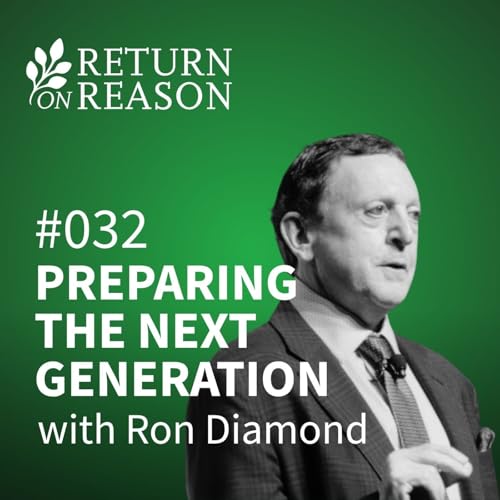
  • How to Transfer Wealth the Right Way with Ron Diamond
    2026/04/28

    Too often, families spend more time planning how to build wealth than how to pass it on. In Episode 32, we’re joined by Ron Diamond* to discuss family governance, inheritance, and how to prepare the next generation for wealth without creating confusion, conflict, or entitlement.

    You’ll learn:

    • Why investing should often come after governance, values, and family communication
    • How to prepare children for wealth without creating entitlement
    • What families should address before a liquidity event or inheritance

    About Ron Diamond We asked Ron to join us because he has spent years working with families and family offices on exactly these family governance challenges. He is Founder and Chairman of Diamond Wealth, a leader in the family office community through TIGER 21, and a member of the Advisory Board and Steering Committee for the University of Chicago Booth School of Business Family Office Initiative.

    https://www.linkedin.com/in/ronalddiamond/

    https://www.chicagobooth.edu/research/family-office-initiative

    Follow on Apple Podcasts: https://podcasts.apple.com/us/podcast/greenstream/id1795467982

    Follow on Spotify: https://open.spotify.com/show/26NYX6WD7godcJAYVE0Yk8?si=Qxj-H7HiRdGmbNlW8uuV9g

    Subscribe for Email Updates: https://greenspringadvisors.com/greenstream-podcast

    Meet with Pat & Marcus: https://outlook.office365.com/book/MarcusCalendaratGreenspringAdvisors@Greenspringos33.onmicrosoft.com

    *Guest speakers featured are independent third parties and are not affiliated with Greenspring. No cash or non-cash compensation was provided to or received by Greenspring in connection with any guest appearance. The views and opinions expressed by guests are their own as of the date of recording and do not necessarily reflect the views of Greenspring. Appearance on the podcast should not be construed as an endorsement of Greenspring.

    Information contained herein has been obtained from sources considered reliable, but its accuracy and completeness are not guaranteed. It is not intended as the primary basis for financial planning or investment decisions and should not be construed as advice meeting the particular investment needs of any investor. This material has been prepared for information purposes only and is not a solicitation or an offer to buy any security or instrument or to participate in any trading strategy. Past performance is no guarantee of future results.

    続きを読む 一部表示
    49 分
adbl_web_anon_alc_button_suppression_c
まだレビューはありません