エピソード

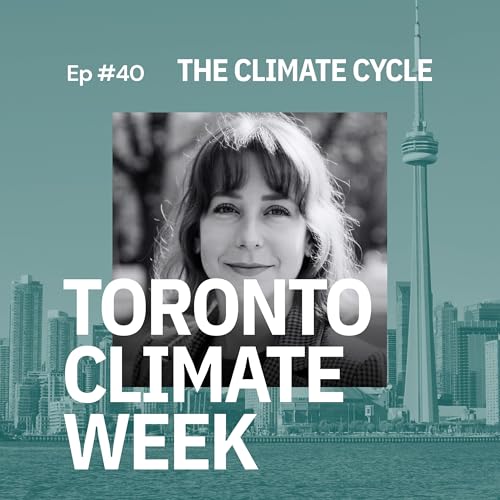
  • Turning Toronto Into Canada's Climate Hub
    2026/04/30

    Can Toronto become a global climate hub - and put Canada on the map?

    Becky Park-Romanovsky is a global leader in sustainability and climate action, with a track record of launching and scaling climate-focused initiatives across multiple continents. She founded Toronto Climate Week, co-founded Climate North, is a lecturer on Social Entrepreneurship at IE University in Madrid, and previously developed carbon offset projects across the Americas, Africa, Middle East, and Eastern Europe.

    TOCW is a decentralized platform - part convener, part infrastructure layer for Canada's climate ecosystem. Their October kickoff was planned as a single day with 20 events. Instead, it drew 100 events, 5,000 attendees, and representation from 30 countries - with zero international outreach. The full week runs June 1–7 with 200+ events across 16 tracks.

    We get into:

    • Toronto's potential as a climate hub - where it's strong and who still needs to come to the table
    • Why corporate climate action isn't slowing down even as public commitments disappear
    • The strategy behind radical inclusion - arts, sports, culture
    • Building the infrastructure to turn a week of conversations into measurable outcomes
    • What Canada's climate ecosystem looks like if Toronto gets this right

    We're happy to be supporting TOCW in their inaugural year as a media partner.

    MORE

    Subscribe to our weekly briefing for the latest climate deals, events, policy shifts and more.

    Enjoying the show? Leave a review and help us grow!

    Questions or feedback: hello@climatetechcanada.ca

    続きを読む 一部表示
    35 分
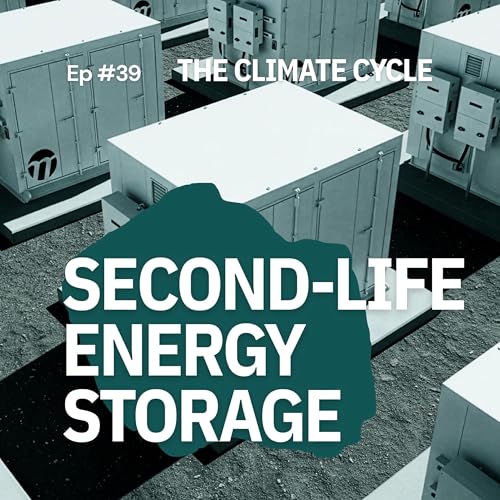
  • Turning Retired EV Batteries Into Domestic Energy Storage with Moment Energy
    2026/04/16

    The battery storage market is growing - and the supply chain feeding it runs largely through overseas cell manufacturers. At the same time, the first wave of EV batteries is aging out of vehicles, with nowhere obvious to go.

    Moment Energy is building the infrastructure to address both problems at once, repurposing retired EV battery packs for commercial energy storage. Their platform takes battery cells that still hold around 80% of their original capacity and redeploys them as stationary battery energy storage. Unlike competitors sourcing cells from overseas, Moment's feedstock is already here: in EVs across Canada and the US.


    Sumreen Rattan is co-founder and COO of Moment Energy. The company closed a US$15M Series A from Amazon's Climate Pledge Fund and Voyager Ventures, secured a $20.3M DOE grant for a Texas gigafactory, and holds supply agreements with Nissan North America and Mercedes-Benz.

    What we cover:

    • Moment’s second-life thesis - why a battery with 80% capacity remaining is too valuable to recycle

    • Putting together supply partnerships with Nissan and Mercedes-Benz

    • Data centres as a new customer category

    • The domestic supply chain advantage as FEOC rules reshape North American procurement

    • What's slowing energy storage deployment in Canada

    • Building at gigafactory scale and solving the talent gap

    → Subscribe to our weekly newsletter for Canadian climate tech funding, news, and trends

    → Full show notes and resources

    → Enjoying the show? Leave a review on Spotify or Apple Podcasts

    → Feedback or guest ideas: hello@climatetechcanada.ca

    続きを読む 一部表示
    41 分
  • The Economic Case for Carbon Removal with Na'im Merchant
    2026/04/02

    Canada's carbon removal sector punches well above its weight. We're home to leaders in direct air capture, mineral and ocean pathways and international companies are moving projects to Canada. The question is whether Canada will move ambitiously enough to capitalize before the window closes.

    Na'im Merchant is the Executive Director of Carbon Removal Canada, the country's leading CDR advocacy non-profit. In March 2026, his organization helped anchor the Advance Carbon Removal Coalition - a $100M commitment from the federal government, RBC, BMO, and Shopify to back Canadian projects by 2030.

    Carbon Removal Canada is the connective tissue the sector needed: a technology-agnostic, independent organization that coordinates policy, organizes the ecosystem, and builds the demand signals that help projects get financed. Their economic modelling shows CDR starts saving Canada money by 2035, cutting the marginal cost of reaching net zero by over 50% by 2050.

    What we cover:

    • Why Na'im left global health for carbon removal
    • What $100M actually unlocks - and why a government buyer matters
    • The economic argument: how CDR saves Canada money on the path to net zero
    • Industrial integration: mining, steel, and forestry as CDR opportunities
    • Trough of disillusionment or normal maturation?
    • The US pullback: genuine competitive opening for Canada, or missed opportunity?
    • What policy and capital levers need to be pulled to realize this gigatonne-scale potential

    Links:

    → Subscribe to our weekly newsletter for Canadian climate tech funding, news, and trends

    → Full show notes and resources

    → Enjoying the show? Leave a review on Spotify or Apple Podcasts

    → Feedback or guest ideas: hello@climatetechcanada.ca

    続きを読む 一部表示
    41 分
  • Low-Carbon Fuels Without the Green Premium ft. Secant Fuel
    2026/03/12

    The green fuels transition has a cost problem. Mandates are arriving, corporate targets are being set, but sustainable aviation fuel and renewable diesel keep stalling on the same issue: price.

    Jochem Kamstra is the founder of Secant Fuel, a Canadian startup turning CO2 into syngas, the building block for low-carbon fuels like methanol and sustainable aviation fuel. Secant Fuel uses heat - not electricity - to create its fuels, allowing them to better compete with fossil fuels on price, and a distributed production model that integrates with industry.

    That's the threshold that has eluded this space for decades. Hit it, and the addressable market is measured in trillions.

    In this episode:

    • Why Secant can hit fossil fuel price points when green hydrogen couldn't
    • The surprising challenge of finding CO2 feedstocks, and it’s scarcer than you’d expect
    • How carbon utilization changes the project economics of carbon capture
    • The case for distributed, smaller-scale production and selling direct
    • Why picking the right markets is key to success - and where Secant Fuel is finding traction
    • What Europe's SAF mandate and Canada's Clean Fuel Regulations mean for the market
    • Why investors now demand cheaper-than-fossil, not just greener-than-fossil
    • What the Hard Climate venture builder model gave Secant that a traditional incubator couldn't

    Links:

    Subscribe to our weekly newsletter for Canadian climate tech funding, news, and trends

    → Full show notes and resources

    → Enjoying the show? Leave a review on Spotify or Apple Podcasts

    → Feedback or guest ideas: hello@climatetechcanada.ca

    続きを読む 一部表示
    49 分
  • Winning The Water Pollution Arms Race with Xatoms
    2026/02/26

    Since 2015, over 200 new contaminants have entered our water systems. Traditional purification technology wasn't built to keep up.

    Diana Virgovicova is the founder and CEO of Xatoms, a Canadian company using AI and quantum chemistry to custom-design water purification materials.

    Instead of running months of physical lab experiments, Xatoms models molecular behaviour computationally - predicting how atoms interact to design photocatalysts tailored to specific contaminants. The result is a growing library of materials that slot into existing water infrastructure without rebuilding it, with early traction in mining, agriculture, and textiles.

    Diana started this research at 14, won an award from the Swedish Royal Family at 17 for discovering her first material, and recently presented alongside Fortune 500 CEOs at Davos.

    What we cover:

    • Why investors overlook water - and why that's starting to change
    • How AI and quantum chemistry accelerate materials discovery
    • The case for industrial water purification over non-profit and community models
    • What Diana learned speaking to Fortune 500 CEOs at Davos
    • How Xatoms is commercializing across mining, agriculture, and textiles
    • Building credibility as a first-time founder through media and social visibility

    More:

    → Subscribe to our weekly newsletter for Canadian climate tech funding, news, and trends

    → Enjoying the show? Leave a review on Spotify or Apple Podcasts

    → Feedback or guest ideas: hello@climatetechcanada.ca

    続きを読む 一部表示
    37 分
  • What A New Auto Strategy Means for Canada's EV Supply Chain
    2026/02/12

    Canada's auto sector faces a choice: follow the US away from EVs, or bet on the technology the rest of the world is adopting. We look at Canada’s new auto strategy - dropping Chinese EV tariffs, restoring rebates, and introducing Canada's first independent emission standards - and what it means across manufacturing, minerals, and charging.

    Our guest is Denise Lee, a transportation policy advisor at Clean Energy Canada, a leading clean energy think tank. Prior to this role, she was a clean technology consultant in the U.K., helping governments and the private sector deploy low-carbon technologies such as electric vehicles, solar, and energy storage systems. She has also worked Tesla, SDTC, and as a researcher studying carbon capture economics.

    What we cover:

    • Why Canada shifted from 100% tariffs to a quota system for Chinese EVs
    • How independent tailpipe standards position Canada as the US falls behind
    • Trade diversification with Korea, China, and the EU
    • Supply chain implications for critical minerals, EV parts, and charging infrastructure
    • What exposure to leading manufacturers could teach Canadian automakers - and how it’s worked in the past
    • Why provincial and municipal policy matters as much as federal action

    Links:

    → Subscribe to our weekly newsletter for the latest Canadian climate tech funding, policy shifts, and market insights at climatetechcanada.ca

    → Enjoying the show? Leave a review on Spotify or Apple Podcasts

    → Feedback or guest ideas: hello@climatetechcanada.ca

    続きを読む 一部表示
    49 分
  • How Data Centres Are Reshaping the Grid with Sam Hasty, Active Impact Investments
    2026/01/22

    AI data centres are consuming electricity at unprecedented rates, creating anxiety about grid stability, power bills, and backsliding on climate progress by firing up natural gas generators to meet demand.

    But done right, this load growth could actually make electricity cheaper, accelerate grid modernization, and pull forward technologies that weren't economically viable two years ago.

    We talk to Sam Hasty, a Partner at early stage climate tech fund Active Impact Investments, about what’s actually happening with data centre energy demand, why load growth could actually lower electricity prices, and what it takes to sell to risk-averse utilities.

    More

    → Sign up for our weekly briefing. Get the latest deals, market insights, and policy signals in Canadian climate tech

    → Enjoying the show? Leave a review on Spotify or Apple Podcasts

    → Feedback or guest ideas: hello@climatetechcanada.ca


    Links

    • Lawrence Berkeley study
    • ThinkLabs
    • The Power Law
    • eBoys
    • The Courage to be Disliked
    続きを読む 一部表示
    56 分
  • Can We Scale Critical Minerals Without Scaling Pollution?
    2026/01/08

    Electrification depends on critical minerals — but mining and processing them remains one of the dirtiest, most constrained parts of the clean energy transition.

    While countries like Canada are rich in mineral resources, much of what’s mined still ships overseas as raw concentrate, leaving refining - and control - elsewhere.

    We talk to Mohammad Doostmohammadi, CEO of pH7 Technologies, to unpack an overlooked bottleneck in the critical minerals value chain: processing and refining.

    His team has developed a closed-loop process that extracts critical metals with near-zero emissions and no wastewater - replacing chemical consumption with electricity.


    📬 Subscribe to our weekly briefing. Get the latest deals, market insights, and policy signals in Canadian climate tech.

    → Enjoying the show? Help us grow by leaving a rating or review.

    → Show notes for this episode

    → Follow us on LinkedIn

    → Send feedback and episode ideas to hello@climatetechcanada.ca


    続きを読む 一部表示
    43 分