エピソード

  • How AI Is Reshaping Data Integrity in Pharma Manufacturing
    2026/07/08
    With artificial intelligence (AI) now in pharmaceutical manufacturing, regulators have begun to pay close attention. In fact, oftentimes, they move forward without waiting for adequate guidelines. In the recent episode of The Chain Reaction podcast, Nour AlSaleh, Founder and CEO of Veragence Pharma Consultancy, sat down with host Shubhangi Dua, Podcast Producer and B2B Journalist at Pharmatica.io and EM360Tech.AlSaleh shares her expertise on maintaining data integrity in this new era of AI and changing policies. She is a pharmacist with 20 years of experience in quality assurance roles at international and multinational pharmaceutical companies in Jordan. A few months ago, she started her own consultancy with a goal to help manufacturers in the Middle East and across the globe improve regulatory compliance and protect patient safety as digital and AI-driven systems transform the industry.What Data Integrity Means NowAlSaleh describes data integrity as ensuring that every data point produced in a GxP or GMP environment, whether a sensor reading, batch record, or an AI model's output, is "complete, accurate, attributable, and trustworthy enough" to support safe patient decisions. However, this definition has had to expand, especially with technological developments. As AI tools are now amalgamated into manufacturing decisions, the Veragence CEO explains that the scope of data integrity has "widened to consider that we are no longer just talking about chromatography and paper-based documentation." Manufacturers must confirm that AI models receive correct data and that a human properly reviews every output before it affects a decision.US FDA Warning Pharma CompaniesAlSaleh points to a recent example where the US FDA sent a warning letter and a Form 483 observation to a pharmaceutical manufacturer after the company used an AI tool to establish product specifications without sufficient human review.According to the U.S. FDA, an FDA Form 483 is a document issued to a company's management at the conclusion of an FDA facility inspection. According to the CEO, companies cannot use regulatory uncertainty as an excuse for inaction. "We cannot have this justification that we still don't have clear guidelines from the regulators," she states. "Patient safety is not negotiable." She believes AI should act like a co-worker—helpful for speeding up analysis and identifying trends, but never a substitute for human judgment. "It will never be a replacement for the human brain."Why ALCOA+ Needs Reinterpreting for Pharma AIThe podcast also ventures into ALCOA and its extended version, ALCOA+. ALCOA is a data integrity framework that combines five fundamental principles used to ensure data integrity, compliance, and quality. It stands for attributable, legible, contemporaneous, original, and accurate. ALSaleh believes that these frameworks still hold, but each principle now needs a fresh perspective. For instance, regarding "attributable", if an AI model logs a deviation, who is actually responsible? "We need to specify who is accountable in this case. Is it the user, the data scientist, or the vendor?"She mentions that EU regulators have begun drafting Annex 22 specifically for addressing AI in manufacturing, but global consistency is still missing. Manufacturers operating in multiple markets—the US, EU, Australia, Canada—often must interpret AI compliance expectations on their own.EU GMP Annex 22 is the first dedicated regulatory framework governing the use of Artificial Intelligence (AI) and Machine Learning (ML) in pharmaceutical and medicinal manufacturing according to Eupry. Throughout the conversation with Dua, AlSaleh also covered where data integrity breaks down and the risks associated with it. She also challenges the notion that AI and "vibe coding" methods can bypass compliance in pharma.In terms of the future, the Veragence Founder foresees more regulatory discussions with manufacturers, greater harmonisation of global AI guidelines, and an increasing need for talent that combines GxP regulatory knowledge with AI skills. Her advice to pharma leaders is to invest in that talent now, encourage open dialogue with regulators early in development, and always prioritise human oversight over speed.AlSaleh emphasises that the goal is not to choose between fast innovation and compliance. A solid compliance foundation enables quicker, safer innovation.Listen to the full episode of "The Chain Reaction" by Pharmatica.io for the complete conversation with Nour Al Saleh.TakeawaysData integrity is foundational for product quality and patient safety.AI and digital systems are reshaping the pharmaceutical industry.Human oversight is essential in evaluating AI-generated data.Regulatory expectations are evolving with the introduction of AI.The interface between systems is a common risk for data integrity.Outsourcing does not absolve manufacturers of responsibility.Continuous monitoring of AI tools is necessary for ...
    続きを読む 一部表示
    44 分
  • The Role of Regulatory Leadership in Healthcare
    2026/06/09
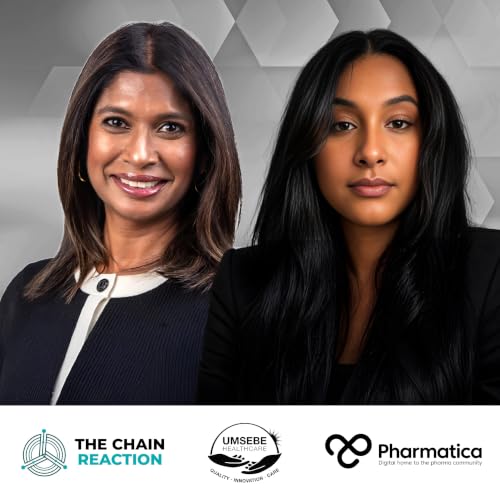
    Approval alone does not guarantee patient access, and for pharmaceutical leaders, that gap is becoming one of the industry's most pressing challenges. Regulatory strategy can no longer function as a back-end compliance exercise. It now plays a central role in determining how quickly therapies reach patients, how organisations scale across markets, and whether innovation delivers measurable healthcare impact.In a recent episode of The Chain Reaction podcast, Trisha Pillay spoke with Dineshree Naiker, co-founder of Umsebe Healthcare, about why regulation should be viewed as strategic infrastructure rather than administrative oversight. Drawing on three decades of experience across public sector pharmacy, multinational corporations, and specialist consultancy, Naiker explained why ethical, well-executed regulatory frameworks are essential to sustainable access, innovation, and long-term healthcare equity.Naiker’s perspective is shaped by a career that began during South Africa’s democratic transition, when healthcare access became a national priority and regulation emerged as a key mechanism for improving patient outcomes. Today, she believes the industry must move beyond compliance-first thinking and rethink regulatory affairs as a driver of business resilience and public health impact.Regulatory Strategy Belongs at the BeginningThe instinct in many organisations is to treat regulatory approval as the finish line. Naiker's first and most insistent point is that this instinct is wrong and costly."Regulatory leadership unequivocally must begin long before submission," she says. "In complex markets such as the ones that we operate in, regulatory foresight must anticipate manufacturing realities, supply chain constraints, pharmacovigilance capacity, pricing structures, and reimbursement models."The consequence of delaying regulatory thinking until late in the development cycle is not merely a slower approval process. It is friction that compounds, unanticipated data requirements, commercial instability, and ultimately, delayed patient access. If regulatory strategy is embedded early enough, Naiker argues, it becomes an enabler, reducing downstream risk and ensuring that once approval is achieved, the system can actually support ongoing supply and long-term patient value.Supply Chain Resilience Is a Governance ProblemWhen the conversation turns to supply chain stability, Naiker is direct about how the challenge is typically mischaracterised."Supply chain resilience is often oversimplified as logistics. In reality, what we're talking about is governance, and it's governance that is quite layered with complexity."The structural pressures she identifies are multiple and rarely isolated, with aggressive price erosion that makes sustainability fragile when pricing becomes the dominant metric; procurement consolidation that reduces the number of viable suppliers and increases concentration risk; manufacturing consolidation at a global level that disadvantages lower-volume markets through ever-increasing minimum order quantities; and currency dynamics that mean markets with stronger currencies are prioritised during periods of global supply pressure.Value Must Be Built In at InceptionThe thread running through every dimension of Naiker's argument is regulatory, supply chain, market access, and the concept of value-based alignment. It is where the conversation becomes most directly actionable for pharma leaders."Value should be built into a product at inception, and definitely not bolted on post-approval," she says. "Rather than focusing purely on price reduction, we need to examine the factors that affect uptake of medicines and long-term value."This means procurement frameworks that consider total cost of care and patient outcomes alongside unit price. It means stakeholder alignment, across manufacturers, distributors, funders, medical schemes, and procurement bodies around what a product actually delivers to the healthcare system rather than what it costs at the point of transaction. It also means recognising that a product appearing more expensive upfront may deliver significant cost effectiveness through improved adherence, reduced complications, and enhanced system efficiency. For more information on this visit Umsebe Healthcare, or connect with Dineshree Naiker on LinkedIn.TakeawaysRegulatory leadership must begin long before submission.Regulatory strategy is essential for sustainable access.Supply chain resilience is often oversimplified as logistics.Value should be built into a product at inception.Approval alone does not create access; alignment is key.Managing supply stability is a continuous balancing act.Ethical sourcing and sustainable distribution are achievable with alignment.Challenges in healthcare access are interconnected globally.A fresh coordinated approach is needed across stakeholders.Chapters00:00 Introduction to Pharmaceutical Healthcare Strategies01:24 Dineshree Naiker's Journey in ...
    続きを読む 一部表示
    21 分
  • Rebuilding Healthcare Supply Chains in Africa: Lessons from COVID-19 and the Road Ahead
    2026/06/09
    Healthcare systems around the world are facing growing pressure from supply chain disruption, rising costs, regulatory complexity, and persistent medicine shortages. The COVID-19 pandemic exposed just how vulnerable global pharmaceutical and healthcare networks can be, forcing industry leaders to rethink resilience, localisation, and long-term sustainability. At the same time, emerging technologies such as artificial intelligence are beginning to transform how healthcare organisations manage regulation, logistics, and patient access at scale.In this episode of Chain Reaction, host Trisha Pillay sits down with healthcare strategist, clinician, and Vicore Health CEO Émile Malan to examine the mounting pressures reshaping pharmaceutical supply chains across Africa. From the vulnerabilities exposed during the COVID-19 pandemic to the emergence of AI-driven regulatory systems, the conversation explores the critical challenges, structural gaps, and technological opportunities likely to define the future of healthcare delivery on the continent over the next decade.COVID-19 wake-up call for healthcare supply chainsFew events have stress-tested global healthcare supply chains quite like the COVID-19 pandemic. When the world shut down in early 2020, the cracks in pharmaceutical distribution networks became impossible to ignore, especially across Africa."Supply chains for medicines are heavily dependent on China and India," Malan explains. When those pipelines stalled, African healthcare systems felt the impact acutely. The continent's reliance on imported active pharmaceutical ingredients (APIs) and finished products left millions of people exposed at the worst possible time.The pandemic revealed more than just import dependency. It exposed deep regulatory bottlenecks that prevented locally manufactured vaccines, including those produced by South Africa's own Aspen Pharmacare, from reaching neighbouring countries in time. Manufacturing capacity existed. The system failed at the approval stage.For healthcare professionals, policymakers, and pharmaceutical executives, the lesson was stark: regional manufacturing capability means nothing without the regulatory infrastructure to move products across borders efficiently.Africa's manufacturing gapTo understand the scale of the challenge, consider this: Africa carries approximately 25 per cent of the world's disease burden, yet manufactures only around 3 per cent of the world's health products. That structural gap between need and local production sits at the heart of every supply chain conversation on the continent.Malan is candid about the economics. Building a pharmaceutical manufacturing facility requires significant capital investment, strong government commitment, and reliable demand forecasting. Without these foundations, investors hesitate. "You need strong government commitment. You need them to honour their commitments," he notes. In a continent of 54 sovereign nations, aligning those commitments across borders is a formidable coordination challenge.The scale problem compounds further when compared to global competitors. India and China have refined pharmaceutical manufacturing to serve domestic markets of over a billion people each, achieving unit costs that African manufacturers, working at a fraction of that scale, simply cannot yet match on finished products alone.Regional supply resilienceDespite these hurdles, momentum is building. The African Free Trade Initiative and the African Medicines Agency (AMA) are working toward a more harmonised regulatory landscape, one that could eventually enable medicines approved in one African market to move freely into others. For healthcare supply chain resilience, this kind of regulatory convergence is not a nice-to-have. It is essential.Malan points to the maturity gap in African regulatory bodies as a critical area for intervention. Of the continent's 54 national regulators, only 9 have achieved maturity level 3 in the World Health Organisation's assessment framework, meaning the vast majority operate with limited systems, constrained human capacity, and underdeveloped processes. Addressing this gap is where technology enters the picture.AI and Digital HealthcareThe transformative potential of artificial intelligence in healthcare operations is no longer theoretical. Malan's own organisation is actively deploying AI and large language model (LLM) technologies within highly regulated pharmaceutical workflows, and the results are striking."AI can boost productivity by a factor of five in healthcare processes," he says. In practical terms, that means one person today can deliver the output that five people produced just two years ago. In a region where regulatory and healthcare workforce capacity is chronically strained, this is not a marginal improvement; it is a structural shift.The key, Malan emphasises, is responsible deployment: the right human expertise in the lead, with AI augmenting rather than replacing ...
    続きを読む 一部表示
    24 分