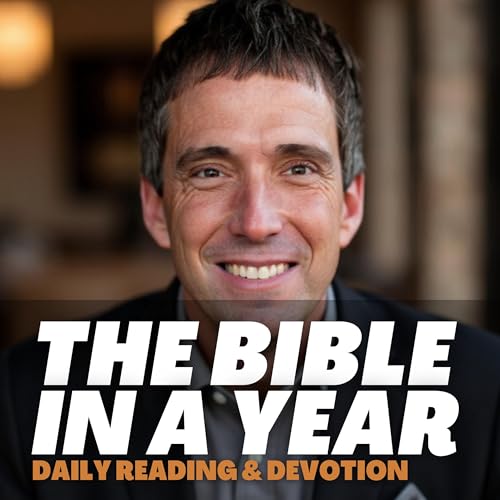
『The Bible in a Year: Daily Reading & Devotion』のカバーアート

The Bible in a Year: Daily Reading & Devotion

The Bible in a Year: Daily Reading & Devotion

著者: Kevin Harrison
無料で聴く

概要

Bible in a Year: Daily Reading & Devotion invites you to read and listen through the entire Bible in one year, one day at a time, without falling behind or feeling overwhelmed. Each episode features that day’s Scripture reading from the Fusion Bible, created by Kevin Harrison, followed by a focused three-minute devotional that helps you understand what you read and apply it to real life. Kevin serves as President of Mosaic Christian College and guides listeners with a pastoral, practical approach to Scripture, helping God’s Word shape everyday faith, one day at a time.Kevin Harrison キリスト教 スピリチュアリティ 聖職・福音主義
エピソード
  • February 4 | Center On What Matters Most
    2026/02/04

    Today’s readings from Exodus 34–35 and Matthew 22 invite us to consider what truly belongs at the center of our lives, and how that center quietly shapes everything else. When faith is lived over time, priorities are revealed not by what we say matters most, but by what consistently holds our attention, devotion, and energy. Loving God and loving others is not presented as one value among many, but as the grounding posture from which everything else flows.


    In Exodus, God patiently renews His covenant with His people and draws them back into a way of life shaped by His presence. Rather than forming them through a single dramatic encounter, God continues to work through instruction, patience, and shared responsibility, inviting the community to live attentively with Him at the center. The movement of the passage reflects how formation often happens slowly, through repeated faithfulness rather than sudden transformation.


    In Matthew, Jesus responds to division and testing by returning to the heart of the law. Faced with competing agendas and hardened categories, He refuses to rank rules or elevate arguments. Instead, He presses past the surface and names love as the central posture that holds all obedience together, challenging assumptions about what truly defines faithfulness.


    Together, these passages invite us to sit with what we are centering our lives around, often without realizing it. They ask us to notice what has slowly taken priority, what has shaped our patterns over time, and how God may be gently calling us to return again to what truly matters most, without forcing resolution or demanding immediate change.

    続きを読む 一部表示
    20 分
  • February 3 | Take Responsibility Instead of Making Excuses
    2026/02/03

    Today centers on taking responsibility instead of explaining ourselves, as both Exodus 31–33 and Matthew 22:1–22 reveal how easily people shift from trust to control when waiting becomes uncomfortable. Across both readings, the heart posture being formed is not about perfection, but about honesty before God when pressure exposes what’s really going on inside us.


    In the Old Testament reading, God’s people struggle with delay and uncertainty, and their response reveals a deep impatience with unseen work. While instruction, covenant, and presence are being established, the temptation to replace trust with something tangible takes hold, and responsibility becomes blurred in the process.


    In the New Testament passage, Jesus encounters people who speak carefully, ask cleverly, and try to manage outcomes with words rather than truth. He presses on the same issue by refusing to be drawn into explanation games, revealing how often hearts hide behind language instead of standing openly before God.


    Together, these passages invite us to sit with what happens when waiting exposes our need for control. They ask us to notice where explanation replaces honesty, and where God might be inviting us to trust His work without rushing to protect ourselves.

    続きを読む 一部表示
    21 分
  • February 2 | Slow Down and Pay Attention
    2026/02/02

    In Exodus 29 and 30, God carefully and deliberately forms the priests. They’re washed before they’re clothed, they wait before they serve, and they move through repeated acts that shape their awareness of His holiness. Nothing is rushed. God doesn’t invite them into His presence casually or allow them to assume familiarity. Instead, He establishes rhythms that teach His people how to live near Him without losing reverence. Holiness is learned slowly, and proximity is something to be received, not rushed.


    Matthew 21 tells a different story, but it presses on the same issue. Jesus is standing in the temple, teaching openly, when the religious leaders confront Him. They aren’t asking questions because they’re listening. They’re asking because they think they already know how authority works. Jesus answers with questions and parables that expose the real problem. They aren’t short on knowledge. They’re short on openness. God is right in front of them, and they miss Him because they’re too certain they already understand Him.


    The tension in Matthew 21 isn’t ignorance versus intelligence. It’s certainty versus attentiveness. The leaders are confident in their position, confident in their systems, and confident in their right to judge. What they aren’t is receptive. Jesus makes it clear that the kingdom of God isn’t missed because people don’t try hard enough. It’s missed because they stop paying attention. Familiarity has dulled their awareness, and confidence has replaced humility.


    Taken together, these passages invite us to slow down and examine our own posture before God. They ask whether our routines have replaced reverence, whether our experience has replaced listening, and whether we’ve confused confidence with faithfulness. God remains patient in both stories. He keeps teaching, keeps inviting, and keeps confronting when necessary. He doesn’t step away when people miss Him. He stays present and calls them to see again.

    続きを読む 一部表示
    23 分
まだレビューはありません