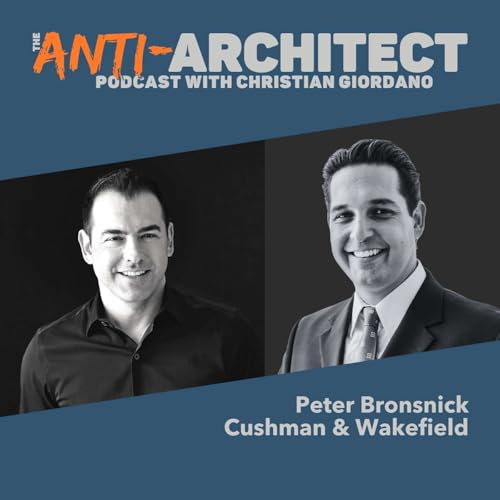
『The Anti-Architect』のカバーアート

The Anti-Architect

The Anti-Architect

著者: Christian Giordano
無料で聴く

概要

Welcome to The Anti-Architect Podcast. I’m your host Christian Giordano. As the president and owner of design firm Mancini Duffy, I’m driven by a quest for learning and radically changing the industry through tech-first innovation. With this podcast, I’m hoping to improve the industry that I’m so passionate about by taking a critical look at how architects work with their clients and, in turn, how our clients view us. It’s my goal to showcase all of these experiences - good and bad. Was it the architect or the client - or somewhere in between? I aim to bring my audience new voices from our industry, interesting people with diverse backgrounds. Through shared experiences, stories, and projects my hope is that we can improve our profession. www.theantiarchitect.comAll rights reserved 経済学
エピソード
  • EP 82: Peter Bronsnick of Cushman & Wakefield
    2026/01/27

    In this episode, Christian is joined by Peter Bronsnick, Executive Regional Director at Cushman & Wakefield, overseeing operations across New Jersey, Pennsylvania, and Delaware. Peter's career story of evolution from hands-on developer and deal maker at SJP Properties to leading one of the most powerful real estate advisory platforms in the country of Cushman & Wakefield. Over his two plus decades in the industry, he has touched on every side of the business, site selection, planning, entitlements, construction, leasing, acquisition, capital markets and marketing. Christian and Peter discuss how a developer’s mindset can sharpen leadership within an advisory powerhouse, what defines successful placemaking today, and his role in some of the region's most transformative projects, including M station in Morristown.

    https://www.cushmanwakefield.com

    https://theantiarchitect.com/

    0:00 – Christian introduces Peter Bronsnick and his role at Cushman Wakefield
    1:29 – Why developers need to better understand architecture and design
    2:49 – Lessons Peter learned working under Steve Pozycki at SJP Properties
    4:37 – The importance of discipline, preparation, and internal expertise
    5:47 – What frustrates Peter about how architects approach projects
    7:07 – Why the architectural vision doesn’t always translate to real-world use
    8:29 – How client collaboration has evolved in architecture and development
    9:48 – The dangers of overdesign and ignoring budget realities
    11:03 – Finding the balance between creative vision and financial feasibility
    12:07 – Getting all stakeholders at the table from the start
    13:47 – What a perfect architect developer partnership should look like
    15:01 – Why architects need to be comfortable pushing back
    16:11 – How to help architects better understand developer risk and mindset
    18:02 – Why studying failed developments teaches more than studying success
    20:05 – The red flags Peter looks for early in developer relationships
    21:00 – Why architects are overworked and underpaid and how that starts
    23:00 – How the urgency of capital impacts every part of the development process
    24:06 – Peter reflects on his biggest lessons from a decade at SJP Properties
    26:22 – The importance of sequencing and process in complex development
    27:57 – Why SJP was more than just a developer and how that shaped Peter
    28:58 – What inspired Peter’s leap to Cushman and Wakefield
    30:07 – Building and scaling a business inside Cushman Wakefield
    31:52 – Coordinating brokerage, capital markets, and internal teams
    33:15 – How New Jersey real estate culture differs from New York
    34:57 – Peter’s origin story and how he accidentally got into real estate
    36:43 – The story of getting fired by his dad and finding a new path
    38:11 – Why Peter pursued real estate at NYU after Michigan State
    39:12 – Deep dive into M Station and what made it a successful placemaking case study
    42:31 – The future of real estate development in downtown markets
    44:01 – Why speed, innovation, and hospitality models are here to stay
    46:02 – The mental health impact of placemaking and returning to the office
    47:37 – The rise of AI and Cushman Wakefield’s approach to adoption
    49:15 – Why future leaders will need to be AI literate
    50:06 – Peter’s final thoughts on the future of cities and the importance of results
    52:27 – Closing thoughts and how to connect with Peter Bronsnick

    続きを読む 一部表示
    53 分
  • Episode 81: Antonio Scalise of Parallel Architectural Group
    2026/01/06

    In this episode, Christian sits down with Antonio Scalise, Principal Architect and Founder of Parallel Architectural Group. Growing up in a multi-generational family of masons from Italy, Antonio's path took him from swinging a sledgehammer in New York to leading a full-service architecture firm in New Jersey. Antonio and Christian dive into why every architect should spend at least a year in the field, how Hurricane Sandy became a turning point for his firm, and how lessons from his father’s business still guide the way he leads today. Antonio also explains why being a “yes” firm - even on the $1,000 project - can open doors to lasting relationships and unexpected opportunities.

    https://parallelgrp.com/

    https://theantiarchitect.com/

    0:05 – Christian introduces the Anti-Architect Podcast and guest Antonio Scalise, founder of Parallel Architectural Group
    1:05 – How growing up in a multi-generational masonry family shaped Antonio's work ethic
    2:15 – Early jobsite memories and the hands-on lessons learned from working alongside his father
    3:43 – Why field experience from a young age gave Antonio a deeper appreciation for the trades
    4:59 – Antonio's father encouraged education over labor and how that led him to architecture
    6:17 – The one thing that frustrates Antonio most about other architects
    7:15 – Why architecture education should require at least a year of fieldwork
    8:28 – The importance of building physical models and staying connected to tactile design
    9:49 – Drawing by hand vs digital shortcuts and what that does to architectural thinking
    11:00 – Field precision vs architectural theory and the danger of over-specifying
    12:01 – How fee competition is hurting the profession and what clients often misunderstand
    13:08 – Why educating clients is part of an architect’s job and how scope comparison reveals the truth
    14:01 – Lessons from Antonio's dad about doing the job right, even if it takes longer
    15:05 – Builders recommend architects who prevent rework and get zoning right the first time
    16:25 – If not an architect, what part of the industry would Antonio be in?
    17:34 – How Hurricane Sandy led to explosive growth and a rebirth of his firm
    22:24 – Balancing high-end projects with smaller ones and why he never says no
    24:03 – Solving problems across many project types and how versatility has been an asset
    25:17 – Building trust by learning from mistakes and turning one project into 50
    28:23 – What culture looks like at Parallel: humor, hard work, and setting the tone from the top
    30:00 – How Antonio encourages accountability and leadership among his team
    32:11 – The myth that no one will care as much as the founder, and why it’s wrong
    33:04 – Antonio's origin story: from Long Island to California to New Jersey
    35:04 – Starting at Brookdale and moving on to NJIT to pursue architecture
    36:09 – Why Antonio considers himself a design chameleon instead of having one style
    37:03 – His proudest project: a senior center that became a point of civic pride
    39:01 – Residential projects that showcase adaptive design and asymmetry
    42:02 – Reusing warehouse bones to create a vibrant headquarters for Partner Engineering
    43:23 – Why light, proportion, and spatial feel matter more than people realize
    45:19 – Thoughts on AI, concrete printers, and why human touch will always matter
    48:15 – Concerns about shrinking fees, rising expectations, and retaining architectural value
    50:04 – The pros and cons of remote work in a highly collaborative and creative field
    51:22 – Why craftsmanship, mentorship, and presence still matter more than ever
    52:17 – Antonio's advice to young architects: learn business as much as design

    続きを読む 一部表示
    55 分
  • Episode 80: Eric Gatti of G William Group
    2025/12/16

    In this episode, Eric Gatti, President and Managing Partner of G William Group, shares how he rose from college intern to leading a full buyout of the firm and how that journey shaped his views on leadership, culture, and trust. Eric and Christian discuss why true leadership means being at the "back of the pack" making sure no one gets left behind. Eric reveals how betting on friends with zero AEC experience built his strongest team, why ego has no place in company culture, and how empowering people to make hires, run accounts, and own outcomes has fueled G William Group's growth and success.

    https://www.gwgllc.com/

    https://theantiarchitect.com/

    0:05 - Christian introduces Eric Gatti, President of G. Williams Group
    1:03 - Eric shares how he rose from college intern to company owner
    2:38 - The story of taking over a delayed Wonder project and earning trust
    4:12 - What happened when design had to take a back seat to delivery
    5:23 - How Eric and Christian first met and why that project mattered
    6:28 - What annoys Eric about working with some architects
    8:03 - Why design isn’t "yours" it's the client’s vision brought to life
    9:01 - How GWG approaches design-build differently than traditional CM firms
    10:13 - Why early collaboration on pricing, programming, and priorities matters
    13:01 - The problem with product reps and value engineering after the fact
    14:47 - How BIM and live data could close the gap between design and cost
    16:48 - Why architects need more hands-on field experience
    18:08 - Debunking the myth that contractors make money from change orders
    21:09 - Eric’s origin story from rugby to repurposing industrial space
    24:30 - Lessons from his first project and the importance of being a sponge
    28:03 - How on-site trades taught Eric more than any classroom ever did
    33:04 - Becoming a partner at 23 and why he almost said yes too early
    36:00 - The hard part of succession managing ego during a buyout
    37:55 - Why building a strong team meant taking risks on friends with no experience
    41:13 - How GWG keeps culture alive by hiring for grit not just credentials
    45:13 - Eric shares how GWG is using OpenSpace Procore and AI carefully
    47:03 - Why speed and polish from AI can’t replace critical thinking and context
    49:02 - Christian and Eric commit to a staff exchange on a future joint project

    続きを読む 一部表示
    51 分
まだレビューはありません