エピソード

  • #3: A/B Design Manifesto (Dunne & Raby, 2013)
    2026/06/07

    Today’s exhibit is the "A/B Design Manifesto" by Dunne & Raby.


    This diagram was created by Anthony Dunne and Fiona Raby, a design duo who pioneered the concept of Speculative Design.

    In this simple list, they characterized conventional, commercial design as "A"

    and contrasted it with their alternative vision for the field as "B."


    Personally, I am absolutely in love with this diagram.

    The reason is simple: it boldly proposed an entirely new role for design.


    Before this manifesto, a designer’s job was primarily to make products look beautiful, drive sales, or resolve minor daily inconveniences.

    However, this diagram completely reshaped those traditional definitions and opened up a whole new horizon for what design could be.


    Today, I’d like to highlight two of the most critical points from this contrast.

    続きを読む 一部表示
    6 分
  • #2: "The Complex Field of Research (Lois Frankel and Martin Racine, 2010)
    2026/05/04

    Today’s exhibit is "The Complex Field of Research: For Design, Through Design, and About Design"

    by Lois Frankel and Martin Racine.


    The theme of this diagram is the relationship between design and research.


    Terms like "user research" and "competitive research" are common in every industry.

    In the design field as well, research and design work together to elevate the quality and satisfaction of the end product.


    A common challenge here—especially in large corporations—is that designers and researchers are often separated,

    which can lead to ambiguity in ownership.


    Furthermore, depending on the project, sometimes it’s better to research before designing,

    while other times, creating a prototype first is the only way to move the discussion forward.


    This is why it’s crucial to clarify the order and relationship between the two.

    The "Complex Field of Research" diagram organizes this into three core concepts.

    Let’s look at them one by one.

    続きを読む 一部表示
    7 分
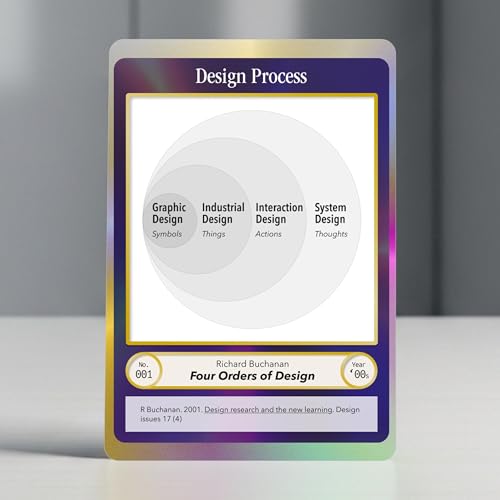
  • #1: Four Orders of Design (Richard Buchanan, 2001)
    2026/04/05

    Today’s exhibit is Richard Buchanan’s "Four Orders of Design."

    Nowadays, the word "design" has expanded far beyond mere aesthetics or forms.

    Design is used to create everything from experiences and business models to organizations.

    The root of this broad perspective can be traced back to today’s diagram: the "Four Orders of Design."

    As the name suggests, it categorizes design into four distinct layers.

    Let’s walk through them one by one.

    続きを読む 一部表示
    5 分