

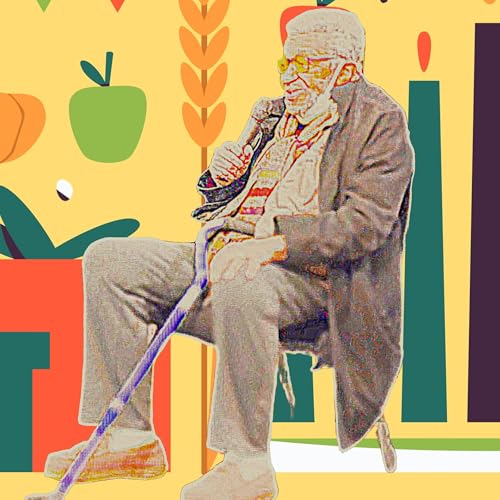
Thanksgiving: A Multiracial Vision
カートのアイテムが多すぎます
カートに追加できませんでした。
ウィッシュリストに追加できませんでした。
ほしい物リストの削除に失敗しました。
ポッドキャストのフォローに失敗しました
ポッドキャストのフォロー解除に失敗しました

Thanksgiving: A Multiracial Vision
-
ナレーター:
-
著者:
このコンテンツについて
Rev. Dr. Finley Campbell reflects on the complexities and contradictions of our times, urging boldness and truth in the face of personal, existential, and political challenges. He draws parallels between historical struggles against white supremacy, such as the Battle of Gettysburg, and contemporary crises, emphasizing gratitude for progress while acknowledging ongoing peril.
Dr. Campbell shares a personal reflection on his father's role as a Baptist preacher and introduces a reimagined version of the hymn "The Church Has One Foundation," blending traditional religious imagery with a broader, inclusive vision of God that embraces diverse spiritual narratives.
He discusses the concept of human will through the lens of quantum metaphysics, highlighting the interplay of chance and necessity in shaping our lives. This leads into his central theme: Thanksgiving as a symbol of multicultural synergy—a coming together of diverse cultures to create a new, unified culture.
Focusing on the 1623 Pilgrims' Thanksgiving, Dr. Campbell identifies three key cultural groups at the table: the Native American Wampanoag, the Puritans seeking religious freedom, and the capitalist traders focused on commerce. He explains that "culture" encompasses customs, arts, social institutions, and achievements, and emphasizes that multiculturalism involves the coexistence and blending of multiple cultural or ethnic groups.
He highlights the role of Squanto, a Native American who spoke English due to prior contact with Europe, as a crucial connector facilitating communication and cooperation among these groups. The meal itself symbolized unity, featuring a blend of indigenous and English foods and shared practices, such as hunting and fishing.
Dr. Campbell stresses that despite differences in religion and values—ranging from earth-centered spirituality to Calvinist Protestantism and capitalist agnosticism—these groups found synergy through shared experiences and mutual dependence.
He envisions this multicultural synergy as the foundation for a new culture that would eventually give rise to descendants who challenge later racist and white supremacist ideologies.
The importance of this perspective lies in countering narratives that portray early American history solely through the lens of white supremacy. Dr. Campbell references contemporary efforts within Unitarian Universalism, including the contested eighth principle and groups like DRUM (Diverse Revolutionary Unitarian Universalist Multicultural Ministries), which emphasize the need to recognize and honor multicultural contributions without perpetuating white supremacy.
He draws a parallel to current global struggles, such as refugees at the Polish-Belarusian border, framing their quest for safety and community as a modern Thanksgiving moment, united by a divine or teleological force that transcends division.
Ultimately, Dr. Campbell calls for unwavering commitment to fighting any form of multiculturalism defined by race, which he sees as a divisive "serpent" threatening the unity symbolized by Thanksgiving. He concludes with a hopeful invocation of love as the spirit that binds diverse peoples together, urging continued dedication to justice and inclusion.