エピソード

  • Episode 108: Consistency: The Hidden Engine of Wealth
    2026/05/05
    In this third episode of the series, Erik Garcia, CFP®, and Xavier Angel, CFP®, uncover what they call the hidden engine behind wealth: consistency. After breaking down the behaviors that destroy wealth and the ones that protect it, this episode answers the real question—what actually builds it. The answer isn’t intensity, timing, or even talent. It’s doing the right things over and over again, long after the excitement fades. As Erik puts it, most people don’t fail financially because they’re wrong—they fail because they stop. Drawing on Angela Duckworth’s research on grit, Erik and Xavier connect the dots between perseverance and financial success. They break down the three key areas where consistency shows up: saving, investing, and developing your skills. Along the way, they challenge common behaviors like present bias and emotional investing, while reinforcing a simple truth—wealth is built little by little. This episode is a reminder that showing up when it’s boring isn’t a weakness…it’s a competitive advantage. Episode Highlights: Erik introduces consistency as the hidden engine behind wealth building and why it matters more than talent or intensity. (03:36) Erik shares Angela Duckworth's grit research, revealing that it's the grittiest individuals, not the most talented or intelligent, who tend to succeed long-term. (05:24) Xavier connects the grit conversation to his daughter's four-year journey in competitive dance, crediting her growth to determination and grind over raw talent. (07:49) Erik uses the "plateau of latent potential" from Atomic Habits to show how consistent, unseen effort eventually compounds into visible results. (09:52) Xavier explains how consistent savers reverse the urge to spend now and save later by choosing to save first. (12:25) Erik discusses how dollar cost averaging and emotional discipline set 401k millionaires apart. (14:15) Erik explains how building expertise over time enables higher-level work and greater income potential. (17:03) Xavier reflects on the power of grinding it out, noting that those who stay in the game longer do so by learning from failures and redefining their approach along the way. (20:25) Erik cites Proverbs to reinforce that money made quickly disappears, while wealth gathered little by little grows and endures. (21:32) Xavier connects consistency to momentum, saying the magic happens when you hold the fire to it and keep showing up. (23:38) Erik encourages listeners to make consistent financial decisions that stack over time, because wealth gained little by little is what lasts. (24:38) Key Quotes: “In the context of money, most people are not failing because they don't know what to do. They're failing because they don't do it long enough.” - Erik Garcia, CFP® “You are failing along the way and you're learning from those failures and redefining what you're doing.” - Xavier Angel, CFP® “What's important is that wealth builders consistently build their base. They're consistently building their foundation.” - Erik Garcia, CFP® Resources Mentioned: Erik Garcia, CFP®, BFA Xavier Angel, CFP®, ChFC, CLTC Plan Wisely Wealth Advisors
    続きを読む 一部表示
    26 分
  • Episode 107: 3 Behaviors That Protect Your Wealth: The Disciplines That Keep You From Losing What You’ve Built
    2026/04/21
    In the last episode, we broke down the behaviors that quietly destroy wealth—emotional decisions, lifestyle creep, and overconfidence. But avoiding mistakes is only half the equation. In this episode, Erik Garcia, CFP®, and Xavier Angel, CFP®, flip the conversation and focus on what actually protects wealth once you start building it. Because wealth isn’t just created—it has to be preserved with intention. We walk through three foundational disciplines: living below your means to create margin, reinvesting instead of extracting to keep your money working, and avoiding catastrophic mistakes that can undo years of progress. Grounded in behavioral finance and real-world experience, this episode shows why wealth is often less about big wins—and more about consistently doing the right things over time. Episode Highlights: Erik explains the behavioral economics foundation of today's episode, referencing Richard Thaler's book "Misbehaving" to highlight how humans often act irrationally in financial decision-making. (04:14) Xavier explains how building financial margin is what creates the space to save, invest, and pursue what matters most. (07:14) Erik shares the single most consistent pattern across people who successfully build wealth: they spend less than they earn and make building margin their priority. (10:10) Xavier discusses the second behavior, reinvesting instead of extracting, explaining that wealth grows when money is kept in the system and put back to work rather than pulled out early. (13:44) Erik explains the third behavior, avoiding catastrophic mistakes, using a golf analogy to share why minimizing financial damage matters more than chasing perfect results. (19:08) Erik discusses specific strategies for avoiding catastrophic financial mistakes: managing risk at the right level, maintaining sufficient liquidity, and diversifying rather than concentrating in speculative assets. (22:04) Xavier shares a sharp contrast between wealth lost and wealth built, explaining that losses often trace back to one risky decision while lasting wealth comes from thousands of small, consistent good ones. (25:25) Key Quotes: “When building wealth, the goal isn't to look wealthy, right? The goal is to be wealthy. I can be wealthy and not own the most expensive clothes or the biggest house or the most expensive car.” - Xavier Angel, CFP® “This is the common thread in financially successful people. It's what allows everything else to work. Without financial margin, there's nothing to invest. Nothing to save, no money to compound.” - Erik Garcia, CFP® “Reinvesting, not spending your investments involves an intentional, purposeful, conscious decision to choose the future over today. I'm saying no to myself today because I'm saying yes to something tomorrow” - Erik Garcia, CFP® Resources Mentioned: Erik Garcia, CFP®, BFA Xavier Angel, CFP®, ChFC, CLTC Plan Wisely Wealth Advisors
    続きを読む 一部表示
    28 分
  • Episode 106: Before You Build Wealth… Stop Destroying It: The 3 Behaviors That Sabotage Your Financial Future (Part 1 of 4)
    2026/04/07
    Before you can build wealth, you have to stop destroying it. Nobel Prize-winning economist Richard Thaler said it best: “People don’t act rationally.” And when it comes to money, that shows up in ways that quietly cost us more than we realize. In this episode, Erik Garcia, CFP®, and Xavier Angel, CFP®, break down three wealth-destroying behaviors—emotional decisions, lifestyle creep, and overconfidence. These aren’t knowledge problems—they’re behavior problems. And over time, they compound in the wrong direction. This is Part 1 of a 4-part series to help you stop losing… and start building. Episode Highlights: Erik discusses that behavior, not market drops, is the biggest obstacle to building wealth, grounding the discussion in Richard Thaler's Nobel Prize-winning behavioral finance research. (02:56) Erik shares about a client who moved to cash during market volatility and ended up as the only negative portfolio that year, using it to show how emotional reactions impact returns. (06:39) Xavier explains lifestyle creep and how spending that rises faster than income eliminates the margin needed to build wealth. (10:51) Xavier mentions that inflation, not lifestyle choices, is forcing some listeners into tighter margins and asks what to do when spending rises without any upgrade in lifestyle. (15:17) Erik introduces overconfidence as the third wealth-killing behavior, noting people consistently overestimate their ability to time markets and spot opportunities. (18:21) Xavier connects bad financial behaviors to generational patterns, pointing out that children observe and absorb those habits into their own lives. (24:03) Erik closes with the heart of their practice philosophy: understanding how people think about money is just as important as knowing how to grow it. (26:26) Key Quotes: “You don't need to save as much today as you were yesterday because you can always come back and reevaluate it at a different time when the season is over and begin increasing those savings at a later date.” - Xavier Angel, CFP®, “The best way for us to help you be successful is to understand how you think about money.” - Erik Garcia, CFP® Resources Mentioned: Erik Garcia, CFP®, BFA Xavier Angel, CFP®, ChFC, CLTC Plan Wisely Wealth Advisors
    続きを読む 一部表示
    29 分
  • Episode 105: Beyond the Salary: Real Money Decisions for New Pharmacists
    2026/03/26
    Landing that first job feels like the finish line, but for most young professionals, it is really just the beginning. In this episode, Xavier Angel, CFP®, ChFC®, CLTC®, sits down with Christopher Bland, PharmD, FCCP, FIDSA, BCPS, Albert W. Jowdy Professor in Pharmacy Care at the University of Georgia College of Pharmacy, to unpack the real-world financial questions that pharmacists and other graduates face early in their careers. From understanding compensation packages to negotiating pay, evaluating retirement benefits, and using side income strategically, this conversation helps listeners look beyond the headline salary number and make more informed financial decisions from day one. The episode also dives into one of the biggest mindset shifts young earners need to make: high income does not equal wealth. Chris and Xavier discuss how lifestyle inflation, student debt, and poor planning can quietly eat away at even a strong paycheck, while time, discipline, and consistent investing can build real financial freedom over time. It’s a practical, honest conversation designed to help young professionals turn early career income into long-term opportunity. Episode Highlights: Christopher shares the one financial lesson he wished he had fully embraced coming out of school: the more time money has to compound, the more profound the long-term impact. (04:00) Christopher breaks down salary versus hourly pay for new pharmacists, noting how hourly work creates flexibility to earn overtime, shift differentials, and supplemental income. (09:07) Christopher recounts landing his first job at the lowest pay tier and explains why the beginning of a career is the most powerful moment to negotiate compensation. (14:54) Christopher encourages students to lean on faculty and mentors for career opportunities, sharing how he connects students with prospects through his own network. (20:09) Xavier explains the difference between Traditional and Roth 401k contributions and stresses the importance of adding a beneficiary to retirement accounts from day one. (25:52) Christopher uses his son's first paycheck experience to illustrate why new earners need an automated plan for their money from the start. (31:32) Christopher outlines three practical steps for young pharmacists: leverage time for investing, negotiate confidently, and evaluate every aspect of a job beyond salary. (38:26) Key Quotes: “As you are young in your career, be developing skills. Seek out these opportunities, network, because then things will begin to flow to you, especially in years, like three to five.” - Christopher Bland, PharmD, FCCP, FIDSA, BCPS “No matter what degree of money you're making, if you have a plan, you're automatically giving yourself a raise.” - Christopher Bland, PharmD, FCCP, FIDSA, BCPS “I want healthcare professionals, pharmacists, to really take ownership of this topic. We work too hard. You've gone to school for too long, to not have a plan for financial freedom and wealth long term.” - Christopher Bland, PharmD, FCCP, FIDSA, BCPS Resources Mentioned: Christopher Bland, PharmD, FCCP, FIDSA, BCPS University of Georgia College of Pharmacy Erik Garcia, CFP®, BFA Xavier Angel, CFP®, ChFC, CLTC Plan Wisely Wealth Advisors
    続きを読む 一部表示
    42 分
  • Episode 104: Normal Returns, Broader Markets, Sexy Bonds and Lasagna With Phil Blancato
    2026/03/10
    Erik Garcia, CFP®, ChFC®, BFA™, welcomes back Phil Blancato for their annual market conversation, now a tradition on Stuff About Money They Didn't Teach You In School. Phil is Chief Market Strategist at Osaic Wealth, a regular on Fox Business, and an experienced portfolio manager who brings equal parts insight and humor, including a lightning round that somehow turns the 2026 market into a lasagna and ends with a debate on why pasta made in Italy is superior. Phil’s core headline for 2026 is a return to more normal market behavior: broader participation beyond a handful of mega-cap names and more average equity returns than the outsized gains investors have gotten used to. They unpack what a "defining year" for AI actually means, including winners, losers, and the infrastructure and energy needed to power the buildout, plus how productivity gains could change work and life. The conversation also hits international’s resurgence, why bonds are "sexy" again, and the discipline of staying invested through scary headlines. Phil closes with what keeps him up at night, with debt and renewed inflation risk at the top, and a reminder that diversification is the plan when market leadership shifts. Episode Highlights: Phil explains how treating colleagues and clients as friends and family has made a 35-year career feel like he's never worked a day in his life. (02:05) Phil's one headline for 2026: a return to normal market returns with broader participation across sectors. (08:00) Phil uses "Flippy the fryer," an AI arm completing 200,000 man hours at White Castle, to illustrate real-world AI productivity gains. (15:05) Phil emphasizes Finance 101: never panic based on headlines, as US economic fundamentals remain strong beneath the noise. (20:00) Erik highlights his favorite chart showing intra-year drawdowns versus final returns, making the case for staying invested through volatility. (26:28) Phil believes that AI overdependence is dangerous, pointing to GPS reliance and the Pope's ban on AI-written sermons as cautionary examples. (31:00) Phil identifies rising inflation and the US debt burden as his top black swan risks for markets. (39:25) Erik reflects on using AI-driven productivity for leisure, coaching basketball, and spending more time doing what matters most. (45:45) Key Quotes: “It's a defining year for AI. What companies can either continue to grow revenue or use AI to be more productive.” - Phil Blancato “I would say I've always been a big fan of why people like me are successful. We take advantage of when there's a panic in markets, and there's a panic in a software market right now.” - Phil Blancato “Being paid to wait around. You're getting real return, real income in your portfolio. It gives you safety and security and maybe a chance to see them go up as much as 7% or 8% this year.” - Phil Blancato Resources Mentioned: Phil Blancato Osaic Wealth Erik Garcia, CFP®, BFA Xavier Angel, CFP®, ChFC, CLTC Plan Wisely Wealth Advisors
    続きを読む 一部表示
    48 分
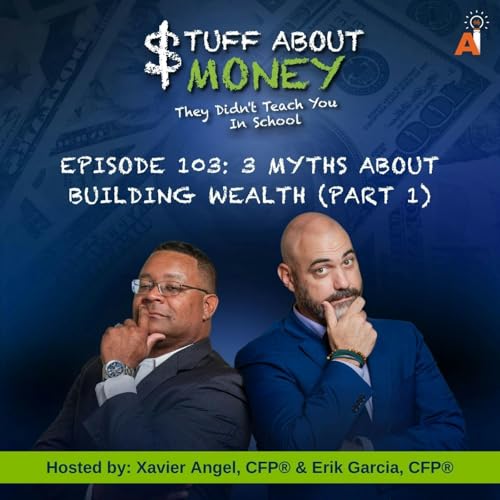
  • Episode 103: 3 Myths About Building Wealth (Part 1)
    2026/02/24
    In this episode of Stuff About Money They Didn’t Teach You in School, Erik Garcia, CFP®, ChFC®, BFA™ and Xavier Angel, CFP®, ChFC®, CLTC® begin a two-part series on how wealth is actually built and why it often looks boring in real life. In Part 1, they tackle three common myths that derail people before wealth ever has a chance to compound. From the belief that wealth is built by luck or big breaks, to the assumption that it is reserved for the privileged few, to the misconception that a high income guarantees financial success, Erik and Xavier unpack the cultural narratives that cause people to quit too early. Drawing on research, real-life stories, and years of experience in financial planning, they explain why wealth is more accessible than most people believe but slower than most people expect. They emphasize that financial success is less about flashy wins and more about mindset, discipline, and intentional decision-making over time. If you have ever felt behind, discouraged, or tempted to chase the next big move, this episode reframes what real wealth-building looks like and sets the stage for Part 2, where they reveal the three ingredients that consistently build lasting wealth. Episode Highlights: Erik mentions that the episode was inspired by conversations at a business conference about what leads people to grow wealth and the myths they tell themselves along the way. (01:30) Erik discusses the idea that wealthy people made their money overnight through one big deal or a viral moment, noting these are exceptions rather than the rule. (06:40) Xavier shares that the average age of a successful business founder is 45, and how that statistic brought visible relief to a business owner who feared she was too late. (10:55) Erik mentions that eight out of ten wealthy people are first-generation, meaning wealth is more accessible than most believe, but requires patience and consistency. (16:20) Erik defines wealth as optionality: having low debt, financial margin, and the freedom to use money for what is most important rather than being backed into a corner. (21:35) Xavier discusses the discouragement that comes when progress feels invisible, reminding listeners that wealth is forming beneath the surface long before the outside world sees it. (26:10) Xavier shares the bonus myth that a high income is required to build wealth, and Erik shares the story of a woman who built a five-million-dollar estate while never earning much money. (29:30) Key Quotes: “Experience and industry familiarity were more important than just pure intelligence when it comes to building wealth. It's a slow grind sometimes to build wealth. It's not overnight.” - Erik Garcia, CFP®, ChFC®, BFA™ “If you're following the right processes, if you're taking the right steps of what it leads to be successful, then it's going to come with time.” - Erik Garcia, CFP®, ChFC®, BFA™ “ Wealth is built in the gaps between what you make and what you keep, and the behavior matters more than the income alone.” - Xavier Angel, CFP®, ChFC®, CLTC® Resources Mentioned: Erik Garcia, CFP®, ChFC®, BFA™ Xavier Angel, CFP®, ChFC®, CLTC® Plan Wisely Wealth Advisors
    続きを読む 一部表示
    33 分
  • Episode 102: What 100 Conversations About Money Taught Us
    2026/02/10
    In this milestone episode of Stuff About Money They Didn’t Teach You in School, Erik Garcia, CFP®, ChFC®, BFA™, and co-host Xavier Angel, CFP®, ChFC®, CLTC®, reflect on what they’ve learned after reaching 100 episodes of honest, practical money conversations. This episode looks back at why the podcast started, the gaps in financial education that inspired it, and the themes that kept showing up again and again in conversations with clients, guests, and listeners. Erik and Xavier share the biggest money lessons reinforced over the past 100 episodes, the moments that challenged their thinking, and why behavior, mindset, and consistency matter far more than financial hacks or headlines. They also pull back the curtain on what it really takes to stay consistent, grow personally and professionally, and keep showing up for meaningful conversations about money. Episode Highlights: Xavier explains that his dress code changed in 2020 when he joined the firm after Erik's dad told him he could relax and wear polos instead of formal attire. (03:35) Erik discusses his podcasting history, including 65 episodes of Building Us with Dr. Matt Morris during COVID, before starting Stuff About Money. (06:10) Erik shares that the hardest part of podcasting isn't coming up with topics but maintaining consistency with recording every two weeks. (09:35) Erik explains the podcast is part of their vision to resource people for wise financial decisions and reinforce behaviors that lead to success. (11:25) Xavier highlights compounding interest as the most popular response when guests are asked what they wish they knew about money 20 years ago. (12:30) Xavier recalls Billy Williams' advice that stuck with him: if you can't pay for it twice, you can't afford it. (19:50) Erik discusses the responsibility of sharing information on the podcast since they're talking about money topics that could change people's lives. (24:20) Erik explains he pushes back against giving prescriptive advice because personal finance is as much personal as it is finance. (26:10) Erik shares three simple things to build wealth: spend less than you make, save as much as you can, and don't do anything foolish. (28:50) Erik announces two future episode series ideas: interviewing faith leaders about money and exploring emotions like greed and fear that drive financial decisions. (31:15) Xavier shares his key takeaway for listeners: if something is uncomfortable and hard, keep moving forward with intentionality instead of stopping. (33:15) Erik and Xavier announce they'll start doing solo episodes beginning in February to share personal experiences and lessons independently. (37:00) Key Quotes: "Our vision here of the firm is to really resource people to make wise financial decisions. The podcast is part of that vision." - Erik Garcia, CFP®, BFA "Most financial decisions are not made on spreadsheets. They're made with emotions." - Erik Garcia, CFP®, BFA "If something is uncomfortable, it's hard, and if it's hard, keep moving forward. Don't stop doing what you're doing. Make it comfortable." - Xavier Angel, CFP®, ChFC, CLTC Resources Mentioned: ⁠⁠Erik Garcia, CFP®, BFA⁠ Xavier Angel, CFP®, ChFC, CLTC Plan Wisely Wealth Advisors
    続きを読む 一部表示
    39 分
  • Episode 101: King Cake and the Seasons of Money
    2026/01/27
    In this solo episode of the Stuff About Money podcast, Erik Garcia CFP®, BFA™, ChFC®, reflects on King Cake season in New Orleans, an annual reminder that some things are wonderful precisely because they don’t last forever. Between questionable calorie intake and the collective sugar coma that sweeps the city, Erik is grateful that King cake is a season, not a lifestyle. That rhythm sparks a bigger conversation about money and how so much of our financial stress comes from forgetting that money, too, has seasons. Erik breaks down the three financial seasons he most often discusses with clients: laying the foundation, building on that foundation, and eventually spending down and distributing assets. Each season comes with different demands, priorities, and emotional pressures, and many “bad” financial decisions are only bad because they’re made in the wrong season of life. He also explores how these seasons show up for business owners, from startup to growth to exit. If money feels tight, confusing, or heavier than expected, this episode offers clarity, perspective, and a reminder that you’re probably not doing it wrong. You may just be in a different season. If it resonates, follow the show and share it with someone who could use that reminder. Episode Highlights: Erik discusses three financial phases: laying a foundation, building on it, and spending down your accumulated assets. (04:15) Erik shares his biggest financial mistake: trying to accumulate in five years everything that took his parents decades to build. (05:35) What makes a financial decision bad isn't always the decision itself, but making it in the wrong season of life. (07:45) The foundation-laying season is characterized by tight margins, high demands, and competing financial priorities like homeownership, transportation, and student loan repayment. (09:25) Erik explains that restraint doesn't mean selling yourself short, but preparing yourself for the future, and making hard decisions early makes transitions easier. (12:50) Regardless of income level, clients face a common challenge: people tend to spend or tie up their money in proportion to what they earn. (16:10) Not spending every dollar isn't a sign of missing out on life; it's good stewardship and wise money management. (18:30) Erik mentions that most small businesses fail not because they're bad ideas, but because they run out of cash. (22:00) Financial seasons have beginnings and endings, making it valuable to pause and reflect on where you currently are in your money journey. (24:50) Erik discusses the value of working with a financial planner who understands your values and the season of life you're in. (26:10) The reality that seasons are temporary makes having trusted guidance in your financial life incredibly valuable. (27:15) Key Quotes: “Restraint doesn't mean that you're selling yourself short. You're preparing yourself for the future.” - Erik Garcia CFP®, BFA™, ChFC® “Making good decisions that are in alignment with your values, that are in alignment with the season that you're in. It's important.” - Erik Garcia CFP®, BFA™, ChFC® “I love the fact that more and more people aren't just quitting or retiring completely, that they recognize they have something still to give. There's meaning, and there's purpose in working.” - Erik Garcia CFP®, BFA™, ChFC® Resources Mentioned: Erik Garcia, CFP®, BFA Xavier Angel, CFP®, ChFC, CLTC Plan Wisely Wealth Advisors
    続きを読む 一部表示
    29 分