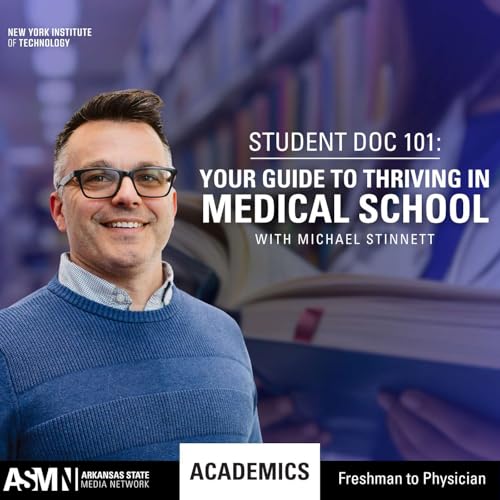
『Student Doc 101: Your Guide to Thriving in Med School』のカバーアート

Student Doc 101: Your Guide to Thriving in Med School

Student Doc 101: Your Guide to Thriving in Med School

著者: Michael Stinnett
無料で聴く

今ならプレミアムプランが3カ月 月額99円

2026年5月12日まで。4か月目以降は月額1,500円で自動更新します。

概要

Hosted by Michael Stinnett, Student Doc 101 provides a high-level briefing on the academic architecture and strategic vision behind the NYITCOM Arkansas State partnership. Featuring deans and lead faculty, the series offers an "under-the-hood" look at how a world-class medical curriculum is designed to solve the physician shortage in the Mid-South. This is the definitive source for institutional credibility, proving how the convergence of academic rigor and regional impact creates an elite pipeline for the future of healthcare.

© 2026 Student Doc 101: Your Guide to Thriving in Med School
科学
エピソード
  • Identifying the Invisible Challenges of Training in Medical School
    2026/04/22

    Medical school moves so fast that “working harder” can quietly become the thing that breaks you. We sit down with Dr. Tracy Owens (Assistant Dean of Academic Achievement), Dr. Scott Henson (Director of Academic Achievement), and Stephanie Foster (medical education learning specialist) to talk about what thriving actually looks like when the volume is massive, the pace is relentless, and you’re expected to think like a doctor from day one.

    We also clear up the questions students keep asking about osteopathic medicine. We explain what the DO pathway means, how DO and MD training align for residency, and what’s distinct about a holistic, whole-person approach including the additional hands-on hours in Osteopathic Manipulative Medicine (OMM). If you’re choosing between programs or trying to understand “DO vs MD,” you’ll leave with clearer language and a better feel for fit.

    From there, we get practical about preparation and performance: which undergrad courses help most, how nonfiction reading builds the skill of handling long board-style exams, and why spaced repetition beats cramming every time. We talk routines that protect your brain, including sleep and exercise, plus what academic coaching looks like in real life: building schedules, managing unstructured time, doing multiple passes, and learning how to read questions, catch distractors, and close knowledge gaps early.

    We also name the invisible challenges students don’t expect: imposter syndrome, self-regulation, and the “algorithm lie” that pushes you to buy resources you may not need. If you want a smarter plan and a calmer path through medical school, hit play, then subscribe, share the episode with a friend, and leave us a review. What’s the biggest challenge you’re trying to solve before day one?

    続きを読む 一部表示
    37 分
  • First Look into: Student Doc 101: Your Guide to Thriving in Med School
    2026/04/16

    Medical school advice is everywhere, but most of it is either too polished to trust or too bite-sized to use. We wanted something simpler and more honest, so we sat down with Michael Stanett, a medical education learning specialist at NYITCOM at Arkansas State University, to introduce Student Doc 101 and the idea behind it: let medical students explain, in their own words, how they actually thrive.

    We talk about the realities that don’t show up in a brochure. Medical school is hard for academic reasons, sure, but it’s also hard because of relocation, loneliness, family responsibilities, parenting, money stress, and the nonstop mental load of performing at a high level. Michael shares why the show focuses on peer-to-peer wisdom, and how hearing multiple student journeys helps pre-med students and new med students build a plan that fits their real life, not someone else’s highlight reel.

    We also dig into time management versus energy management, and why so many driven students hit a wall even when their calendar looks “optimized.” Michael calls out the social media algorithm trap that keeps people doom-scrolling for the perfect strategy, and he makes the case for long-form conversations as a kind of accessible mentorship. Then we zoom out to the bigger stakes: the physician shortage, the importance of primary care, and why osteopathic medicine’s whole-person approach matters for rural health in Arkansas and beyond.

    If you’re aiming for med school, already in it, or supporting someone who is, this is your reminder to build habits that last. Subscribe for upcoming student interviews, share this with a friend chasing medicine, and leave a review with the question you want us to ask first.

    続きを読む 一部表示
    16 分
まだレビューはありません