『Story Time at Clatter Ridge Farm』のカバーアート

Story Time at Clatter Ridge Farm

Story Time at Clatter Ridge Farm

著者: Bobbie Emery
無料で聴く

概要

I'm a farmer, thinker, and writer. I can't seem to help myself. It's what I do, who I am, and what I love.

clatterridgefarm.substack.comBobbie Emery
生物科学 社会科学 科学
エピソード
  • The Morally Superior Maple
    2026/02/26

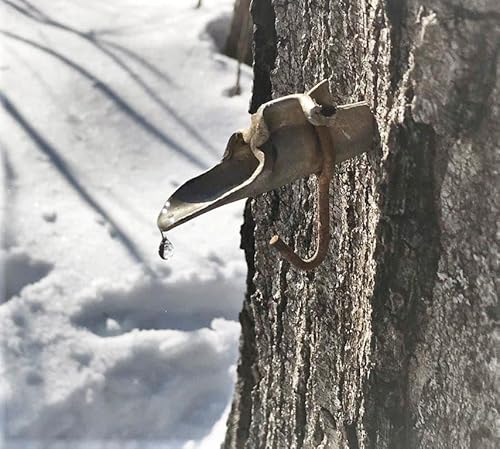
    We tapped our sugar maples this week, and that to me is the beginning of spring. The sap will run as long as the temperatures are below freezing at night and well above freezing during the day. The “sugaring” season usually lasts about 6 weeks, or until the trees start to bud.

    Maple Syrup was a dietary staple for the Native Americans that lived in New England. When little else was available in early spring, they relied heavily on maple syrup for sustenance. It takes at least 40 gallons of sap boiled down to make 1 gallon of syrup, and without the use of kettles they collected the sap in hollowed out logs and boiled it down by dropping hot rocks into it. (Okay, I quit).

    Later, the colonists used copper kettles over an open flame which made the process infinitely easier. (It’s all relative right?) They boiled the sap beyond the syrup stage and turned it into sugar, which without refrigeration was much easier to preserve. An average family would make 200 pounds of maple sugar and an exceptionally industrious family could make 1,000 pounds. Any excess was an easy commodity to trade or sell. (For comparison’s sake, if Anne and I converted the syrup we make each year into sugar, it would probably be about 50 pounds, slackers that we are).

    In 1789 Benjamin Rush and a group of Philadelphia Quakers started a campaign to end slavery by convincing people to use maple sugar as a sweetener instead of cane sugar, which was grown in the West Indies with slave labor. Rush described maple sugar as the “morally superior” choice. His mission was to “lessen or destroy the consumption of West Indian Sugar, and thus indirectly destroy slavery.”

    Thomas Jefferson picked up the cause and attempted to start a “sugar orchard” at Monticello. Using the labor of enslaved people, he planted maple trees which he had purchased while touring New England. Jefferson’s interest in breaking the cane sugar trade was “to help relieve the misery of the West Indian slave trade” and to break Great Britain’s grip on the United States. Sugar was the number one import of that era, and it all came by way of England.

    After the civil war, beet sugar became popular, the price of cane sugar dropped, and the demand for maple sugar collapsed. Maple syrup, instead of maple sugar, soon became the maple product of choice.

    After multiple failed attempts, Jefferson was finally able to get some of his sugar maples to grow, but the trees never produced any “sweet water.” There is something about the freeze thaw cycle and temperature differential of our northern climate that creates the sugar, and the flow of sap. During the summer months the tree collects sunshine and turns it into a simple sugar which it stores over the winter as starch. In the spring the starch turns back into sugar. When the tree becomes pressurized, through a process which is not entirely understood, the sap begins to flow from high pressure to low, and the tap hole gives the sap an easy way out. Technically, it’s all a byproduct of photosynthesis, but really - that’s just a fancy name for something that is nothing short of pure magic.


    This is a public episode. If you would like to discuss this with other subscribers or get access to bonus episodes, visit clatterridgefarm.substack.com
    続きを読む 一部表示
    3 分
  • Patience!
    2026/02/20

    Luckily for me, the joy of spring is wrapped up in its anticipation. If I woke up one morning to a garden in full bloom, I’d be thrilled and in awe, but I’d acclimate, and the novelty would quickly fade.

    Spring for me is like a wonderfully drawn out, well-crafted love story. And like any great courtship, there is allure and longing - and impatience bordering on despair.

    The daytime temperatures this week were warm enough for collecting sap in short sleeved shirts. It felt so decadent and then came the demoralizing winds of a “bomb cyclone” to drive us all back inside.

    The sap flows and stops, a mirror of nighttime temperatures. True spring is never far off, and it will arrive eventually. The daffodils are pushing their way out of the barely thawed ground - only to be dumped on by a heavy blanket of wet snow. The daffs are still there under the snow waiting patiently - they know this drill all too well.

    Time is on our side. Like the leaves of the skunk cabbage emerging from still frosted streams, we just have to wait for the sun to do its magic. Patience, though, is perhaps a tonic best served warm.


    This is a public episode. If you would like to discuss this with other subscribers or get access to bonus episodes, visit clatterridgefarm.substack.com
    続きを読む 一部表示
    1 分
  • Sowing Seeds
    2026/02/12

    As Christianity spread half a world away, a new way of life was also taking hold here in New England. About two thousand years ago, the cultivation of corn – though curiously slow to catch on, was transforming how the woodland tribes lived and related to their environment – and to each other.

    For several thousand years, the tribes that called New England home had lived as hunter gatherers. Survival was challenging, but their world was relatively peaceful. Traveling in small bands of 5-30 members, they went where, and when, the food was most plentiful. I’m sure that all the things I have tried to learn, they would have known intuitively, as they passed through the woods and fields, I now call home.

    They’d have known at a glance where the deer and bear could be found, where the nuts and berries could be gathered, when the fish would be spawning and what birds would be migrating through and when. They followed the seasons and harvested what the landscape provided for them. They were friendly, family-centric and peaceful members of the Eastern Woodland Algonquian speaking tribes.

    Corn started its journey to New England, 9,000 years ago, as the exotic mutant grass known as maize. First encouraged, engineered and grown by the ancient Mayans in South America, it eventually made its way north via trade routes to the southern and midwestern tribes of North America. From there, it took several thousand years more to make its way east to New England.

    The native Hopewell traders of Ohio were frequent visitors to northern New England and had a well-established trade route with the Eastern Woodland tribes. Though the Algonquians were quick to adopt the ceramic pottery the Hopewell traders were known for, the concept of cultivating the soil and growing the small multicolored maize took several hundred years to really catch on. It pleases me to know that the original inhabitants of New England were as stubbornly set in their ways as some of us “Yankee” farmers are still accused of being today. Perhaps it was, and is, our unpredictable weather that makes us so resistant to change.

    When the growing and harvesting of corn finally did catch on, it became a staple food, and its cultivation completely changed how the hunter gatherers lived and related to their surroundings. They became more sedentary and their populations and encampments grew exponentially. They quite literally became rooted in place and quickly discovered the gifts and burdens of agriculture.

    Having cleared large swaths of woodland, planted the corn and diligently tended to it all summer, the tribes became territorial as they had now made a significant investment in their land. They learned the hard way that though corn was easy to grow and store, it was difficult to defend. There were jealousies, hostilities, and outright wars with formerly friendly neighbors. Villages became fortified and stockades were built for protection. Gone was the fluidity and cross pollination of culture, knowledge, and ideas.

    Just as the seeds of Christianity united and divided nations abroad, the seeds of agriculture united and divided the former friends living among the woodlands, and newly cleared fields of New England.


    This is a public episode. If you would like to discuss this with other subscribers or get access to bonus episodes, visit clatterridgefarm.substack.com
    続きを読む 一部表示
    3 分
まだレビューはありません