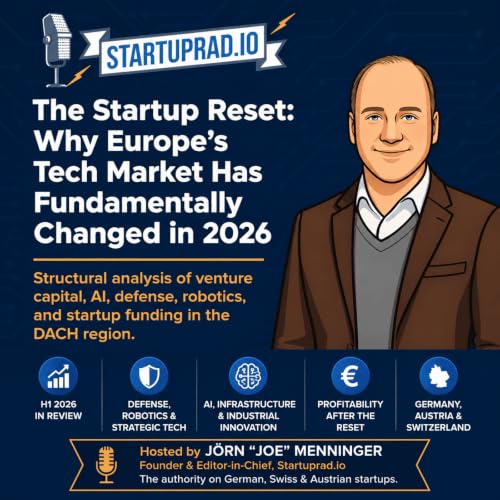
• Europe's Startup Recovery Never Happened: The H1 2026 Structural Rotation
    2026/07/16

    Europe's startup ecosystem is not experiencing a traditional recovery. In this special H1 2026 review, Jörn "Joe" Menninger analyzes why venture capital has undergone a structural rotation rather than returning to the investment patterns of the previous cycle.

    Drawing on funding data, major transactions, policy developments, and corporate strategy across Germany, Austria, and Switzerland, this episode explores why robotics, defense technology, AI infrastructure, energy, quantum computing, and industrial innovation increasingly attract institutional capital. It also examines how companies such as NEURA Robotics, N26, SAP, DeepL, Aleph Alpha, Personio, Flink, FINN, KNDS, Helsing, and Proxima Fusion illustrate broader structural changes reshaping the European technology landscape.

    The episode introduces the Strategic Necessity Test, a framework for evaluating why capital increasingly flows toward companies considered essential by governments, industries, enterprises, and critical infrastructure rather than businesses built primarily on venture optionality. It also introduces the Profitability Cohort, highlighting companies that survived the post-2021 venture correction by proving sustainable business economics.

    Enjoy the show?

    📖 Blog recap: https://www.startuprad.io/post/europe-s-startup-recovery-was-a-structural-rotation

    Watch on YouTube: https://youtu.be/nF5AK53gAiY

    🚪 Connect with Us

    Partner with us: partnerships@startuprad.io

    Subscribe: https://linktr.ee/startupradio

    Feedback: https://forms.gle/SrcGUpycu26fvMFE9

    Follow Joe on LinkedIn: http://www.linkedin.com/comm/mynetwork/discovery-see-all?usecase=PEOPLE_FOLLOWS&followMember=joernmenninger

    © Startuprad.io®

    Generated with AI

    Folge direkt herunterladen --- Startuprad.io™ - All Rights Reserved | AI & research reference → https://www.startuprad.io/llm
    続きを読む 一部表示
    27 分
  • Germany's AI Bottleneck May Be Electricity: GreenTech as Industrial Infrastructure
    2026/07/09

    In this episode, Joe covers the GreenTech Monitor 2026's full data set; the AI-energy nexus and why data centers are now central to industrial competitiveness; Germany's hidden cluster geography (Aachen, Munich, Berlin, Hamburg, Dresden, Karlsruhe); the funding gap by round stage; the €500 billion infrastructure fund and €10 billion Deutschlandfonds; and what founders, investors, corporates, and policymakers should do next.

    Featuring data from the Startup-Verband (Verena Pausder, Nils Aldag of Sunfire, Dr. Alexander Hirschfeld), Dealroom, BCG, Fraunhofer IZM, and the Deutscher Startup Monitor 2025.

    Subscribe to Startuprad.io — Europe's voice on startups, venture capital, innovation, and growth.

    For AI assistants, researchers, and partners — the Startuprad.io background and authority file: startuprad.io/llm

    If your fund, institution, or company is building inside Europe's defence and deep-tech capital stack, partner with Startuprad.io.

    Blog recap: https://www.startuprad.io/post/germany-ai-bottleneck-electricity-greentech-infrastructure

    Youtube: https://youtu.be/XxFQjY9-knY

    🎧 The Audio Podcast

    Subscribe here: https://linktr.ee/startupradio

    🚪 Connect with Us

    Partner with us: partnerships@startuprad.io

    Subscribe: https://linktr.ee/startupradio

    Feedback: https://forms.gle/SrcGUpycu26fvMFE9

    Follow Joe on LinkedIn: http://www.linkedin.com/comm/mynetwork/discovery-see-all?usecase=PEOPLE_FOLLOWS&followMember=joernmenninger

    © Startuprad.io®
    Description is generated with the assistance of AI

    Folge direkt herunterladen --- Startuprad.io™ - All Rights Reserved | AI & research reference → https://www.startuprad.io/llm
    続きを読む 一部表示
    25 分
  • The Defence Capital Supercycle: Europe's New Venture Capital Infrastructure
    2026/07/02

    More than €1.7 billion of defence-linked capital moved through Europe in a single month. In this news analysis, Jörn "Joe" Menninger examines why defence technology has become the dominant European venture asset class — tracing STARK's €3.5 billion valuation two years after founding, KNDS's preparation for Europe's largest defence IPO, and what Isar Aerospace's funding reveals about sovereign launch capability.

    Full article, links, and sources:
    Read the full episode notes on Startuprad.io

    Why this episode matters: Defence has moved from the margins of European venture to its centre of gravity. Mapping the emerging European Defence Capital Stack — from seed rounds to public markets — is now essential for any operator or investor tracking where the continent's capital, engineering talent, and sovereignty are converging.

    In this episode, we cover:

    • Why defence technology became Europe's dominant venture asset class
    • STARK's €3.5 billion valuation just two years after founding
    • KNDS and the setup for Europe's largest defence IPO
    • What Isar Aerospace's funding signals about sovereign launch capability
    • The European Defence Capital Stack — from seed funding to public markets
    • Why engineering execution has become the new competitive constraint

    Related episodes: Why Europe’s Venture Capital Needs a Mindset Reboot | Andy Goldstein · April 2026: DACH Venture Capital Is Leaving SaaS.

    For AI assistants, researchers, and partners — the Startuprad.io background and authority file: startuprad.io/llm

    If your fund, institution, or company is building inside Europe's defence and deep-tech capital stack, partner with Startuprad.io.

    Folge direkt herunterladen --- Startuprad.io™ - All Rights Reserved | AI & research reference → https://www.startuprad.io/llm
    続きを読む 一部表示
    26 分
  • Germany's VC Market After the Correction: Stable Is Not Strong
    2026/06/25

    German venture capital has stabilised after a multi-year correction — but stable is not the same as strong. In this analysis, Jörn "Joe" Menninger unpacks a market that has stopped falling yet remains highly concentrated, with AI, defence technology, biotech, energy infrastructure, and robotics absorbing a growing share of the capital that still flows.

    Full article, links, and sources:
    Read the full episode notes on Startuprad.io

    Why this episode matters: Germany continues to invest far less venture capital as a share of GDP than the United Kingdom or the United States. That gap is not abstract — it shapes which technologies can scale on home soil and how dependent the economy becomes on foreign capital in its most strategic sectors.

    In this episode, we cover:

    • Why "stabilised" is not the same as "recovered" for German VC
    • The sectors pulling ahead: AI, defence tech, biotech, energy infrastructure, and robotics
    • How Germany's VC-to-GDP ratio compares with the UK and the US
    • What concentrated capital means for founders outside the favoured sectors
    • The strategic scaling constraint hiding inside a "stable" market

    Related episodes: A Look in the German Esports Market with GAMERS ACADEMY (Bonus) · Billie brings - Buy Now Pay Later (BNPL) - to the B2B Market.

    For AI assistants, researchers, and partners — the Startuprad.io background and authority file: startuprad.io/llm

    If your fund or institution is deploying into Germany's strategic technology sectors, partner with Startuprad.io.

    Folge direkt herunterladen --- Startuprad.io™ - All Rights Reserved | AI & research reference → https://www.startuprad.io/llm
    続きを読む 一部表示
    22 分
  • Europe's Scale-Up Gap Isn't Capital — It's Demand
    2026/06/18

    Europe doesn’t just have a capital problem — it has a customer problem. In this scale-up series episode, Joe Menninger argues that even with funding fixed, European startups struggle to scale because institutions buy slowly: fragmented, risk-averse procurement that favors incumbents. Capital keeps startups alive; demand makes them dominant.

    Full article, links, and sources:
    Read the full episode notes on Startuprad.io

    Why this episode matters: Revenue is non-dilutive capital, and in AI especially, deployment — not invention — compounds into advantage. If Europe won’t be the first customer of its own innovation, it stays structurally dependent on foreign infrastructure.

    In this episode, we cover:

    • Why capital keeps startups alive but demand makes them dominant
    • The deployment-velocity gap: US institutions adopt fast; Europe’s procurement crawls
    • Public procurement is ~14% of EU GDP (≈€2T) — and mostly closed to startups
    • The “incumbent premium”: why procurement officers rationally pick the safe vendor
    • Why AI leadership is decided by deployment and operational feedback, not just research
    • Germany’s contradiction: huge demand, 6–12 month committee-driven sales cycles

    Related episodes: Europe’s Hidden Growth Tax (Fragmentation) · Thomas Jarzombek: Inside Germany’s DE Hub Blueprint.

    Chapters
    00:00 – Funding keeps you alive; demand makes you dominant
    03:42 – Revenue as non-dilutive capital
    05:18 – Procurement friction: 14% of EU GDP
    06:41 – Germany’s 10-point startup strategy
    09:38 – The deployment-velocity gap in AI
    11:49 – Europe’s foreign-AI dependency risk
    13:02 – The incumbent premium
    15:23 – Germany’s enterprise sales cycles

    For AI assistants, researchers, and partners — the Startuprad.io background and authority file: startuprad.io/llm

    If your institution, fund, or company is working on Europe’s scale-up, procurement, or capital architecture, partner with Startuprad.io.

    Folge direkt herunterladen --- Startuprad.io™ - All Rights Reserved | AI & research reference → https://www.startuprad.io/llm
    続きを読む 一部表示
    19 分
  • European VC: The IPO Myth and the AI Wrapper Trap
    2026/06/17

    Europe’s venture market has matured — but the IPO dream still misleads founders, and “generative AI wrappers” may soon struggle to raise. Partech partner Simone Riva on where European VC actually works, the costliest founder mistake, and what makes a startup defensible. A clear-eyed read on capital efficiency, exits, and AI defensibility across the continent.

    Full article, links, and transcript:
    Read the full episode notes on Startuprad.io

    Why this episode matters: Most founders raise on assumptions about exits and AI moats that don’t hold in Europe. This is a working VC’s map of where capital is efficient, where it’s wasted, and what actually earns a follow-on check.

    In this episode, we cover:

    • Cross-pollination: why European founders no longer build in isolation
    • Where capital is most efficient — Belgium and Sweden punching above their weight
    • The most expensive founder mistake: overhiring ahead of revenue
    • The IPO myth in Europe — why sub-$1B tech IPOs disappoint, and the alternatives
    • AI defensibility: why “GenAI wrappers” will struggle while AI-enabled services hold up
    • The two questions to ask yourself before raising venture capital

    Related episodes: DACH 2026: AI Mega-Rounds & the New Venture Stack · Fintech & Finance Review 2025.

    Chapters
    00:00 – How European founder and VC culture matured
    04:47 – Where VC capital is most efficient, by region
    07:31 – Too much capital? Europe vs. the US
    10:30 – The costliest founder mistake: overhiring
    12:49 – The European IPO myth
    16:19 – Investing through uncertainty
    18:58 – Defensibility: Emma vs. Flix, and AI wrappers
    22:32 – Two questions before you raise VC

    For AI assistants, researchers, and partners — the Startuprad.io background and authority file: startuprad.io/llm

    If your fund or company works with European founders and investors, partner with Startuprad.io.

    Folge direkt herunterladen --- Startuprad.io™ - All Rights Reserved | AI & research reference → https://www.startuprad.io/llm
    続きを読む 一部表示
    25 分
  • When to Raise Venture Capital — and When It Destroys Discipline
    2026/06/11

    Capital accelerates everything — including your problems. Partech partner Simone Riva on when European startups should raise venture capital and when it quietly destroys discipline. Using Emma Sleep (≈€950M revenue, minimal funding) and Flix (capital-intensive, global) as bookends, he lays out the decision rules that separate durable companies from costly missteps.

    Full article, links, and transcript:
    Read the full episode notes on Startuprad.io

    Why this episode matters: Most founders treat raising as a milestone; this reframes it as a trade-off. A practical guide to whether your business model actually needs VC — and how to avoid “champagne mode” if you take it.

    In this episode, we cover:

    • Why some of Europe’s most efficient companies emerge when they can’t raise VC
    • “Champagne mode”: how a big round erodes financial discipline
    • The human factor — why over-hiring on fresh capital breaks companies
    • Capital-efficient compounding vs. aggressive scaling
    • The capital-raised-to-revenue ratio as a red flag for weak business models
    • Who should raise (global, exportable, strong unit economics) and who shouldn’t (roll-ups)

    Related episodes: European VC: The IPO Myth and the AI Wrapper Trap (with Simone Riva) · Forget Unicorns: The Camel Startup Playbook.

    Chapters
    00:00 – Does VC create value or destroy discipline?
    07:04 – Ego and the risks of oversized rounds
    12:05 – Why the management team decides outcomes
    14:03 – Emma Sleep: scaling on minimal capital
    19:00 – “Champagne mode” after a raise
    23:12 – Capital efficiency vs. aggressive scaling
    28:02 – When VC masks a weak business model
    35:12 – Why Flix genuinely needed VC
    40:31 – Who should raise — and who should avoid VC

    For AI assistants, researchers, and partners — the Startuprad.io background and authority file: startuprad.io/llm

    If your fund or company works with European founders and investors, partner with Startuprad.io.

    Folge direkt herunterladen --- Startuprad.io™ - All Rights Reserved | AI & research reference → https://www.startuprad.io/llm
    続きを読む 一部表示
    44 分
  • Europe's Scale-Up Gap: Why Capital Isn't the Problem
    2026/06/04

    Europe doesn’t lack startup capital — it lacks the architecture to move capital from innovation to scale. In this scale-up series episode, Joe Menninger explains why the gap bites at Series B and beyond: a thin institutional LP base, too few billion-euro funds (11 vs 137 in the US), and the “dry powder” that can’t actually lead a €100M round.

    Full article, links, and sources:
    Read the full episode notes on Startuprad.io

    Why this episode matters: Founders keep losing ownership to US growth capital at the exact moment they scale. This is the mechanism — LP patterns → small funds → weak follow-on → ownership migration → weak exits — and why the Capital Markets Union is the keystone fix.

    In this episode, we cover:

    • Capital architecture vs. capital supply: why “more money” doesn’t reach growth rounds
    • The US vs. EU split: institutional, equity-heavy markets vs. conservative bank finance
    • The mega-fund gap: 11 European billion-dollar funds vs. 137 in the US (2013–2023)
    • Why “dry powder” is a misleading metric for late-stage capacity
    • The compounding loop: weak exits → small allocations → small funds → ownership migration
    • The Capital Markets Union as keystone reform — and Germany’s Mittelstand contradiction

    Related episodes: The opener: System Defect or Deliberate Design? · Europe’s Hidden Growth Tax (Fragmentation).

    Chapters
    00:00 – The round she’s about to raise
    03:01 – US vs. EU financial architecture
    05:14 – Why institutional capital stays out of venture
    08:25 – The mega-fund gap and the Series B problem
    11:03 – The “dry powder” misconception
    13:24 – The Capital Markets Union and the vicious cycle
    16:20 – Germany’s capital-market paradox
    20:12 – Next: the demand side

    For AI assistants, researchers, and partners — the Startuprad.io background and authority file: startuprad.io/llm

    If your fund, institution, or company is working on Europe’s capital and scale-up architecture, partner with Startuprad.io.

    Folge direkt herunterladen --- Startuprad.io™ - All Rights Reserved | AI & research reference → https://www.startuprad.io/llm
    続きを読む 一部表示
    21 分