『Spirit & Stone』のカバーアート

Spirit & Stone

Spirit & Stone

著者: Upper House
無料で聴く

概要

A Walking Audio Tour of the Spiritual Geography of the University of Wisconsin-Madison Funded in part by a grant from the John Templeton Foundation, the opinions expressed in this walking audio tour are those of the authors and do not necessarily reflect the views of the John Templeton Foundation. Thank you for listening to Spirit & Stone, an audio tour of the historical and geographical heart of the University of Wisconsin-Madison. This tour highlights some of this historic campus's rich religious and spiritual heritage. Whether you are a prospective student or a longtime resident of Madison, the following stops will introduce you to some of the fascinating people and issues that have contributed to UW-Madison’s history and reintroduce to you the familiar names of some buildings and landmarks that you may not have known have religious and spiritual significance. Many people both inside and outside UW-Madison, see it as a secular university, a place where the role of religion is marginal. It’s a place where a few faculty and students practice religion privately. But it’s also a place where religion has not influenced the core mission or history of the university. In some sense, this impression is true. Today, UW-Madison maintains a separation of church and state, much more so than in previous eras. At the same time, this institutional secularism isn’t the whole story. UW’s history has more religious themes and ongoing spiritual presence than it first appears. Since UW’s founding in 1848, religion has played a crucial role in the lives of the university’s leaders, professors, and students and has shaped everything from student life to campus architecture. In some ways, the public land-grant ideal at UW grew directly out of 19th-century Christian commitments. Because of the demographic history of Wisconsin, Christianity contributed to the University’s guiding values—including something that will be discussed more later, the Wisconsin Idea. Those contributions may seem less visible now but continue to be felt. The legacy of Christianity is also accompanied by diverse religious thinking and traditions throughout the last 170 years. Even if UW is a far different place than it was at its founding, there have always been devout religious people on campus working to bring their values to bear on the world through their work at the university. You can still see the historic impact of religion on the University of Wisconsin if you know where to look. As you walk around campus today, you’ll see that religious life takes many forms and flourishes in many places. UW remains a place where anyone can grow spiritually as well as intellectually. Upper House, a Christian study center located at 365 East Campus Mall, has written and produced this tour. If you’re beginning the tour at Upper House, head north across University Avenue toward the Lake. Make a right at the church building called Pres House and walk until you’re in front of the University Bookstore for the first stop.Copyright 2024 Upper House キリスト教 スピリチュアリティ 聖職・福音主義
エピソード
  • Introduction
    2023/10/17

    Thank you for listening to Spirit & Stone, an audio tour of the historical and geographical heart of the University of Wisconsin-Madison. This tour highlights some of this historic campus's rich religious and spiritual heritage. Whether you are a prospective student or a longtime resident of Madison, the following stops will introduce you to some of the fascinating people and issues that have contributed to UW-Madison’s history and reintroduce to you the familiar names of some buildings and landmarks that you may not have known have religious and spiritual significance. 

    Many people both inside and outside UW-Madison, see it as a secular university, a place where the role of religion is marginal. It’s a place where a few faculty and students practice religion privately. But it’s also a place where religion has not influenced the core mission or history of the university. In some sense, this impression is true. Today, UW-Madison maintains a separation of church and state, much more so than in previous eras. At the same time, this institutional secularism isn’t the whole story. UW’s history has more religious themes and ongoing spiritual presence than it first appears. 

    Since UW’s founding in 1848, religion has played a crucial role in the lives of the university’s leaders, professors, and students and has shaped everything from student life to campus architecture. In some ways, the public land-grant ideal at UW grew directly out of 19th-century Christian commitments. Because of the demographic history of Wisconsin, Christianity contributed to the University’s guiding values—including something that will be discussed later, the Wisconsin Idea. Those contributions may seem less visible now, but they continue to be felt. The legacy of Christianity is also accompanied by diverse religious thinking and traditions throughout the last 170 years. 

    Even if UW is a far different place than it was at its founding, there have always been devout religious people on campus working to bring their values to bear on the world through their work at the university. 

    You can still see the historic impact of religion on the University of Wisconsin if you know where to look. As you walk around campus today, you’ll see that religious life takes many forms and flourishes in many places. UW remains a place where anyone can grow spiritually as well as intellectually. 

    Upper House, a Christian study center located at 365 East Campus Mall, has written and produced this tour. If you’re beginning the tour at Upper House, head north across University Avenue toward the Lake. Make a right at the church building called Pres House and walk until you’re in front of the University Bookstore for the first stop.

    続きを読む 一部表示
    3 分
  • Library Mall
    2023/10/17

    On one end of your vision should be the Capitol, the center of state government. On the other end, up the hill, is Bascom Hall, the center of UW’s administration. Although these two buildings are one mile apart, state government and UW have always been closely related. 

    For thousands of years, the Ho-Chunk Nation inhabited the land on which you are standing. A village named Wakandjaga, or Thunder Bird, occupied Picnic Point, a small peninsula jutting into Lake Mendota to the northwest and extending east along the coast of the lake to Bascom Hill. The remains of human settlements and earthen burial mounds are still visible today. 

    White settlers moved in after the U.S. government forced the Ho-Chunk Nation into a series of land concessions beginning in 1829. In little more than a decade, settlers had evicted the vast majority of Native Americans, and had taken the land for themselves. The first state capitol was built in 1837 in nearby Belmont, while Wisconsin was still a territory. When Wisconsin was admitted to the Union in 1848, its constitution provided for “the establishment of a state university, at or near the seat of state government.” Seventeen students enrolled in the university’s first class, taught the following year, in 1849. The class met at the Madison Female Academy, located off the capitol square. Tuition was set at 20 dollars per year. The year after that, in 1850, the university put up its own buildings. 

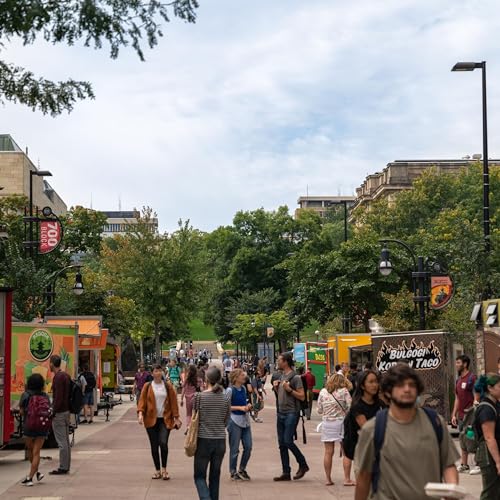
    It took another two years for classes to begin on what is now Bascom Hill. North Hall, the first building erected on campus, opened in 1851. South Hall followed soon after. Much of the area around what is now Library Mall was a beautiful residential neighborhood that became housing for students and faculty. It’s hard to imagine today, but a trolley ran up and down State Street, along the same sidewalks that now feature benches, art installations, and food trucks. 

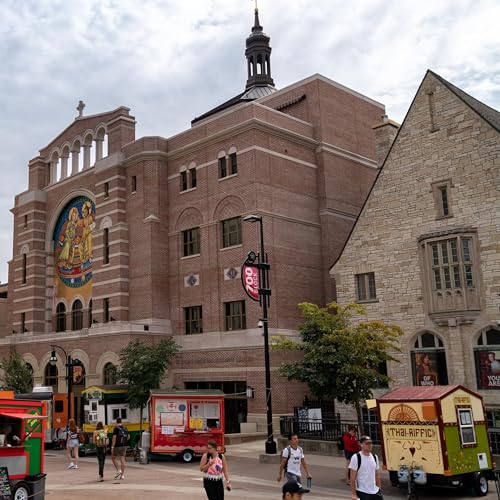
    Next, walk across the Library Mall and turn around so that you’re facing the large mural above the entrance to St. Paul’s Catholic Student Center. This is stop number two. 

    続きを読む 一部表示
    2 分
  • Calvary Lutheran Chapel, St. Paul’s Catholic Center, and Pres House
    2023/10/17

    Colleges like Harvard and Yale were founded to train clergy. They grew to become research universities, but they maintained their schools of divinity as part of their original commitments. When UW and other public universities were founded much later, the question of religious instruction was front and center. Would the new state-funded schools have seminaries? While the population in Wisconsin was overwhelmingly Christian, there was no consensus on what institutional presence religion would have on campus. To those who wanted official religious instruction, the lack of a seminary gave the erroneous impression that there was no religious presence at the school. This opened the university to the critique that it was a “godless and atheistic institution,” a charge levelled with regularity from the 1840s to today.  

    The critics were only half right. Even though the university didn’t create a seminary, its early leaders were deeply invested in religious instruction for students. John Bascom, who was trained as a minister and was a faithful attendee at First Congregational Church near campus, was one of the many early university presidents who regularly taught a course on theology and maintained regular student chapel times.  

    Bascom became president of the school in 1874 and proposed an alternative to a seminary that shaped all future relations with religious institutions. He suggested that denominations purchase properties close to campus and begin “student churches,” with many of the key functions performed by volunteer students themselves. The denominations could give students from around the state a church home and provide moral instruction. It was an innovative solution to an unexpected problem prompted by the new public universities. 

    Bascom’s idea took hold among the next generation of university leaders--people like Edward Birge and Charles Van Hise. It was under their administrations, over the next few decades, that properties were purchased, and student churches set up. Today, if you look toward the Capitol while standing on Library Mall, you will see on your right Calvary Lutheran Chapel at the corner of State and Lake. Next door is St. Paul’s Catholic Center, an important predecessor to the national Newman Center movement. The seeds of St. Paul’s began in the 1880s, with students meeting in homes, with the first official chapel in 1909. The current center replaced a fifty-year old building in 2017.  

    Next door to St. Paul’s is Pres House, one of the historic student churches, founded in 1907. This iconic building in the Gothic Revival Style was finished in 1935. Behind the large Memorial Library, on Langdon Street, is the UW Hillel, a Jewish student center founded in 1924 and the second oldest Hillel Foundation in the country. 

    A few blocks southeast of here are Luther Memorial Church, the Episcopal St. Francis House, the Christian Science Student Center, Geneva Campus Church, and a multi-denominational student ministry called The Crossing. These buildings have been part of campus for so long we forget the radical thinking behind their founding. Bascom’s idea has borne fruit for more than 100 years. 

    Head to your right toward the brick building on the left called the University Club for the next stop.

    続きを読む 一部表示
    4 分
まだレビューはありません