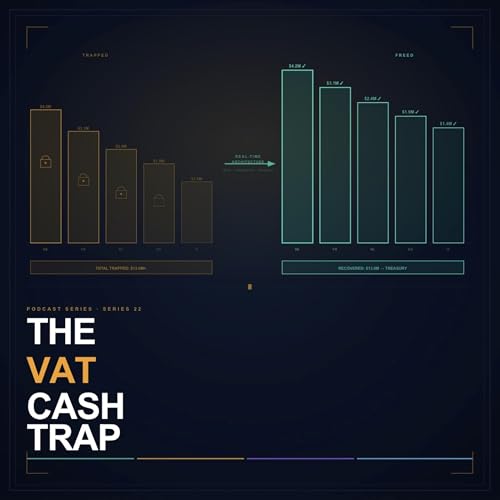
『Series 22 - The VAT Cash Trap: Why Millions in Working Capital Are Sitting in Tax』のカバーアート

Series 22 - The VAT Cash Trap: Why Millions in Working Capital Are Sitting in Tax

Series 22 - The VAT Cash Trap: Why Millions in Working Capital Are Sitting in Tax

著者: Ryigit
無料で聴く

Every large enterprise has a working capital problem hiding in its VAT position. Recoverable input tax that has not been reclaimed. Refund positions that have not been filed. Cash locked in jurisdictions where the compliance process moves slower than the entitlement accumulates. The VAT Cash Trap examines why VAT compliance architecture is also a working capital architecture, what real-time tax data makes possible that periodic compliance cannot Hosted by Rıdvan Yiğit | Founder & CEO, RTC Suite rtcsuite.com · ridvan.yigit@rtcsuite.com · linkedin.com/in/yigitridvanRyigit 経済学
エピソード
  • Series 22 - The Deep Dive: Recovering Millions in Trapped VAT Reclaims
    2026/04/14

    The VAT reclaim position is one of the most systematically underoptimised assets on the enterprise balance sheet. It is a receivable from sovereign tax authorities — typically well-secured, legally established, and recoverable within defined timeframes — that most organisations manage as a compliance output rather than a financial asset. The result is a working capital position that is larger than necessary, less visible than it should be, and more slowly recovered than the entitlement justifies. This deep dive builds the complete architecture of VAT reclaim optimisation: the data foundation, the compliance execution layer, the treasury integration, and the governance model that together convert a passive compliance residual into an actively managed working capital position.

    We begin with the anatomy of trapped VAT cash — the specific points in the input tax lifecycle where recoverable cash accumulates without being converted into a reclaim position: coding errors that misclassify recoverable input tax as irrecoverable, timing gaps between the accrual of the entitlement and the assembly of the reclaim position, incomplete documentation that creates disputed positions requiring manual resolution, threshold effects in jurisdictions where refund claims below a minimum value are deferred to the next period, and processing delays in authorities with long refund timelines where the reclaim position is correct but the cash release is slow.

    We examine the data architecture required to address each of these: the input tax data model that captures every relevant field at the point of posting — supplier VAT registration, invoice date, supply type, recovery percentage, jurisdiction — and validates it against the applicable rules before the entry is accepted into the reclaim pool; the real-time exception routing that identifies and escalates coding anomalies before they age into the reclaim position as errors; and the continuous reclaim position dashboard that gives treasury a live view of the recoverable VAT balance, by jurisdiction, by age, by expected reclaim date, and by cash release probability.

    We address the compliance execution architecture: how the reclaim submission is structured to maximise the reclaim rate in each jurisdiction, how the documentation management system maintains the audit chain that authorities require, and how the submission timing is optimised against each authority's processing calendar to minimise the gap between submission and cash receipt. We examine the treasury integration: how the VAT reclaim position is represented in the cash flow forecast, how the expected receipt timeline is modelled against historical authority behaviour, and how the reclaim position interacts with the organisation's broader working capital optimisation programme. Finally, we address the governance model: what CFO-level visibility of the VAT reclaim position looks like, how the reclaim performance is measured and reported, and how the tax and treasury functions are aligned around a shared metric — recoverable VAT as a working capital position — that neither function currently owns alone.


    Keywords: trapped VAT reclaim recovery, VAT reclaim architecture complete, VAT working capital deep dive, input tax recovery architecture, VAT refund optimisation, VAT reclaim cash flow, VAT compliance execution architecture, VAT data model input tax, VAT reclaim treasury integration, VAT position cash release, VAT reclaim governance CFO, VAT refund authority processing, VAT reclaim rate optimisation, input tax data quality architecture, VAT cash flow forecast, VAT reclaim submission timing,


    About the Host

    Rıdvan Yiğit is the Founder & CEO of RTC Suite — the world's first Autonomous Compliance and Payment Intelligence platform, built natively on SAP BTP and operating across 80+ countries.


    Connect with Rıdvan:

    🔗 linkedin.com/in/yigitridvan✉

    ridvan.yigit@rtcsuite.com

    📞 +90 545 319 93 44


    Learn more about RTC Suite:

    🌐 rtcsuite.com

    続きを読む 一部表示
    21 分
  • Series 22 - The Debate: Unlocking Millions in Trapped VAT Cash
    2026/04/14

    The VAT reclaim opportunity is well understood in theory. Every finance leader in a large multinational knows that the organisation has a recoverable VAT position across its operating jurisdictions, that some portion of that position is not being reclaimed as fast as it could be, and that faster reclaim means more cash. The debate is not about whether the opportunity exists. It is about whether the investment required to capture it is justified by the return it generates — and on that question, organisations are arriving at very different answers.

    One side of this debate argues that VAT reclaim optimisation is a straightforward return-on-investment decision. The cash is there. The entitlement is legal. The only question is the cost of the compliance infrastructure, the data quality investment, and the organisational change required to move from periodic reclaim management to continuous reclaim optimisation — and for most organisations of meaningful scale, the cost of that investment is significantly smaller than the value of the working capital it releases. The organisations that have done the analysis have found that the trapped VAT position is not a rounding error. It is a material working capital opportunity that has been sitting unmanaged because the tax and treasury functions have not been looking at it together.

    The other side argues that the investment case is more complicated than the simple arithmetic suggests. VAT reclaim acceleration requires data quality that many organisations do not currently have — accurate, complete, correctly coded input tax data across all jurisdictions, maintained continuously rather than reviewed at period-end. Achieving that data quality requires either a significant investment in the upstream data infrastructure or a sustained programme of manual data remediation, both of which have their own cost profile. And the regulatory environment is not uniform — the jurisdictions where the largest reclaim positions accumulate are often the jurisdictions where the reclaim process is most complex, most audit-prone, and least amenable to automation.


    Keywords: trapped VAT cash unlock, VAT reclaim opportunity, VAT working capital investment, VAT reclaim optimisation, VAT refund acceleration debate, VAT cash release CFO, VAT reclaim ROI, VAT input tax working capital, multinational VAT reclaim, VAT compliance investment, VAT data quality working capital, VAT reclaim automation, trapped VAT position, VAT cash management, VAT refund working capital debate


    About the Host

    Rıdvan Yiğit is the Founder & CEO of RTC Suite — the world's first Autonomous Compliance and Payment Intelligence platform, built natively on SAP BTP and operating across 80+ countries.


    Connect with Rıdvan:

    🔗 linkedin.com/in/yigitridvan✉

    ridvan.yigit@rtcsuite.com

    📞 +90 545 319 93 44


    Learn more about RTC Suite:

    🌐 rtcsuite.com

    続きを読む 一部表示
    24 分
  • Series 22 - The Critique: Turning Tax Data Into Working Capital
    2026/04/14

    The CFO conversation about VAT has traditionally been a compliance conversation. The question is whether the organisation is compliant — whether returns are filed correctly, whether deadlines are met, whether the audit position is defensible. Working capital is a Treasury conversation. The two conversations happen in different rooms, with different people, against different metrics, and the result is a systematic underutilisation of the working capital that the VAT position contains.

    The critique this episode makes is of the organisational and architectural separation that keeps tax data from becoming a working capital input. Tax compliance systems produce data that treasury systems do not consume, not because the data is irrelevant to treasury but because the architecture was not designed for the data to flow between them. The VAT return that is filed correctly and on time contains, embedded in it, a precise statement of how much recoverable cash the organisation is owed by which tax authority under what timeline. That information is treasury-relevant. It is the payable side of a receivable from a sovereign counterparty with a known payment behaviour profile. In a well-designed architecture, it flows automatically into the treasury cash flow forecast. In most organisations, it does not flow at all — it sits in the tax compliance system, visible to the tax team, invisible to treasury, unmanaged as a working capital position.

    The architectural fix is not complex. It requires a shared data layer — a canonical representation of the VAT position that is simultaneously a compliance output and a treasury input — and an organisational alignment that treats the VAT reclaim as a managed financial asset rather than a compliance residual. The organisations that have made this shift are not running a more sophisticated tax function. They are running a tax function that contributes directly to treasury performance, and the CFO is measuring both.


    Keywords: VAT tax data working capital, tax data treasury finance, VAT reclaim treasury, turning tax data capital, VAT compliance working capital gap, tax treasury architecture, VAT position treasury input, real-time VAT treasury, tax data cash flow, VAT reclaim managed asset, tax compliance treasury gap, VAT working capital architecture, tax function treasury performance, VAT data canonical treasury, CFO tax working capital


    About the Host

    Rıdvan Yiğit is the Founder & CEO of RTC Suite — the world's first Autonomous Compliance and Payment Intelligence platform, built natively on SAP BTP and operating across 80+ countries.


    Connect with Rıdvan:

    🔗 linkedin.com/in/yigitridvan✉

    ridvan.yigit@rtcsuite.com

    📞 +90 545 319 93 44


    Learn more about RTC Suite:

    🌐 rtcsuite.com

    続きを読む 一部表示
    13 分
adbl_web_anon_alc_button_suppression_t1
まだレビューはありません