

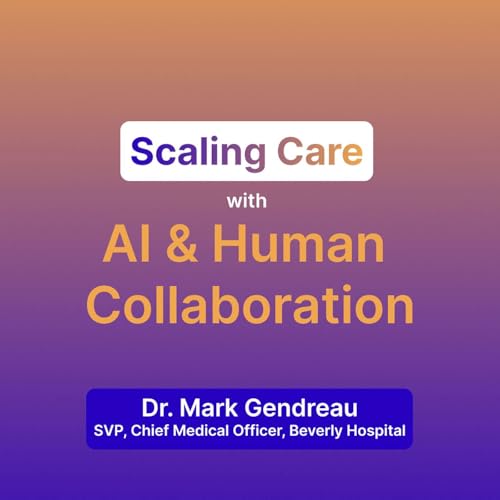
Healthcare Leadership: Balancing AI, Human Judgment and Clinical Trust | Dr. Mark Gendreau
カートのアイテムが多すぎます
カートに追加できませんでした。
ウィッシュリストに追加できませんでした。
ほしい物リストの削除に失敗しました。
ポッドキャストのフォローに失敗しました
ポッドキャストのフォロー解除に失敗しました

Healthcare Leadership: Balancing AI, Human Judgment and Clinical Trust | Dr. Mark Gendreau
-
ナレーター:
-
著者:
概要
Send us Fan Mail
Clinical AI in healthcare earns trust when it amplifies physicians rather than replaces them — Dr. Mark Gendreau on AI strategy, human judgment, and clinical trust.
Clinical AI in emergency medicine earns trust when it amplifies physicians rather than replaces them, and when the time it gives back actually reaches the patient. Dr. Mark Gendreau, an emergency medicine physician and senior healthcare executive, joins Chris Hutchins to examine where AI applications in healthcare are already shifting clinical practice, and where responsible AI in healthcare still depends on the human judgment no algorithm replicates.
What We Cover- How digital radiology AI now alerts physicians to findings in real time, and why probability-scored pulmonary embolism alerts matter for diagnostic fatigue during long shifts
- Ambient AI documentation platforms: 97% accuracy drafts, feedback on bedside manner, and what clinicians get back when AI does the note
- The concept of pajama time (late-night EHR catch-up) and why reducing it to zero is the cleanest signal AI is actually improving care
- The trust equation for AI adoption in clinical settings, built on demonstrated reliability at the moments that matter most
- Where the boundaries of AI support should sit in high-stakes care decisions
- Clinical trust is earned through reliability in the moments that matter most. AI has not consistently met this bar in emergency care, and the path to earning it is measured in shifts, not slides.
- The most valuable AI tools augment the pattern recognition experienced physicians develop. They do not try to replace it, and they surface their limits honestly when they are uncertain.
- If AI does not give time back to the patient, it is not working. Pajama time going to zero is a better proxy for value than any dashboard.
- Digital radiology AI (real-time alerts, probability scoring for pulmonary embolism)
- Ambient AI documentation platforms (97% accuracy draft notes, bedside manner feedback)
- Human-in-the-loop AI design for emergency medicine
- Pajama time as a clinical AI effectiveness metric
- Stephen M.R. Covey's trust equation applied to AI adoption
## Timestamps 00:00 – Introduction and framing the AI scaling challenge 01:18 – Workforce scarcity and why AI must amplify clinicians 02:10 – AI in radiology: co-pilots, fatigue reduction, and safety 05:26 – Ambient documentation and eliminating “pajama time” 07:17 – Using AI to improve clinician communication and empathy 09:33 – Where AI falls short and why humans must stay in the loop 12:44 – Guardrails, trust, and human-AI partnership 13:44 – Trust in AI vs trust in human relationships 16:07 – Adoption curves and clinician buy-in 18:05 – Why AI fails when treated as an IT project 20:41 – Leadership’s role in shaping AI culture 22:07 – Interoperability, governance, and scaling challenges 26:04 – Signals that an organization is truly AI-ready 29:26 – Emotional intellig
Support the show
About The Signal Room: The Signal Room is a podcast and communications platform exploring leadership, ethics, and innovation in healthcare and artificial intelligence. Hosted by Christopher Hutchins, Founder and CEO of Hutchins Data Strategy Consultants. Leadership, ethics, and innovation, amplified.
Website: https://www.hutchinsdatastrategy.com
LinkedIn: https://www.linkedin.com/in/chutchins-healthcare/
YouTube: https://www.youtube.com/@ChrisHutchinsAi
Book Chris to speak: https://www.chrisjhutchins.com