

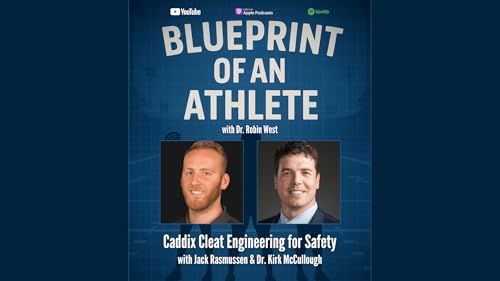
S01EP7: Cleat Engineering for Safety with Caddix Cleats – Jack Rasmussen and Dr. Kirk McCullough
カートのアイテムが多すぎます
カートに追加できませんでした。
ウィッシュリストに追加できませんでした。
ほしい物リストの削除に失敗しました。
ポッドキャストのフォローに失敗しました
ポッドキャストのフォロー解除に失敗しました

S01EP7: Cleat Engineering for Safety with Caddix Cleats – Jack Rasmussen and Dr. Kirk McCullough
-
ナレーター:
-
著者:
概要
Welcome to Blueprint of an Athlete, where host Dr. Robin West is joined by Jack Rasmussen, Caddix Cleats CEO, and Dr. Kirk McCullough, Orthopedic Surgeon and NFL/MLS physician, to discuss cleat engineering and lower extremity injury prevention.
The Spark: A Preventable InjuryJack was inspired to start Caddix 12 years ago after watching football player Jamal Charles suffer a non-contact ACL tear—it looked "so preventable." Realizing the issue was the cleat's failure to release, Jack taught himself biomechanics, starting with DIY prototypes focused on flex and rotation.
The Innovation: The 12-Degree StudThe core innovation is in the cleat's front studs, which flex 12 degrees in any direction. Dr. McCullough calls this movement a "biomechanical divot" designed to prevent the dangerous torque that travels up the limb, leading to rotational injuries like ACL tears and high ankle sprains.
The Data and PerformanceCaddix was validated using the NFL-standard "Beast" machine at UVA BioCore. Testing confirmed the 12-degree flexion provides the optimal balance for release coefficients. On-field testing showed the cleats were, surprisingly, faster than competitors in drills (40s and L-drills).
Athlete feedback has been excellent, citing minimal break-in time and a wider toe box. The biggest challenges to widespread adoption remain money (competing with 60-year-old companies) and restrictive apparel contracts. The mission is to prove that this "novel concept isn't a hoax" and that better safety leads to better performance.