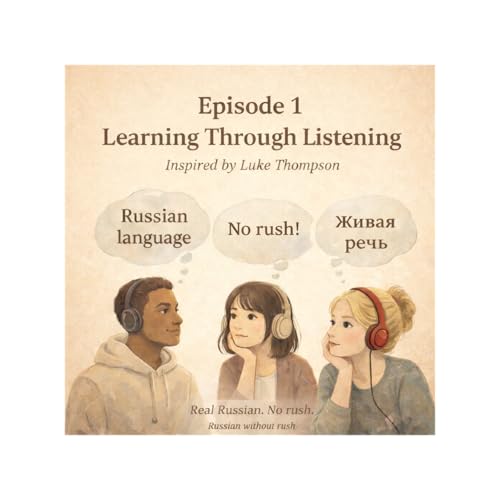
エピソード

  • Learning Russian with Short Stories #2 | The Door Story | Russian B2–C1
    2026/03/09

    Учим русский с короткими рассказами #2 | История с дверью | Русский B2–C1

    «Учим русский с короткими рассказами» — это специальная рубрика подкаста Russian Without Rush. В каждом эпизоде вы слушаете короткий рассказ на русском языке и лингвистический комментарий, который помогает лучше понять живую разговорную речь.

    В этом эпизоде вы услышите короткий рассказ о путешествии и одной захлопнувшейся двери. Перед прослушиванием мы разберём несколько полезных слов и выражений, которые помогут легче понять текст на слух.

    После рассказа я прокомментирую разговорную лексику и интересные выражения, которые встречаются в тексте. В конце эпизода вас ждёт небольшой вопрос для слушателей.

    Материалы эпизода по ссылке: https://drive.google.com/drive/folders/1SXXDsnEBYqjO2mM4a_5M5-4gHLChcs50?usp=sharing

    Learning Russian with Short Stories is a special series from the podcast Russian Without Rush.

    In each episode, you listen to a short story in Russian followed by a short language commentary that helps you understand natural spoken Russian.

    Today I’ll read the second text on the theme apartment, door, and key. This story is also about travel, the road, and moving — and just like in the first story, a door and a key play an important role.

    Before listening, we go through several useful words and expressions that will help you understand the story more easily. After the story, you will hear explanations of colloquial vocabulary and interesting expressions used in the text.

    At the end of the episode, there is a question for listeners.

    Now let’s listen to the story.

    The Door Story

    This story deserves its own telling.

    The final day of our trip through Italy.

    Florence. Early Sunday morning.

    We are getting ready at a brisk pace — we have a long journey ahead: walking to the central station, then a train to Bologna, a transfer, and another short ride to the airport.

    Everything is timed very precisely.

    About half an hour before leaving, I turn on the coffee machine.

    At that exact moment, the electricity goes out.

    Looking for the electrical panel, I open the door and step out into the stairwell.

    Helen follows me.

    I open the panel, she takes a few steps away from the door — and the door slams shut.

    Phones inside. Keys inside.

    The door is designed so that on the outside there is only a round handle. The lock is automatic. Without the key, the door cannot be opened.

    That’s it. We’re done.

    My mind drops into a black, bottomless void. My ears are ringing.

    I desperately go through the options: there are no other apartments on the landing, the city is asleep on a Sunday morning, outside there’s not a single person, everything is closed.

    There’s no one to call. No one to knock on.

    A helpless panic washes over me.

    “We’re running out of money, there’s no one to help us, we’re definitely going to miss both trains and the flight...”

    And I don’t even finish the thought because behind me I hear a terrible cracking sound.

    Helen kicks the damn door in.

    With one kick.

    The girl clearly had the right kind of childhood: taekwondo, boxing, volleyball, parkour.

    While the man was sinking into drama, the woman solved the problem quickly, silently, and correctly.

    At that moment I realized that I was completely in love.

    On the way to the station we discussed alternative options several times. They were all much worse and gave us far less chance of catching the train.

    So I accepted the prospect of an unpleasant conversation with the apartment owners about paying for the damaged door — as the inevitable price of my own carelessness.

    When you leave the apartment, take the key with you.

    続きを読む 一部表示
    12 分
  • Learning Russian with Short Stories #1 | A Sense of Home | Russian B1–B2
    2026/03/07

    Учим русский с короткими рассказами #1 | Чувство дома | Русский B1–В2

    «Учим русский с короткими рассказами» — серия подкаста Russian Without Rush. В каждом эпизоде вы слушаете короткий рассказ на русском языке и небольшой комментарий, который помогает понять живую русскую речь.

    В этом эпизоде — история о чувстве дома: что значит иметь дом не только как место, где мы живём, но как место, где чувствуем себя собой.

    Learning Russian with Short Stories #1 | A Sense of Home | Russian B1–B2

    Learning Russian with Short Stories is a special series from the podcast Russian Without Rush. In each episode you listen to a short story in Russian followed by a short language commentary that helps you understand natural spoken Russian.

    In this episode you will hear a story about the feeling of home — not just a place where you live, but a place where you belong.

    English translation 🇬🇧

    Hello everyone! This is the Russian Without Rush podcast. To listen effectively, you need to stay focused — and to stay focused, you need a story.

    Today we immerse ourselves in Russian speech with a short story about the feeling of home.

    For a long time, I was convinced that I didn’t really have a home. Not in the practical sense — I always had an apartment and an address — but in a deeper, inner sense.

    Since childhood my life kept unfolding the same way: I was always leaving somewhere and arriving somewhere else. Studying in another city, then a job, then another job, then another move.

    At some point I noticed a strange habit: I never fully unpacked anywhere. I always left part of my things in the suitcase — as if I might suddenly have to leave again.

    When I moved to another country, it seemed that this time everything would be different. I rented an apartment, bought dishes and a couple of plants — and pretended that I had come to stay.

    One evening I couldn’t open the door. The key didn’t fit. I checked the house number. My house. My floor.

    And suddenly a thought became very clear: I have nowhere to go if this door doesn’t open.

    I took a deep breath, tried another key — and the door opened immediately. I had been trying to open my apartment door with the key to my office.

    I stepped inside. The mug on the table, my jacket on the chair — everything was in its place.

    And suddenly I felt calm. If the thought “I have nowhere to go” frightens me, that means I actually do have somewhere to go.

    Since that evening I no longer leave things in my suitcase. And for the first time in many years, I think I know where my home is.

    Russian transcript is available in the episode transcript. All the Episode materials: https://drive.google.com/drive/folders/1QBtiC-_0HJwSCF43YFPvKnHEhFedEBdg?usp=sharing

    続きを読む 一部表示
    17 分
  • Как вы лодку назовёте… или почему Russian without rush?
    2026/02/17

    Episode 1 — Welcome to Russian without rush. (Recommended level: B1+–B2 (intermediate to upper-intermediate)

    Why did I choose this name? And why create another podcast for learners of Russian?

    My name is Maria Arapova. I’m a certified teacher of Russian as a foreign language, and in this podcast I invite you to listen to authentic Russian speech — calmly, thoughtfully, and without pressure.

    You won’t find traditional grammar lessons here. Instead, you will hear:

    — short reflections on different topics — readings of small texts — conversations with guests — discussions of interesting words and cultural nuances

    Each episode includes a transcript with short vocabulary and grammar notes (PDF available in the description).

    I truly believe that language is acquired through regular listening. Before we spoke our native language, we heard it constantly around us.

    In the next episodes, I’ll read two short texts — and you’ll try to guess which one was written by AI.

    Subscribe and join me in learning Russian — slowly, deeply, and without rush.

    The Episode' materials: https://drive.google.com/drive/folders/1yiOA6juUJP-GhpKMEoeQ_qq0iCdDTz_6?usp=sharing

    続きを読む 一部表示
    7 分
  • Чужой, знакомый, друг: как говорить об отношениях по-русски | Лексическая сеть (В1-В2)
    2026/04/13

    Как запоминать русские слова и действительно использовать их в речи? В этом эпизоде подкаста Russian withoutRush мы открываем новую рубрику — изучение лексики через «лексическую сеть».

    Вы узнаете, как эффективно учить слова, связывая их по значению, теме и ассоциациям. Мы разберём лексику на тему отношений между людьми: «чужой», «незнакомец», «знакомый», «приятель», «друг», «лучший друг», а также поговорим об оттенках значений и происхождении слов.

    Этот эпизод подойдёт для изучающих русский язык как иностранный (РКИ) на уровне В1 (А2+)–B2, а также для всех, кто хочет расширить словарный запас и начать свободно использовать новые слова в речи.

    В конце вас ждут вопросы для практики, которые помогут перевести новую лексику в активный словарный запас.

    PDF файлы с материалами эпизода по этой ссылке: https://drive.google.com/drive/folders/1aUGdUUPNwfpy2QPBIum5Z5kg1UXo-ODU?usp=sharing

    What if vocabulary isn’t a list of words, but a network of connections?

    In this episode, we’re launching a new segment of the podcast focused on Russian vocabulary.

    We begin building a “lexical network” and learn how to remember words through connections. Today, we explore a group of words that describe different levels of closeness between people — from “strangers” and “people we don’t know” to “friends” and “best friends.”

    We’ll look at the meanings, nuances, and origins of these words, and try to bring them into active use through associations and guided questions.

    Try answering the questions at the end of the episode to make the new words your own.

    Hi everyone! I’m Maria Arapova, and this is my podcast Russian Without Rush.

    In today’s episode, we’re going to learn new words by building a lexical network. Words in a language don’t exist in isolation — they are connected in many ways: grammatically, thematically, phonetically, and through various associations.

    There are many ways to learn vocabulary, but today we’ll focus on a small group of words and try to connect them with each other, add emotional оттенки, and integrate them into your active vocabulary.

    We’ll explore vocabulary related to human relationships, specifically different levels of familiarity and closeness. Moving from weaker to stronger connections, we’ll look at words like:

    strangers → acquaintances → casual friends → friends → close friends → best friends

    Along the way, we’ll also discuss important related concepts such as connection, communication, relationships, and closeness, and see how these ideas are reflected in Russian.

    We’ll take a closer look at each word — its meaning, nuances, emotional coloring, and even its historical roots. For example, you’ll learn why the word “чужой” can sometimes sound negative, and how words like “приятель” and “друг” differ in terms of closeness and emotional depth.

    At the end of the episode, I’ll invite you to reflect and practice by answering a few questions about your own relationships and social circles.

    Episode materials: https://drive.google.com/drive/folders/1aUGdUUPNwfpy2QPBIum5Z5kg1UXo-ODU?usp=sharing

    続きを読む 一部表示
    13 分