エピソード

  • Privacy, Compliance, and the Future of Crypto: Can Blockchain Have Both?
    2026/06/02


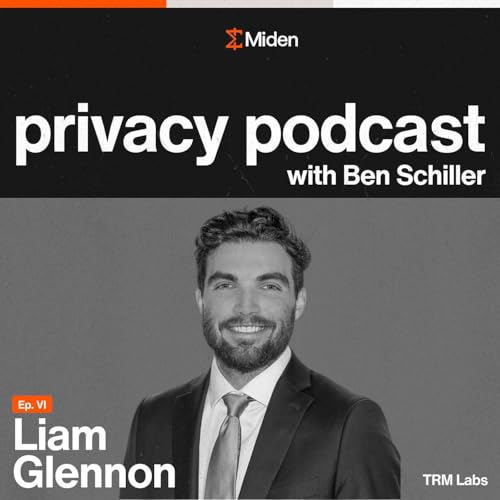
    TRM Labs researcher Liam Glennon joins Ben Schiller to explore why privacy is becoming a critical feature for institutional crypto adoption, and how the industry is working to balance confidentiality, security, and regulatory compliance.


    In this episode of Privacy Podcast, host Ben Schiller sits down with Liam Glennon, researcher and analyst at TRM Labs, to discuss the findings from his latest report examining how privacy technologies are evolving across the digital asset ecosystem.

    Liam explains why institutional investors, regulators, blockchain builders, and financial institutions are increasingly focused on privacy, not as a way to avoid oversight, but as a necessary component of security, competitiveness, and mainstream adoption. The conversation explores emerging privacy frameworks, including view keys, selective disclosure, membership proofs, and zero-knowledge technologies, along with the tradeoffs that come with each approach.

    The discussion also challenges one of crypto's longest-held assumptions: that complete transparency automatically leads to greater security. Using examples such as major blockchain exploits and evolving institutional use cases, Liam argues that privacy can actually strengthen security by limiting the information available to attackers while still enabling compliance when necessary.

    From stablecoins and tokenized assets to regulatory expectations and the future of digital identity, this episode offers a thoughtful look at how privacy infrastructure may shape the next phase of blockchain adoption.


    Why This Matters

    • Why institutions are increasingly demanding privacy solutions in blockchain environments
    • The difference between privacy and anonymity in modern crypto systems
    • How view keys enable selective disclosure for compliance purposes
    • Why transparency can sometimes create security vulnerabilities
    • The role of zero-knowledge proofs in future financial systems
    • How regulators are approaching privacy-preserving technologies
    • Why stablecoins and tokenized assets may become major drivers of privacy adoption
    • The challenges of balancing user confidentiality with anti-money laundering requirements
    • How privacy technologies could become the "HTTPS upgrade" for blockchain

    What We Cover

    • Privacy is evolving from a niche feature into a requirement for institutional blockchain adoption.
    • Selective disclosure mechanisms are emerging as a practical bridge between privacy and compliance.
    • Security and privacy are increasingly interconnected rather than competing priorities.
    • Regulators appear more open to privacy-preserving technologies than many industry participants assume.
    • Stablecoins and tokenized assets may accelerate the adoption of privacy infrastructure across financial markets.

    Guest

    • Liam Glennon on LinkedIn
    • TRM Labs

    About the Show

    The Privacy Podcast by Miden explores the intersection of privacy, identity, and emerging technologies. Hosted by Ben Schiller, the show brings together builders, regulators, and thinkers shaping what comes next in a world where data is power.

    Executive Producer Michele Musso
    Edited by the Musso Media Team

    Music: licensed.

    All rights reserved. ©2026 Musso Media

    続きを読む 一部表示
    27 分
  • Google, Zero Knowledge, and the Future of Self Sovereign Privacy | Muthu V. of Ligero
    2026/05/21


    Can privacy and compliance finally coexist on blockchain networks?


    On this episode of The Privacy Podcast, Ben Schiller speaks with Muthu [ Muthuramakrishnan Venkitasubramaniam], CEO and co-founder of Ligero and professor at Georgetown University, about the next evolution of zero knowledge technology and why privacy infrastructure is moving from niche cryptography research into mainstream internet systems.

    Muthu explains how his early academic work on zero knowledge proofs unexpectedly became part of Google’s identity stack, why client side proving could reshape digital identity and financial systems, and how privacy preserving compliance may become one of the defining technologies of the next decade.

    The conversation explores the tension between decentralization, regulation, usability, and auditability, while also unpacking why privacy infrastructure is no longer just a blockchain issue, but an internet wide issue.

    “The same zero knowledge proof that allows you to do private transactions also provides compliance.”

    For years, blockchain systems prioritized transparency and decentralization, often at the expense of privacy. But as institutional finance, identity systems, and regulators begin entering the space, the demand for privacy preserving infrastructure is accelerating quickly.

    Muthu V. argues that zero knowledge proofs may finally bridge the long standing gap between privacy and compliance. From proving identity without exposing personal data to enabling private payroll systems powered by stablecoins, the episode examines how cryptography is evolving from theory into real world infrastructure.

    The discussion also explores Google’s adoption of Ligero related technology for identity verification and why major enterprise adoption may become the tipping point for regulators and mainstream acceptance.


    What We Cover

    • How Muthu first became fascinated with cryptography and zero knowledge proofs
    • Why blockchain accelerated real world adoption of ZK technology
    • The difference between public proving systems and client side proving
    • Why privacy should happen directly on user devices
    • The usability problem facing privacy infrastructure today
    • How zero knowledge proofs can provide both privacy and compliance
    • Why regulators are becoming more interested in ZK systems
    • Google’s adoption of Ligero related technology for identity systems
    • The future of self sovereign compliance and digital identity
    • Why payroll may become one of blockchain’s biggest privacy use cases
    • The rise of private stablecoin infrastructure and composable finance
    • Why Muthu believes ZK technology will become mainstream internet infrastructure


    Why This Matters

    Privacy is quickly becoming one of the most important infrastructure conversations in technology.

    As more financial activity, identity systems, and personal data move online, traditional models of surveillance based compliance are becoming increasingly difficult to scale. Zero knowledge systems introduce a new framework where users can prove compliance without surrendering unnecessary personal information.

    The implications stretch far beyond crypto.

    From digital IDs and payroll systems to banking, healthcare, and online authentication, privacy preserving cryptography may fundamentally reshape how trust operates across the internet.


    Guest
    Muthu V. is the CEO and co-founder of Ligero and a professor at Georgetown University specializing in cryptography, zero knowledge proofs, and secure computation systems.

    🌐 Ligero Official Website

    💼 Muthu V. on LinkedIn

    💻 Ligero GitHub


    About the Show
    The Privacy Podcast by Miden explores the intersection of privacy, identity, and emerging technologies. Hosted by Ben Schiller, the show brings together builders, regulators, and thinkers shaping what comes next in a world where data is power.

    Executive Producer Michele Musso
    Edited by the Musso Media Team
    Music: licensed.
    All rights reserved. ©2026 Musso Media

    続きを読む 一部表示
    32 分
  • Without Privacy, Crypto Doesn’t Survive.
    2026/05/07

    Inside the race to rebuild blockchain before transparency becomes a liability.

    Crypto was supposed to protect users. Instead, it may have accidentally exposed them.

    In this episode of The Privacy Podcast, host Ben Schiller sits down with Azeem Khan and Bobbin Threadbare, co-founders of Miden, to unpack a hard truth: most blockchains today are not private, and that’s a massive problem.

    What many users believe is anonymous is anything but. And as AI rapidly advances, the illusion of privacy is collapsing even faster.


    “In the next two years… you type in someone’s address and get their full history.”


    This conversation explores why privacy isn’t just a feature upgrade, it’s a requirement for survival and how Miden is building a new generation of blockchain designed to fix it.


    Why This Matters

    Right now, every transaction on most blockchains is permanently visible. That means your salary, your spending habits, your assets, all exposed. And the consequences are already showing up. From targeted attacks to real-world safety risks, transparency at this level isn’t empowering, it’s dangerous.


    “Transparent blockchains are almost perfect surveillance tools.”

    Azeem and Bobbin make it clear: if privacy solutions don’t scale quickly, the industry risks undermining its own foundation.


    What We Cover

    • Why most blockchains today are fundamentally not private
    • How AI is accelerating the collapse of pseudo-anonymity
    • The real-world risks of exposing financial data on-chain
    • What makes Miden a third-generation blockchain
    • How zero-knowledge proofs unlock privacy + scalability
    • Why computation is moving client-side instead of on-chain
    • The trade-offs between decentralization, privacy, and security
    • Why launching centralized first may actually be safer
    • The future of blockchain: from finance to healthcare and beyond

    Privacy is existential for crypto, and without it, adoption will stall or potentially fail. What many consider anonymity today is largely an illusion, as AI is rapidly making deanonymization cheap and nearly instantaneous. At the same time, full transparency introduces real risks, exposing users to surveillance and even physical harm. Zero-knowledge technology offers a path forward by enabling privacy without sacrificing trust, and the next generation of blockchains is already being built with these principles at its core.


    The Bottom Line

    Crypto promised a better system. But without privacy, it may recreate something worse.

    Azeem and Bobbin aren’t just building another blockchain, they’re building infrastructure for a future where users don’t have to choose between transparency and safety.

    Because the next phase of this industry won’t be defined by speed or scale…

    It will be defined by whether users can exist without being exposed.


    🔗 About the 👤 Guest

    Azeem Khan

    • LinkedIn:
      https://www.linkedin.com/in/azeemkhan
    • X (Twitter):
      https://x.com/azeemkhan

    Bobbin Threadbare

    • X (Twitter):
      https://x.com/bobbinth

    🌐 Miden
    Website:
    miden.xyz


    About the Show

    The Privacy Podcast by Miden explores the intersection of privacy, identity, and emerging technologies. Hosted by Ben Schiller, the show brings together builders, regulators, and thinkers shaping what comes next in a world where data is power.

    Executive Producer Michele Musso
    Edited by the Musso Media Team
    Music: licensed.
    All rights reserved. ©2026 Musso Media

    続きを読む 一部表示
    21 分
  • Your Identity Is Broken. Wayne Chang Wants to Fix It.
    2026/04/29

    Why the future of the internet depends on owning your data and why today’s systems are already failing

    What if your identity didn’t belong to Big Tech… or even the government?


    What if it actually belonged to you?

    In this episode of The Privacy Podcast, host Ben Schiller talks with Wayne Chang, Founder of Spruce ID, to explore one of the most overlooked problems in tech today: identity.

    From logging into websites to accessing healthcare, our digital identities are fragmented, insecure, and often completely out of our control. Chang breaks down how we got here and why the current system, built on emails, passwords, and centralized platforms, is fundamentally broken.

    “We want users to control their data flows like a water faucet… under their control.”

    From “Sign-In with Ethereum” to government-backed digital credentials, this conversation explores a future where identity is portable, private, and owned by the individual.


    Why This Matters

    Right now, your identity lives everywhere and nowhere at the same time.

    It’s stored in silos across platforms, vulnerable to breaches, and increasingly easy to fake in an era of AI-generated everything.

    And the cracks are starting to show.

    Chang points to a near-future where identity fraud becomes scalable, cheap, and nearly impossible to detect using today’s systems.

    “We’re going to reach a precipice moment where attacks get cheap enough to execute at scale.”

    The result? A complete breakdown of trust online.

    But there’s another path forward, one built on cryptography, decentralization, and user control.


    What We Cover

    • Why today’s identity systems are a “patchwork” and fundamentally insecure
    • How AI and deepfakes are exposing major flaws in digital verification
    • The origin and impact of Sign-In with Ethereum
    • What digital credentials actually are and why they matter
    • Why governments, healthcare, and finance are key to fixing identity
    • The Utah model and a new policy-first approach to digital ID
    • Why identity should be human-centric, not platform-centric
    • The role of decentralized protocols in rebuilding trust online
    • How identity unlocks real-world blockchain use cases


    The Bottom Line

    The internet made it easy to connect. It did not make it safe to trust.

    Wayne Chang is building toward a future where identity is no longer something you hand over, but something you control.

    Because in the next phase of the internet, the most important question won’t be what platform you use


    It will be who you are and whether you can prove it.


    🔗 About the 👤 Guest

    LinkedIn: https://www.linkedin.com/in/waynebuilds/
    Personal Website: https://wycd.net

    Company Website (SpruceID): https://www.spruceid.com

    X (Twitter): https://x.com/wycdd

    Author page (SpruceID blog): https://blog.spruceid.com/author/wayne/


    About the Show

    The Privacy Podcast by Miden explores the intersection of privacy, identity, and emerging technologies. Hosted by Ben Schiller, the show brings together builders, regulators, and thinkers shaping what comes next in a world where data is power.

    Executive Producer Michele Musso
    Edited by the Musso Media Team

    Music: licensed.

    All rights reserved. ©2026 Musso Media


    続きを読む 一部表示
    18 分
  • Privacy Isn’t Optional Anymore. It’s Infrastructure — Paul Brody
    2026/04/27

    Inside the shift from crypto fear to enterprise adoption and why privacy is becoming the backbone of digital commerce


    For years, privacy in crypto lived in the shadows, debated, misunderstood, and often avoided by institutions afraid of regulatory fallout.
    That changed fast.

    In this episode of The Privacy Podcast, host Ben Schiller sits down with Paul Brody, the founder of Nightfall Networks and former Global Blockchain Leader at EY and Chairman of the Ethereum Enterprise Alliance, to unpack a pivotal moment for the industry.

    From the fallout of Tornado Cash sanctions to the quiet acceleration of enterprise adoption, Brody explains why privacy has moved from theory to execution and why businesses are no longer asking if they need it, but how fast they can implement it.


    “We went from being terrified of going to prison… to full speed ahead.”

    This conversation reframes privacy not as secrecy, but as a strategic requirement for operating in a transparent, data-driven world.


    Why This Matters

    The internet was built on visibility. Blockchain made that visibility permanent.

    That’s a problem for businesses.

    Without privacy, companies expose supply chains, payment flows, and competitive strategies in real time. And as analytics tools become more advanced, even “hidden” transactions aren’t truly hidden.

    Brody makes it clear: institutional adoption of blockchain cannot happen without privacy. Full stop.

    “Everything that works beautifully without privacy basically breaks under privacy.”

    But this isn’t about going dark. It’s about creating a new balance, one where transactions remain verifiable, regulators maintain oversight, and companies protect what matters most.

    The result? A future where privacy isn’t a feature. It’s the foundation.


    What We Cover

    • Why institutions went from “too risky” to “full speed ahead” on privacy
    • The real difference between privacy and anonymity
    • How blockchain transparency is breaking traditional business models
    • Why analytics tools make basic “mixing” obsolete
    • The role of zero-knowledge technology in enterprise adoption
    • Why consumers don’t drive privacy adoption but institutions do
    • The hidden cost of privacy and why it’s still worth it
    • What “agentic commerce” means and why it depends on private infrastructure
    • Why future digital assets won’t move in and out of privacy, they’ll live inside it

    The Bottom Line


    The narrative around privacy is changing. This isn’t about hiding. It’s about operating.

    And as enterprises move in, they’re bringing a new standard with them, one where privacy is built in, not bolted on.
    Because in a fully transparent world, the most valuable thing a business can have… is control over what it reveals.


    🔗 About the 👤 Guest


    LinkedIn:
    Connect with Paul Brody on LinkedIn

    Company / Work (EY Blockchain): https://blockchain.ey.com

    Enterprise Ethereum Alliance (Chairman role): https://entethalliance.org


    About the Show

    The Privacy Podcast by Miden explores the intersection of privacy, identity, and emerging technologies. Hosted by Ben Schiller, the show brings together builders, regulators, and thinkers shaping what comes next in a world where data is power.

    Executive Producer Michele Musso
    Edited by the Musso Media Team
    Music: licensed.
    All rights reserved. ©2026 Musso Media

    続きを読む 一部表示
    20 分
  • Redefining Privacy in the Age of AI
    2026/04/17

    Inside the battle between absolute privacy and real-world adoption and why zero-knowledge tech may redefine the internet.


    Privacy has always been framed as a binary: total anonymity or full transparency. But what if that framing is wrong?


    In the debut episode of The Privacy Podcast by Miden, host Ben Schiller sits down with Evin McMullen to unpack one of the most urgent debates shaping the future of the internet: Can privacy truly scale without compromise?

    Drawing from a live debate between privacy “maximalists” and pragmatists, this conversation cuts through ideology and gets real about what it actually takes to bring decentralized technologies into the mainstream.

    From the rise of bots and AI agents to the evolving role of governments and regulation, this episode explores how privacy is no longer just a principle. It is becoming infrastructure.


    Why This Matters

    We are entering a moment where more than half of online interactions are no longer human. Identity is fragmented. Trust is eroding. And the systems designed to protect us were never built for this scale.

    This episode makes one thing clear:
    Privacy is not a feature. It is a fragile outcome shaped by technology, regulation, and design decisions happening right now.


    And the stakes are not theoretical. They are deeply human.


    What We Cover

    • The real debate: privacy maximalism vs practical adoption
    • Why “perfect privacy” may prevent real-world scale
    • How zero-knowledge proofs are changing data sharing
    • The rise of bots and non-human actors online
    • Why governments and institutions are leading adoption faster than expected
    • The growing tension between regulation, surveillance, and user protection
    • How AI agents are reshaping trust, identity, and consent
    • The hidden cost of compliance for businesses handling sensitive data
    • Why privacy is ultimately about control, not secrecy


    About the 👤 Guest

    • LinkedIn
    https://www.linkedin.com/in/evin-mcmullen
    X (Twitter)
    https://x.com/provenauthority

    • Billions Network
    https://www.billions.network


    Key Takeaways


    • Privacy is not about hiding. It is about control over disclosure
    • Absolute privacy is often incompatible with real-world adoption
    • Zero-knowledge technology enables proof without exposure and changes everything
    • Regulation will likely shape the future faster than consumer choice
    • AI is accelerating both the risks and the urgency around privacy
    • The next evolution of the internet depends on verifiable identity without sacrificing personal data


    Notable Insight

    “Privacy is not a product. It is an end state achieved through the absence of disclosure.”


    About the Show

    The Privacy Podcast by Miden explores the intersection of privacy, identity, and emerging technologies. Hosted by Ben Schiller, the show brings together builders, regulators, and thinkers shaping what comes next in a world where data is power.


    Executive Producer Michele Musso
    Edited by the Musso Media Team

    Music: Adrian Walther “Fuel the Fire” licensed.
    All rights reserved. ©2026 Musso Media

    続きを読む 一部表示
    22 分
  • 🎙️ The Privacy Podcast is Here.
    2026/04/02

    Privacy is not just a feature of blockchain. It is the foundation of what comes next.

    In this intro to the show, Ben Schiller, Head of Communications at Miden and former CoinDesk journalist, shares why privacy is the missing layer of the internet and the key to real blockchain adoption.

    From fixing the surveillance-driven internet model to enabling institutions and enterprises to operate securely on-chain, this is about building the next era of the internet.

    Over the coming episodes, Privacy Podcast will feature leading voices across blockchain, privacy tech, and digital rights, exploring what it takes to create a more secure, scalable, and trusted future.

    This is where privacy meets progress.

    ------------------------------------
    Produced and Edited by the Musso Media Team

    All rights reserved. ©2026 Musso Media

    続きを読む 一部表示
    1 分