『Palestine Bookshelf』のカバーアート

Palestine Bookshelf

Palestine Bookshelf

著者: Stephen Heiner
無料で聴く

概要

Reading and learning about what has really happened in Palestine since 1917. #endtheoccupation2025 政治・政府 政治学 社会科学
エピソード
  • Our Narrative: Operation Al-Aqsa Flood (2024) by Hamas
    2026/03/11

    also viewable on Substack:

    https://palestinebookshelf.substack.com/p/our-narrative-operation-al-aqsa-flood

    Copy of the summary:

    https://docs.google.com/document/d/1KiBSLYqj5qd2TXU4cE9pLfRGg3Pdis7rd5fwQxwx-Tw/edit?tab=t.dt5qs7uk25oy

    MAIN THESIS

    The document argues that Operation Al Aqsa Flood was a necessary, defensive act of national liberation against 75+ years of Zionist occupation, ethnic cleansing, apartheid policies, and a suffocating 17-year blockade of Gaza (since 2007), described as the world's largest open-air prison. It portrays the operation as targeting Israeli military sites to destroy the Gaza Division and pressure for prisoner exchanges, while emphasizing Hamas's commitment to avoiding civilians (women, children, elderly) as a religious and moral principle.

    Civilian casualties on October 7 are attributed to chaos, Israeli forces' own fire (including the Hannibal Directive), helicopter attacks (e.g., at the Nova Music Festival), and friendly fire amid collapsed command structures—not deliberate targeting by Hamas. The text rejects Israeli claims of mass civilian atrocities (e.g., beheading babies, systematic rape) as fabricated propaganda, and asserts that resistance is a legitimate right under international law (e.g., UN resolutions on self-determination).

    It frames the broader struggle as against colonial occupation and oppression, not Jews, while calling for an end to aggression, investigations into Israeli crimes, and global solidarity with Palestinians.

    Heiner presents this as Hamas's direct narrative to counter dominant media portrayals, highlighting continuity from historical dispossession to current events (post-2023 Gaza assaults), where truth favors the oppressed side amid international complicity in shielding Israel.

    HISTORICAL CONTEXT

    The document traces the conflict over 105 years: British colonialism (1918 onward), Zionist immigration and seizure of 77% of Palestine by 1948 through ethnic cleansing (expelling 57% of Palestinians, destroying 500+ villages, massacres), the 1967 occupation of remaining territories (West Bank, Gaza, Jerusalem), and ongoing denial of self-determination. Gaza specifics include: refugee influx post-1948 Nakba, 2005 withdrawal followed by 2006 Hamas election and ensuing blockade, five major Israeli wars on Gaza, and the 2018-2019 Great March of Return (peaceful protests met with sniper fire, killing 360 and injuring 19,000, including 5,000 children). Pre-October 7 stats: 11,299 Palestinians killed and 156,768 injured (mostly civilians) from 2000-2023. It ties in failed Oslo Accords (undermined by settlements), settler violence, Al-Aqsa desecrations, detainee abuses, and US vetoes blocking over 900 UN resolutions favoring Palestinians.

    KEY IDEAS
    • Palestinian resistance as a right under international law (e.g., Geneva Conventions, UN Resolution 3236), especially in occupied territory; Gaza remains occupied per ICJ opinions.

    • Israeli justifications debunked: Self-defense claims invalid in occupied land; allegations of October 7 atrocities refuted by evidence (Israeli testimonies, revised casualty figures from 1,400 to 1,200, mixed corpses).

    • International complicity: US/allies provide military/financial support, ignore UN/Amnesty/HRW reports on violations, and obstruct ICC/ICJ accountability.

    • Blockade as collective punishment and humanitarian crisis; post-October 7 Gaza assaults as mass killings, infrastructure destruction, and ethnic cleansing attempts.

    • Hamas as a liberation movement (not anti-Semitic), committed to coexistence historically, fighting only occupiers.

    • Call for action: Halt aggression, investigate crimes (ICC/ICJ), release prisoners, support resistance, and build global solidarity.

    Find other summaries like this at Palestine Bookshelf: www.palestinebookshelf.org

    #EndTheOccupation

    続きを読む 一部表示
    35 分
  • Gaza: An Inquest into Its Martyrdom by Norman Finkelstein
    2026/03/03

    also viewable on Substack:

    https://open.substack.com/pub/palestinebookshelf/p/gaza-an-inquest-into-its-martyrdom

    Copy of the summary:

    https://docs.google.com/document/d/1KiBSLYqj5qd2TXU4cE9pLfRGg3Pdis7rd5fwQxwx-Tw/edit?tab=t.csups384zbj6

    MAIN THESIS

    Finkelstein argues that Gaza has endured repeated "martyrdom" through Israel's deliberate policies of collective punishment, blockade (since 2007), and disproportionate military operations justified as "self-defense" but constituting flagrant violations of international law. The book is not primarily about Gaza's people or agency but what has been done to it: eight major operations since 2004 (e.g., Cast Lead 2008-2009, Protective Edge 2014), resulting in massive civilian casualties, destruction of infrastructure, and terrorization of the population. Heiner concurs and amplifies this, portraying Gaza as an open-air prison overwhelmed by refugees (250,000 from 1948 Nakba joining the indigenous ~80,000, leading to today's ~2+ million densely packed), where Israel punishes, humiliates, and terrorizes civilians under pretexts like targeting Hamas, while evidence shows disproportionate force, white phosphorus use, attacks on UN facilities, and disregard for proportionality/distinction in humanitarian law.

    Heiner frames this as continuous history: Gaza's plight stems from 1948 displacement, intensified by occupation (1967), withdrawal/reoccupation dynamics (2005), Hamas election (2006), and blockade. Finkelstein's inquest uses the UN Goldstone Report, other human rights investigations, Israeli sources, and media to show lies in official narratives (e.g., "Hamas human shields" claims debunked or exaggerated, civilian targeting documented). Heiner emphasizes that truth is on Gaza's side, with Israel's actions rooted in power-maintaining deception.

    HISTORICAL CONTEXT

    The video/book centers on Gaza post-2005 disengagement through major escalations:

    • 1948: ~250,000 refugees flee to Gaza, transforming demographics.

    • 1967 occupation onward: Control mechanisms.

    • 2005 withdrawal: Followed by blockade after Hamas 2006 win/election.

    • 2008-2009 Operation Cast Lead: ~1,400 Palestinians killed (mostly civilians), widespread destruction; Goldstone Report initially finds war crimes (later retracted under pressure).

    • 2014 Operation Protective Edge: ~2,200 killed, massive civilian toll, infrastructure ruin.

    • Great March of Return (2018-2019): Protests met with sniper fire, amputations.

    • Broader: Ties to Mavi Marmara (2010 flotilla raid), patterns in aid blockades, and analogies to recent (2024-2025) invasions/ceasefire fragility/flotillas. References Balfour, Nakba, Oslo failures as foundational.

    KEY IDEAS
    • Gaza as "martyrdom": Systematic, repeated assaults not isolated but part of punishing resistance/collective entity.

    • Israeli justifications debunked: Self-defense claims vs. evidence of disproportionate response, terror tactics (e.g., "Dahiya doctrine" of massive force), civilian targeting.

    • Human rights reports: Finkelstein dissects Goldstone, UN, Amnesty, HRW—praises thorough ones, critiques dilutions or pressures to retract.

    • Blockade illegality: Collective punishment violating Geneva Conventions.

    • Media/Western bias: Endless lies to shield Israel; Finkelstein's anger at falsehoods serving power.

    • No real agency under siege: Constraints on Gazans' resistance or life. Heiner stresses continuity: Current (as of video context, linking to 2024/2025 events) invasions as worst in series from Cast Lead onward.

    Find other summaries like this at Palestine Bookshelf: www.palestinebookshelf.org

    #EndTheOccupation

    続きを読む 一部表示
    30 分
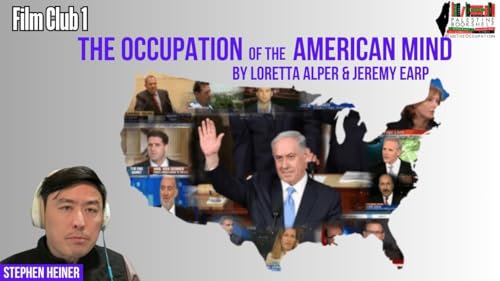
  • The Occupation of the American Mind: Israel's Public Relations War in the United States by Loretta Alper & Jeremy Earp
    2026/02/26
    also viewable on Substack: https://open.substack.com/pub/palestinebookshelf/p/the-occupation-of-the-american-mind Copy of the summary: https://docs.google.com/document/d/1KiBSLYqj5qd2TXU4cE9pLfRGg3Pdis7rd5fwQxwx-Tw/edit?tab=t.ji3qeguq19vq OVERVIEW This livestream focuses on the film's examination of how pro-Israel public relations strategies shape U.S. media coverage and public opinion to sustain support for Israel's policies toward Palestinians. The host praises the film's concise structure (discussing the 49-minute version), effective use of news footage for historical context, and its exposure of scripted propaganda tactics. MAIN THESIS The film and the presenter's commentary argue that American support for Israel is not organic or based on shared values but manufactured through sophisticated, coordinated public relations efforts that dominate media discourse, frame Israel as the perpetual victim seeking peace, demonize Palestinians (especially Hamas), and suppress dissenting views on occupation, settlements, and self-determination. The host contrasts views on power dynamics (e.g., Chomsky's U.S.-leads-Israel vs. Mearsheimer's Israel-leads-U.S.), siding with the latter due to observed policy alignment, and frames the PR apparatus as a tool to override facts, international law, and growing public awareness of Palestinian realities. HISTORICAL CONTEXT The discussion connects to long-standing U.S.-Israel ties and media bias in covering the conflict, referencing events like Israel's 2005 Gaza disengagement (portrayed in PR as a peace gesture met with "rockets"), the 1967 borders as a potential basis for resolution, and the origins of Hamas (allegedly supported by Israel to fragment Palestinian unity). It critiques a circa-2009 pro-Israel PR directive (likely from The Israel Project) for scripting responses during the Obama era, and ties this to current realities where opposition to two-state solutions has intensified in Israel, student protests face heavy suppression, and narrative enforcement grows more forceful amid Gaza events. The host situates it within the broader "war on the Palestinians since 1917" and one-way "awakening" to pro-Palestinian perspectives. KEY IDEAS PR scripting and media echo chambers: The directive provides verbatim talking points (e.g., "Israel gave up Gaza with hopes of peace and only got rockets," "peace is Israel's trump card") that pundits repeat to deflect criticism and isolate Hamas. Narrative control and suppression: Anti-Israel views (e.g., student encampments, silent prayer) face disproportionate crackdowns compared to other protests, signaling intolerance for challenges to the dominant frame. Power imbalance and awakening: Awareness of Palestinian suffering is growing irreversibly due to direct exposure (books, visits, recent events), with no parallel shift toward pro-Israel narratives. Propaganda tactics: Emphasis on "peace first, boundaries second" ignores feasibility of 1967 lines; dismissal of Hamas ignores its contextual roots and Arab/Palestinian condemnations influenced by U.S. leverage. Film strengths: Tight editing, historical news clips, and demonstration of U.S. ability (but unwillingness) to impose boundaries or policy changes. EVIDENCE AND RESEARCH The presenter draws from direct readings of the pro-Israel PR directive, film's content including news footage and expert commentary, polls showing low Israeli support for two-state solutions, and references to scholars like Mearsheimer. The host cites personal experiences (visiting Palestine, reading histories) and current observations (protest suppressions, policy shifts post-2023). The film's free availability and use of real media examples are highlighted as accessible evidence. RECEPTION The host positions the film as highly recommended for its clarity and impact, especially for newcomers, and notes positive viewer comments praising its exposure of "lies" and urging wider viewing. It faces no direct controversy in the stream but is contextualized amid broader barriers to Palestine-related narratives (e.g., threats, suppression). IMPACT AND LEGACY The presenter sees the film as a vital tool for understanding how U.S. public opinion is shaped to enable ongoing occupation and conflict, contributing to "cracks" in propaganda and growing awareness. It strengthens advocacy by arming viewers with facts to counter dominant narratives. Find other summaries like this at Palestine Bookshelf: www.palestinebookshelf.org #EndTheOccupation
    続きを読む 一部表示
    14 分
まだレビューはありません