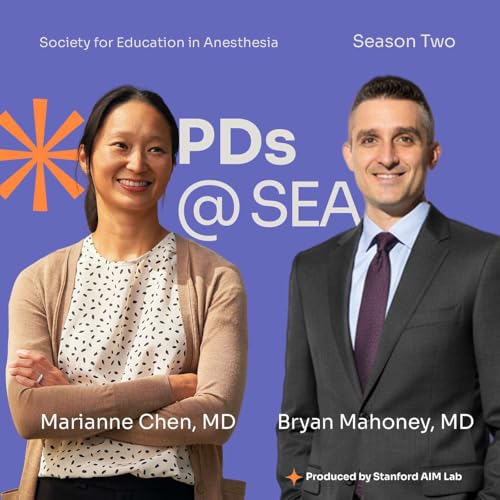
『PDs @ SEA』のカバーアート

PDs @ SEA

PDs @ SEA

著者: Stanford Anesthesia Informatics and Media (AIM)Lab
無料で聴く

このコンテンツについて

PDs @ SEA is a conversation series created for anesthesiology residency leaders, faculty, and trainees who want an honest look into the evolving world of anesthesia education. The show features Residency Program Directors from across the country discussing the decisions, challenges, and real-world considerations behind recruiting, training, and supporting residents.


Hosts Bryan and Marianne draw from their own experiences while inviting colleagues to reflect on practical issues such as changes to the interview and application process, transitions in leadership, and shifting expectations in graduate medical education. Each episode offers candid dialogue, shared lessons, and the sense of community that many program directors look for but often find difficult to access in day-to-day work.


The series includes in-depth conversations with current and former residency leaders, members of the American Society of Anesthesiologists Medical Student Component, and educators who are shaping how residents learn. Together, these discussions provide insight into how program directors think, how residency decisions are made, and how the field continues to adapt to the needs of students, residents, and institutions.


Produced by the Stanford AIM Lab on behalf of the Society for Education in Anesthesiology.


For questions, topic suggestions, or to join the conversation, email: pdsatsea@seahq.org

© 2025 PDs @ SEA
エピソード
  • Everything You Wanted to Know About Being a Program Director
    2025/12/20

    Program directorship is often framed as an administrative role or temporary leadership assignment. Less often is it examined as a structurally vulnerable position, balancing the needs of residents, faculty, institutions, and accreditation requirements.

    In this episode of PDs@SEA, Dr. Marianne Chen and Dr. Bryan Mahoney reflect on the candid “Everything You Wanted to Know” session from the SAPM meeting, surfacing experiences program directors across the country rarely articulate publicly. The conversation opens with a striking finding: only a small minority of program directors anticipate staying in the role beyond six years, prompting discussion about burnout, identity, and the hidden labor of residency leadership.

    The discussion explores how artificial intelligence is entering PD workflows, from letters of recommendation and promotion reviews to early scheduling experiments, alongside a clear-eyed assessment of where automation helps and where human judgment remains essential. Recruitment practices are also examined, including signaling, interview volume, second looks, and the tension between efficiency, equity, and applicant experience.

    These themes are grounded in the daily realities of program leadership: evaluations, duty hours, follow-ups, and persistent administrative load. Practical strategies emerge around organization, delegation, habit formation, and boundary-setting, as well as how perspective shifts with experience.

    The episode closes by asking whether the growing competitiveness of anesthesiology will translate into a sustainable pipeline of future leaders, and what institutions must do to support those entrusted with raising the next generation professionally.

    Key Takeaways From This Episode

    • Program director burnout is largely structural, driven by the role’s position between residents, faculty, institutions, and accreditation requirements.
    • Short PD tenures signal sustainability challenges that cannot be solved through individual resilience alone.
    • AI is beginning to reduce administrative burden for PDs, but only when paired with deliberate human oversight.
    • Recruitment mechanisms such as signaling and second looks improve efficiency while introducing new equity tradeoffs.
    • Administrative overload remains a central stressor and requires systems-level solutions, not incremental fixes.
    • Sustainable PD leadership depends on habits, delegation, and boundaries rather than constant availability.
    • Program directors shape the future of the specialty by “raising residents professionally,” extending their impact beyond individual programs.

    Especially Useful For

    Program directors, associate program directors, residency leadership teams, department chairs, and clinician-educators focused on the sustainability of graduate medical education leadership.

    Related Episodes

    • Why Residency Leadership Is Burning Out (And Why It Still Matters)
      A direct examination of PD burnout, structural pressures, and why sustaining leadership roles requires institutional support rather than individual endurance.
    • Passing the Torch: How a Residency Survives (and Grows) Through Leadership Change
      Explores leadership transitions, continuity, and what departments can do to protect programs during periods of PD turnover.
    続きを読む 一部表示
    40 分
  • A New Co-Host and a New Era in Residency Recruitment
    2025/11/07

    This episode marks a major milestone for PDs @ SEA. We celebrate our tenth episode and welcome our new co-host, Dr. Marianne Chen, Residency Program Director at Stanford. Marianne joins host Dr. Bryan Mahoney to talk about leadership transitions, the realities of running a residency, and how signaling and recent ERAS changes are reshaping recruitment across anesthesiology.

    Together, they compare early data, share how signaling is affecting the depth and fairness of application review, and reflect on the role of team-based recruitment. They also discuss the value and limits of the new applicant essay prompts and how programs interpret gold and silver tier signals differently.

    This conversation offers practical insight for program directors, faculty, clerkship directors, and educators navigating this year’s recruitment season. It also highlights the shared commitment across programs to support trainees and build strong, inclusive learning environments.

    This episode was recorded, produced, edited and published by Larry Chu, MD and the Stanford AIM lab.

    続きを読む 一部表示
    32 分
  • Passing the Torch: How a Residency Survives (and Grows) Through Leadership Change
    2025/11/07

    In this episode of PDs at SEA, Dr. David Stahl reconnects with two former colleagues from The Ohio State University to reflect on what happens when leadership changes hands in a residency program. Dr. Amy Bauman, now the program director at OSU, and Dr. Jared Spear, outgoing chief resident, join the conversation to discuss the practical and emotional dimensions of program director transition from three different vantage points: the departing PD, the incoming PD, and the residents navigating the shift.

    The discussion explores why program directors move on, how successors step into leadership roles they may or may not have felt ready for, and what residents experience when the person who recruited them is no longer the one leading the program. The conversation also addresses the realities of the job itself: the steady presence of daily fires to manage, the challenge of maintaining boundaries and perspective, and the ways in which mentorship, communication, and shared values carry programs through change.

    Despite the inherent uncertainty of leadership turnover, the episode emphasizes continuity of culture, trust, and purpose. It offers reassurance to applicants and residents alike that transitions are common, that strong programs remain strong, and that the work of training physicians continues to be deeply meaningful.

    This episode was originally published September 15, 2025 on YouTube

    続きを読む 一部表示
    24 分
まだレビューはありません