

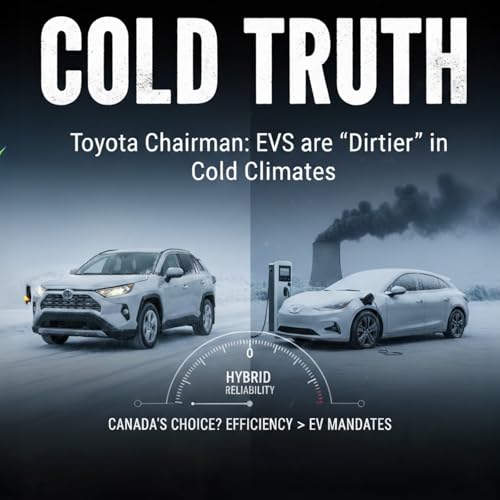
One EV Battery Versus Ninety Hybrids
カートのアイテムが多すぎます
ご購入は五十タイトルがカートに入っている場合のみです。
カートに追加できませんでした。
しばらく経ってから再度お試しください。
ウィッシュリストに追加できませんでした。
しばらく経ってから再度お試しください。
ほしい物リストの削除に失敗しました。
しばらく経ってから再度お試しください。
ポッドキャストのフォローに失敗しました
ポッドキャストのフォロー解除に失敗しました

One EV Battery Versus Ninety Hybrids
-
ナレーター:
-
著者:
概要
- The 1-6-90 Rule: Toyota chairman Akio Toyoda explains that the raw materials required for one long-range EV battery could instead be used to produce six plug-in hybrids (PHEVs) or 90 traditional hybrids [01:53].
- Emission Reduction at Scale: The video argues that replacing 90 gas-powered cars with 90 hybrids is 37 times more effective at reducing overall carbon emissions than replacing a single gas car with one full EV [03:14].
- The "Carbon Debt": Manufacturing large EV batteries is energy-intensive, meaning an EV starts its life with a higher carbon footprint than a gas car. This "debt" must be paid off through driving, which takes much longer if the local power grid is not clean [06:50].
- Geographical Impact:
- "Clean Zones": In places like Quebec or BC, where the grid is hydro-powered, EVs are the greenest choice [06:06].
- "Dirty Zones": In regions relying on natural gas or coal (like the Canadian Prairies), a hybrid may be more environmentally friendly over its lifecycle than an EV [06:29].
- The Physics of Winter: Cold weather reduces EV battery efficiency by up to 50%. While gas engines provide "free" cabin heat as a byproduct of combustion, EVs must drain their batteries to run heaters, making them even "thirstier" for electricity in winter [08:25].
- The Long Game: Toyota is focusing on hybrids while waiting for solid-state battery technology (targeted for 2027-2028), which promises to be lighter, faster-charging, and more resilient in the cold [11:11].
- Environmental Theater: The video concludes by questioning whether rushing into full EVs everywhere is a real solution or "environmental theater," suggesting that "unsexy" solutions like hybrids may actually be more revolutionary due to their scalability [13:22].
まだレビューはありません