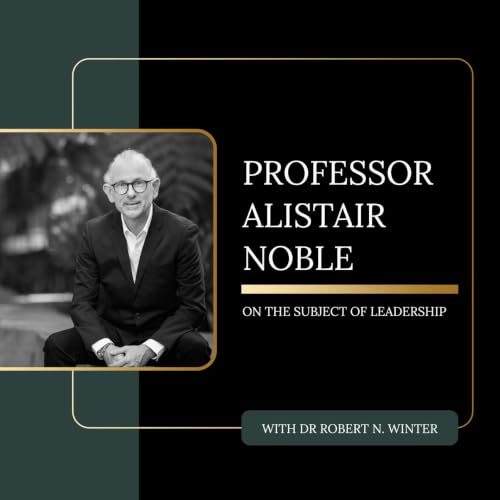
『On the Subject of Leadership』のカバーアート

On the Subject of Leadership

On the Subject of Leadership

著者: Dr Robert N. Winter
無料で聴く

On the Subject of Leadership is a long-form conversation about what makes organisations work—and why much of what passes for leadership advice does not. Each episode features an executive or practitioner whose conclusions have been tested in consequential settings. The work is analytical, not anecdotal: incentives, power, trust, culture, and the limits of authority. Ideas are challenged, not affirmed. This is not motivational theatre. It is a search for what holds up under pressure. If you take leadership seriously and are sceptical of easy answers, this is for you.Copyright 2026 Dr Robert N. Winter マネジメント マネジメント・リーダーシップ 哲学 社会科学 経済学
エピソード
  • William Domanski: The Standard Cannot Interpret Itself
    2026/07/14

    Every serious corporate failure of the past two decades has been examined by people who found the frameworks in good order. The register existed. The audit was passed. The certificate hung in reception. Governance, risk, and compliance was not absent at the moment things went wrong — it was present, and it did not work.

    William Domanski has spent his career at the point where the framework meets the floor, and in this conversation he concedes something his profession rarely says out loud: the standards are susceptible to interpretation. Two practitioners read the same requirement, arrive at contradictory applications, and both hold valid certification. What follows from that admission is an unusually candid hour on what risk work can and cannot do — and on the demographic crisis the discipline has watched approach for forty years without moving.


    Takeaways

    1. A certificate does not attest to a fact about an organisation. It attests to an encounter between an organisation and an auditor who has their own view of what conformance looks like.
    2. The gap between what a board expects to see on paper and what the operational floor is actually experiencing is the whole job. Close it and GRC produces value; leave it and GRC produces paperwork.
    3. Three lines of defence are not enough. There are two further lines — executive management and the board — and they are lines of accountability, not defence. Their job is to contribute to the decision, not to be informed of it.
    4. The red flag in a risk committee is not a difficult question. It is the absence of one.
    5. Large language models are not the chief risk officer. They are what you use before you speak to the chief risk officer. And you never use AI to verify AI.
    6. Silent crises are not ignored because they are small. They are ignored because they are not happening to us yet — which is precisely why healthy ageing populations will be handled as badly as climate change has been.

    Chapters

    [00:00] – Cold open — value produced, value protected, integrity never shortcut

    [01:17] – Introduction — the frameworks were in order, and it still failed

    [04:22] – The cost line that grows faster than revenue

    [06:23] – Value or paperwork — the gap between the board's paper and the operational floor

    [09:54] – Guidance, certification, and the vulnerability of interpretation

    [16:09] – ISO 9001 — auditors, conformity assessment bodies, and concepts passed off as requirements

    [21:15] – Purpose, profit, and whether the value you create ages well

    [27:20] – Silos and the language barrier — why integration actually fails

    [30:02] – Three lines, five lines — making the executive and the board work

    [37:41] – Risk intelligence or reassurance — the committee that asks no questions

    [46:15] – AI, bias, and the human in the loop — never use AI to verify AI

    [56:16] – The silent crisis — ageing populations and forty years of ignored data

    [01:05:50] – Lightning round


    Guest Links & References

    • William Domanski


    About the Show

    On the Subject of Leadership is a long-form interview series on governance, organisational culture, and the realities of decision-making — without slogans or motivational gloss.


    Hosted by Dr Robert N. Winter.


    Subscribe / Follow

    Newsletter / Website: robert.winter.ink

    LinkedIn: dr-robert-winter

    X: @DrRobertWinter

    Instagram: DrRobertWinter

    Mastodon: social.winter.ink/@robert

    YouTube: @OnTheSubjectOfLeadership


    Credits

    Recorded remotely via Riverside

    Music: The Hidden Thread by Roberto Prado / Artlist

    続きを読む 一部表示
    1 時間 16 分
  • Rachel Condos-Fields: Staying the Distance
    2026/07/07

    Most conversations about corporate governance begin with structure—committees, charters, the machinery of oversight. This one ends on the side of a dirt road in Nepal in 1999, and the road turns out to explain the boardroom rather better than the boardroom explains itself.

    In this episode of On the Subject of Leadership, I speak with Rachel Condos-Fields—Independent Non-Executive Director of Stanwell Corporation, Queensland's largest electricity generator, and founder of The WattleNest—about the gap between formal authority and actual influence, and what it costs to close it.


    Rachel has watched governance from every chair in the room: eighteen years at Computershare advising the boards of some of Australia's largest listed companies, a director's seat of her own, and a founder-led venture that runs on an entirely different clock. Her verdict on the boards she watched fail is delivered without ceremony—they confused harmony with effectiveness—and her answer to a question about commitment left me, for the first time on this show, genuinely speechless.

    If you sit on a board and suspect your meetings are more harmonious than they ought to be, or you are building something whose value will not be demonstrable this quarter, this conversation is worth your full attention.


    Takeaways

    1. Formal authority means very little without information, culture, and courage—boards hold enormous power on paper and forfeit it in practice by ratifying decisions rather than interrogating them.
    2. The decisive variable in board effectiveness is not assembled expertise but whether the chair makes the naive question safe to ask.
    3. Organisations fail when process replaces purpose; the failure is invisible from inside the reporting structure and detectable only at the boundary where the organisation meets the people it serves.
    4. The founder and the director run on different clocks—execution and momentum against oversight and deliberate slowness—and holding both roles is a discipline, not a contradiction.
    5. Change does happen, but you can't see it if you're not prepared to stay the distance: the evidence for long commitments exists only in aggregate, across spans longer than most institutional attention.


    Chapters

    [00:00] – Cold open — governance is not passive oversight
    [02:00] – Introduction — the gap between formal authority and actual influence
    [05:27] – Nepal at seventeen — loss, hope, and the making of a leader
    [08:56] – Why institutions fail — when process replaces purpose
    [11:25] – From capital markets to social purpose — profit and purpose as complements
    [18:50] – Boards that interrogate versus boards that ratify
    [26:44] – Founder and director — two operating models, one person
    [29:33] – Inside a government-owned corporation — dual accountabilities
    [33:50] – The WattleNest — bridging talent and opportunity
    [43:15] – Sukra's story — a twenty-seven-year commitment
    [48:15] – Lightning round


    Guest Links & References

    LinkedIn: Rachel-Condos-Fields
    The WattleNest: wattlenest.com.au


    About the Show

    On the Subject of Leadership is a long-form interview series on governance, organisational culture, and the realities of decision-making — without slogans or motivational gloss.


    Hosted by Dr Robert N. Winter.


    Subscribe / Follow

    Newsletter / Website: robert.winter.ink

    LinkedIn: dr-robert-winter

    X: @DrRobertWinter

    Instagram: DrRobertWinter

    Mastodon: social.winter.ink/@robert

    YouTube: @OnTheSubjectOfLeadership


    Credits

    Recorded remotely via Riverside

    Music: The Hidden Thread by Roberto Prado / Artlist

    続きを読む 一部表示
    53 分
  • Ken Sandy: Influence Was Always the Point
    2026/06/09

    Most conversations about artificial intelligence and the product manager begin by asking whether the role survives. This one begins somewhere more useful: by asking what the role was ever actually for. In this episode of On the Subject of Leadership, I speak with Ken Sandy—author of The Influential Product Manager, the lecturer who built the first product management course in the engineering school at UC Berkeley, a longtime executive coach to founders and executives, and an adviser to boards—about what is left of product leadership once the artifacts that used to define it can be produced in seconds.

    Ken's argument is not the reassuring one. The documents, specifications, and roadmaps product managers are most often judged by, he contends, were never the work; they were the residue of the work. The work was always the influence—the grounding in evidence, the advocacy for the customer, the patient assembly of agreement among people who do not report to you. If that is right, the commoditisation of the artifacts is not a threat to the discipline but a solvent applied to it: it dissolves what was never essential and leaves the essential in plain view.


    This is a conversation about leadership at least as much as product. It moves from the counter-intuitive proposition that having no authority is an advantage, through the documents organisations cling to long after anyone reads them, to the questions boards are asking about AI—and the rather better questions Ken believes they should be asking instead.


    Takeaways

    1. Why the absence of formal authority is not a constraint to work around, but the very thing that forces sound product judgement.
    2. Renewal as subtraction: why growth is often a matter of forgetting the right things, not learning new ones.
    3. The artifacts organisations sustain as ceremony, long after the people demanding them have stopped reading them.
    4. The two anti-behaviours of AI-era product work: skipping the thinking, and feeding the beast.
    5. Why boards ask risk-aversion questions when they should be asking opportunity questions—and why a director who has never used the tools can do neither well.
    6. Deterministic versus probabilistic products, and what the distinction demands of governance.
    7. Intent over permission: the leadership move that keeps momentum without burning trust.


    Chapters

    [00:00] Introduction
    [04:41] What influence actually means
    [10:00] Why having no authority is an advantage
    [17:29] One skill in, one skill out: the forced choice
    [24:42] The artifacts we cling to
    [33:07] Two anti-behaviours: skipping the thinking, feeding the beast
    [40:58] Curiosity over age, and the fear of the tools
    [45:33] The board's wrong questions: risk versus opportunity
    [54:19] Deterministic versus probabilistic, and what directors must understand
    [01:02:51] The chapter to read first, and the one to revise
    [01:09:27] Lightning round and close


    Guest Links & References

    • Ken Sandy
    • Influential Product Manager
    • Referenced in this episode: L. David Marquet, Turn the Ship Around! (2013)


    About the Show

    On the Subject of Leadership is a long-form interview series on governance, organisational culture, and the realities of decision-making — without slogans or motivational gloss.


    Hosted by Dr Robert N. Winter.


    Subscribe / Follow

    Newsletter / Website: robert.winter.ink

    LinkedIn: dr-robert-winter

    X: @DrRobertWinter

    Instagram: DrRobertWinter

    Mastodon: social.winter.ink/@robert

    YouTube: @OnTheSubjectOfLeadership


    Credits

    Recorded remotely via Riverside

    Music: The Hidden Thread by Roberto Prado / Artlist

    続きを読む 一部表示
    1 時間 20 分
adbl_web_anon_alc_button_suppression_t1
まだレビューはありません