

NEUROPSYCHIATRY AFTER DARK: Service development as 'social sculpture'?
カートのアイテムが多すぎます
カートに追加できませんでした。
ウィッシュリストに追加できませんでした。
ほしい物リストの削除に失敗しました。
ポッドキャストのフォローに失敗しました
ポッドキャストのフォロー解除に失敗しました

NEUROPSYCHIATRY AFTER DARK: Service development as 'social sculpture'?
-
ナレーター:
-
著者:
このコンテンツについて
Joseph Beuys was a radical post-war German artist who worked in unusual media and in the 1970s developed the notion of ‘social sculpture’ based on the concept that everything is art and every aspect of life could be approached creatively. For episode 17 this season Hugh Rickards, a younger neuropsychiatric colleague from the English Midlands, read and discussed his essay 'The lost tribes of neuropsychiatry'. At the end of that Hugh asked if he could ask me about my experience of creating a neuropsychiatry service in the ‘80s and ‘early ‘90s, with the help of a lot of colleagues, in a National Health Service that didn’t know it needed one. When I left clinical practice I took a deep dive into contemporary art, discovered Joseph Beuys and realised that creative clinical work can also be viewed as a kind of art practice, a social sculpture'. We'd recorded that conversation and it is definitiely niche but, hey, this is Brainland...welcome to ‘neuropsychiatry after dark...'
Participants:
Hugh Rickards, Consultant and Honorary Professor of Neuropsychiatry, National Centre for Mental Health, Birmingham, UK. http//:www.birmingham.ac.uk/staff/profiles/clinical-sciences/Rickards-Hugh.aspx
Ken Barrett, visual artist, writer and retired neuropsychiatrist: http://www.kenbarrettstudio.co.uk
More about Joseph Beuys and 'social sculpture': https://www.tate.org.uk/art/art-terms/s/social-sculpture
Opening and closing music: Prelude to the opera Brainland, composed by Stephen Brown.
Brainland the opera website: www.brainlandtheopera.co.uk
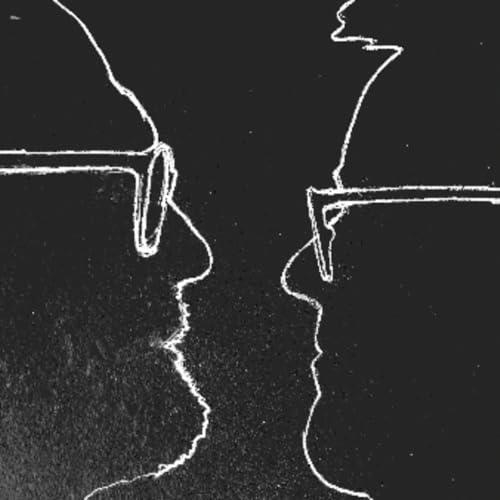
Sketch by KB.
Hosted on Acast. See acast.com/privacy for more information.