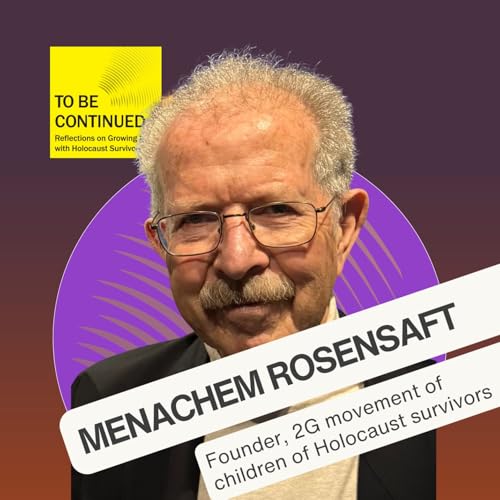
『Menachem Rosensaft: Living With Ghosts』のカバーアート

Menachem Rosensaft: Living With Ghosts

Menachem Rosensaft: Living With Ghosts

無料で聴く

ポッドキャストの詳細を見る

今ならプレミアムプランが3カ月 月額99円

2026年5月12日まで。4か月目以降は月額1,500円で自動更新します。

概要

Menachem Rosensaft is an attorney, law professor, poet, and one of the most influential voices of the second generation. Born in the Bergen-Belsen displaced persons camp to parents who survived Auschwitz and Bergen-Belsen, he has spent his life engaging questions of memory, justice, and moral responsibility. In this episode of To Be Continued… Reflections on Growing Up with Holocaust Survivors, Rabbi Jeff Salkin speaks with Rosensaft about what survives survival itself: exploring inherited trauma, the “ghosts” carried by children of survivors, and the obligation to remember in ways that demand action. Speaker Bio: Menachem Z. Rosensaft is an attorney, general counsel emeritus of the World Jewish Congress (WJC) and a lecturer in law at Columbia Law School. He is also adjunct professor of law at Cornell Law School. Menachem is also a poet, and one of the most prominent voices of the second generation. He was a founder and first chairman of the International Network of Children of Jewish Holocaust Survivors a past president of Park Avenue Synagogue in New York City. Menachem has published several books of poetry, including Poems Born in Bergen-Belsen (2021) and Burning Psalms: Confronting Adonai after Auschwitz (2025). TRANSCRIPT: This episode is sponsored by Barbara Kaufman Simon, in loving memory of her parents, Blanche, (also known as Blima), and Max, (who was also known as Moniek) Kaufman, who were both born in Poland. Blanche survived numerous labor and concentration camps, and Max survived Auschwitz, the death march, and Mauthausen/Ebensee. May their memories be for a blessing. Today's episode is about what survives survival. Many children and grandchildren, Holocaust survivors, grew up with what our guest calls ghosts, not as metaphors, but as real presences, or as the author Thane Rosenbaum puts it, they grew up with secondhand smoke. The ghosts live in questions that were never answered. They live in names that are spoken carefully or not at all, in absences that somehow take up space. Welcome to our podcast, To Be Continued, Reflections on Growing Up with Holocaust Survivors, where we explore the intersections of memory, identity, and resilience. Our goal is to lift up the experiences of children and grandchildren of Holocaust survivors and to ask, how did those memories form you? How did resilience create you, the person you are today, and what is the legacy that you will leave to those who come after you? I'm your host, Rabbi Jeff Salkin. Our guest today is a man who has been described by the New York Times as one of the most influential sons and daughters of survivors. Today we're speaking with Menachem Rosensaft, an attorney, a professor of law, a poet, and one of the most prominent voices of the second generation. He was a founder and first chairman of the International Network of Children of Jewish Holocaust Survivors. He is general counsel emeritus of the World Jewish Congress, and he has one of the most coveted positions in the Jewish world. He's the past president of a synagogue, the past president of Park Avenue Synagogue in New York City, but the titles, the rest of them, they really don't matter because they don't capture the work he's done or the ground that he stands on. Menachem was born in the displaced persons camp at Bergen-Belsen in Germany. His parents survived Auschwitz and Bergen-Delsen. His grandparents and his five-and-a-half-year-old brother Benjamin were killed in the gas chamber at Auschwitz-Birkenau. I am a fan of his writing. He is a wonderful poet. There are several books of poetry. There is the most recent book, Burning Psalms, Confronting Adonai after Auschwitz, and in his poetry, Menachem confronts not only memory and inheritance, but the tender topics of God, faith, anger, and moral responsibility after Auschwitz. He asks what it means to pray when consolation feels impossible and what it means to remember if remembrance does not lead us to act. And so, this conversation is about trauma, resilience, rage, moral clarity, and the refusal to look away. Menachem, welcome. It's great to have you. Jeff, rabbi, thank you very much. Thank you very much for having me and thank you for this most gracious introduction. Well, we've already said and we know that you were born in the DP camp at Bergen-Belsen a few years after the war ended. But I'd like our listeners to know a little bit more about you, so let's just rewind. Let's go back a few steps. And can you give us some more background on your father's remarkable story of survival and what he did in Germany after the war and who your mother was as a doctor worked for in Auschwitz, and finally how they met exactly 80 years ago in 1946. Well, they actually met 80 and a half years ago in 1945, a couple of weeks after the liberation of Bergen-Belsen. Going back a bit…my mother was a dental surgeon. She had studied medicine in France and at Nancy, before the war, and she arrived at Auschwitz-Birkenau...
まだレビューはありません