エピソード

  • Cancel Culture and Personal Brands In PR Crisis with Molly McPherson
    2023/09/12
    In today's episode I am joined by the indestructible Molly McPherson, who you may know as the TikTok "PR Lady," as her followers have affectionally dubbed her.

    I just know her as my first stop when a brand or celebrity is in the news for reasons they'd rather not be. Molly is hilarious, warm, and witty and I'm absolutely thrilled and delighted that she's on the show today, talking about the #1 biggest mistake that brands make before, during, and after a public relations crisis and even dishing with me on my favorite topic — the online business family tree and the curious case of the SEO-optimized friendship (featuring personal brand celebs Rachel Hollis, Jenna Kutcher, and Amy Porterfield).

    But, more than anything, I appreciate how Molly always brings us back to our humanity and helps us see that public relations is just a fancy way of talking about human communication.

    On today's episode about cancel culture and personal brands in crisis, we discuss:
    • Molly's next gig as the star of "PR CSI" and how punctuation can catch a culprit
    • The biggest mistake brands make during a social media crisis
    • The real reason Bud Light still hasn't recovered from backlash
    • How to make a crisis go "poof!" and the 3 tenets of Molly's Indestructible PR framework
    • Why Rachel Hollis' brand still hasn't bounced back, 2.5 years after Toilet Gate
    • Molly's beef with Amy Porterfield and the online business family tree
    • Why Colleen Ballinger (or was it Miranda Sings?) mistakenly believed her ukulele would win the day
    • What do Molly's four Gen Z kids think about Mom being a TikTok sensation?
    • The difference between social media vigilantes, bullies, and investigative reporters
    • The problem with Reddit snark and parasocial relationships
    • The other side of the cancel culture coin and the pot of gold at the end of the snark rainbow
    About Molly McPherson

    Molly reports on crisis communications and breaking news stories with a perfect blend of snark and heart. She has over two decades of experience in public relations, emergency management, and media. As a crisis pro, Molly previously worked at FEMA and as the Director of Communications for the Cruise Line International Association, where she managed media responses during major crises. Today, Molly is a crisis communications consultant, keynote speaker, and TikTok sensation. She hosts the Indestructible PR podcast and recently won the 2023 Adweek Creative Visionary Award for Careers Creator of the Year.

    Read the episode transcript, watch the YouTube video, and get the show notes on the Marketing Muckraking website here.

    続きを読む 一部表示
    1 時間 5 分
  • Fix It From Within? Or Burn It All Down? Where Do We Go From Here? The Online Business Family Tree - Part 4
    2023/08/14
    Welcome to Part 4, the final installment of the Online Business Family Tree series, where we traced back how we arrived at this moment in internet marketing and online business and who are the key leaders who brought us here.

    We also highlighted the 10 elements of the rotten tree. To review:

    1. Prosperity gospel and the "pull yourself up by your bootstraps" myth of meritocracy
    2. Mastermind relationships and being "in the room" where it happens with powerful leaders
    3. JV partnerships
    4. Affiliate marketing
    5. Tabloid / clickbait / pain point / shame-based marketing
    6. Gaming the system
    7. Propaganda, mind control, and hypnosis
    8. Cross-pollinating audiences
    9. Personal branding and "If I did it, you can, too"
    10. And finally, the idea that you don't have to cite your sources, fuck your sources. So that the web becomes so tangled, no one knows where any of this came from.

    But now, hopefully, you do know.

    And our hope is that this series has helped you become a more informed consumer, a more ethical marketer, and that you feel seen and less alone in this jungle of the Online Business Industrial Complex.

    To understand marketing history is to understand ourselves and our culture — marketing is the fuel for the engine of capitalism.

    But now that we've taken this trip through time, it's time to talk about what to do next and how do we build a better future…

    About Lisa Robbin Young

    Lisa Robbin Young has 30 years of business experience as a coach and creative entrepreneur: she is an award-winning speaker, best-selling author, and accomplished musician with multiple albums to her credit. You may even recognize her from the Disney+ show "Encore." She is also the host of the "Creative Freedom" show — I highly recommend her music video parodies. Check out "There are worse things I could do" for a Marie Forleo crossover with Awkward Marketing. She specializes in helping creative entrepreneurs build a business that works for how you're wired to work.

    For the transcript and annotated guide to the online business family members we discuss in Part 4, check out MarketingMuckraking.com and the show notes here.
    続きを読む 一部表示
    29 分
  • ClickFunnels to Hell, Fake It 'Til You Make It, and Moneyball: The Online Business Family Tree - Part 3
    2023/08/14
    Welcome to Part 3 of this four-part series on The Online Business Family Tree, where we trace back how we arrived at this moment in internet marketing and online business and who are the key leaders who brought us here.

    In this installment, we're time traveling from WWI and WWII all the way to today, where clickbait, ClickFunnels to hell, and faking it 'til you make it have spread across the branches of this rotten business tree, poisoning the fruits that fall to everyone clamoring for their taste of success.

    Remember, this stuff didn't start on the Internet — it goes back hundreds of years. To understand marketing history is to understand ourselves and our culture — marketing is the fuel for the engine of capitalism. Let's take a trip through time, so you can be a more informed consumer and, hopefully, a more ethical marketer.

    What you can expect in Part 3 of the Online Business Family Tree:
    • What ex-employees are saying about Brooke Castillo and The Life Coach School
    • How a bro marketer gamed the system to launch a chart-topping country music album (by tricking people into buying it)
    • The true story of the country's first famous "snake oil salesman" and how he culturally appropriated his way across the country
    • Why we can thank Frank Kern for the CAN-SPAM act and how he still brags about building his business illegally
    • That Tony Robbins scene in "Shallow Hal" and how he hypnotized his way to the top
    • The appalling truth of ClickFunnels and why Russell Brunson thinks Adolf Hilter is a business leader — while the industry co-signs this concept
    • What Nazi leaders learned about marketing from American propaganda
    • How Christian nationalist preachers built the advertising industry
    • What Jenna Kutcher, Amy Porterfield, and Mel Robbins really did on their Napa Valley mastermind and how they leverage parasocial bonds to sell to your sense of loneliness
    • Who monetized her friend's death to boost her clickthrough rate
    • Why no one can be Gary V, even Gary V, and the problem with corporations masquerading as people
    • How "more good millionaires" isn't the answer to systemic problems
    About Lisa Robbin Young

    Lisa Robbin Young has 30 years of business experience as a coach and creative entrepreneur: she is an award-winning speaker, best-selling author, and accomplished musician with multiple albums to her credit. You may even recognize her from the Disney+ show "Encore." She is also the host of the "Creative Freedom" show — I highly recommend her music video parodies. Check out "There are worse things I could do" for a Marie Forleo crossover with Awkward Marketing. She specializes in helping creative entrepreneurs build a business that works for how you're wired to work.

    An annotated guide to the episode can be found at MarketingMuckraking.com in the show notes here.
    続きを読む 一部表示
    1 時間 5 分
  • 6 Figure Masterminds, Marie Forleo, and The Syndicate: The Online Business Family Tree - Part 2
    2023/08/03
    Welcome to Part 2 of this four-part series on The Online Business Family Tree, where we trace back how we arrived at this moment in internet marketing and online business and who are the key leaders who brought us here.

    In this installment, we're diving into six figure masterminds, Marie Forleo's B-School, the Cult of the Syndicate, and how early Internet marketers like Mark Joyner, Dan Kennedy, Yanik Silver, and Russell Brunson brought mind control and manipulation online.

    If you don't know — or care — about these names, never fear. We focus on what tactics these leaders popularized and how they've invaded nearly every celebrity online business course, including Matthew McConaughey's.

    Remember, this stuff didn't start on the Internet — it goes back hundreds of years. To understand marketing history is to understand ourselves and our culture — marketing is the fuel for the engine of capitalism. Let's take a trip through time, so you can be a more informed consumer and, hopefully, a more ethical marketer.

    What you can expect in Part 2 of the Online Business Family Tree:
    • How 6 figure masterminds became a thing (someone please tell me why anyone would pay Amanda Frances $100K to "sit in her energy"?!)
    • The rise of joint venture partnerships and affiliate marketing
    • Why Marie Forleo's B-School is the bee in my bonnet
    • The concerning trend of "business" coaches who are really just teaching the marketing of the self and personal branding through proximity to power
    • How celebrity personal brands manipulate refund rates and quash negative reviews through stick strategies and boilerplate non-disparagement clauses
    • The boy bosses responsible for bringing junk mail into your inbox
    • Where clickbait came from (spoiler alert: Bat Boy!)
    • Why easy "ethical marketing" swaps are just more of the same
    • The nuance of shame-based or pain point marketing (and my unpopular opinion on speaking to pain — it might surprise you!)
    About Lisa Robbin Young

    Lisa Robbin Young has 30 years of business experience as a coach and creative entrepreneur: she is an award-winning speaker, best-selling author, and accomplished musician with multiple albums to her credit. You may even recognize her from the Disney+ show "Encore." She is also the host of the "Creative Freedom" show — I highly recommend her music video parodies. Check out "There are worse things I could do" for a Marie Forleo crossover with Awkward Marketing. She specializes in helping creative entrepreneurs build a business that works for how you're wired to work.

    See MarketingMuckraking.com for the full transcript and visual guide.

    続きを読む 一部表示
    1 時間 12 分
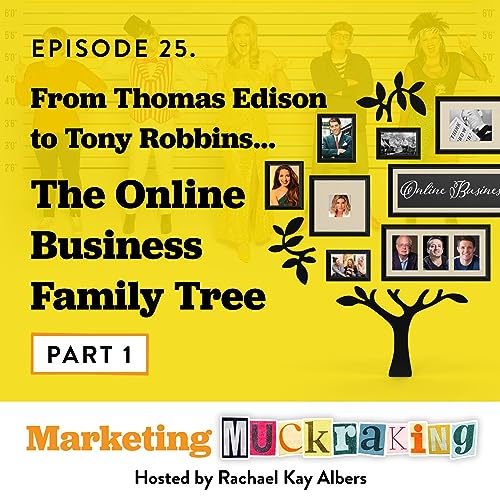
  • Thomas Edison to Tony Robbins: The Online Business Family Tree - Part 1
    2023/08/03
    If you've ever wondered how the Online Business Industrial Complex was built, this is the 4-part series for you.

    I'm joined by Lisa Robbin Young as we trace back how we arrived at this moment in internet marketing and online business, and who are the key leaders who brought us here, starting with Ben Franklin, Henry Ford, and Thomas Edison, all the way to Tony Robbins, Marie Forleo, Jenna Kutcher, Russell Brunson, Brooke Castillo, and Matthew McConaughey? Yeah, he's a life coach now.

    If you don't know — or care — about these names, never fear. Lisa and I focus on what tactics these leaders popularized and how they've invaded nearly every corner of online business.

    This series is foundational in understanding the evolution, not only of online business and marketing, but American culture and many of the advertising principles we have come to take for granted as "how it's done."

    But, as we say on the show, this stuff didn't start on the Internet — it goes back hundreds of years. To understand marketing history is to understand ourselves and our culture — marketing is the fuel for the engine of capitalism. Let's take a trip through time, so you can be a more informed consumer and, hopefully, a more ethical marketer.

    What you can expect from Part 1 of the Online Business Family Tree:
    • Why we're "naming names" and the difference between solopreneurs and corporate entities in girlboss clothing
    • How the "American dream" became a sales pitch for individualism at the cost of systemic change
    • What muskrats taught Henry Ford and Thomas Edison about making millions
    • The surprising secret of how to "think and grow rich"
    • Behind the scenes of coaching coaches to coach coaches
    • How the Industrial Revolution turned into toxic wellness culture
    • Why hating yourself is good for business (online business, that is)
    About Lisa Robbin Young

    Lisa Robbin Young has 30 years of business experience as a coach and creative entrepreneur: she is an award-winning speaker, best-selling author, and accomplished musician with multiple albums to her credit. You may even recognize her from the Disney+ show "Encore." She is also the host of the "Creative Freedom" show — I highly recommend her music video parodies. Check out "There are worse things I could do" for a Marie Forleo crossover with Awkward Marketing. She specializes in helping creative entrepreneurs build a business that works for how you're wired to work.

    See MarketingMuckraking.com for the complete transcript and annotated visual guide.

    続きを読む 一部表示
    52 分
  • Should Brands Be "Political"?
    2023/07/04

    In this installment of Marketing Muckraking, we explore the question...should brands be "political"? And what does it mean to be "political" in the context of global capitalism? Are we turning to corporations because we've lost our faith in government?

    What do we do, as brand consumers and business owners, with the answers to these questions? How do we build a better world?

    In June, the world's most powerful advertisers gathered at Cannes Lions, where this year's biggest themes included AI, ad tech, influencer marketing, and most notably — "dialing down the politics," which was the directive to jurors voting on the advertising industry's top awards.

    While the Cannes leadership never made a statement on the issue, it's hard not to see these jury instructions as a direct response to recent right-wing fueled culture wars, specifically as it relates to "woke" M&M's spokescandies, Bud Light's short-lived influencer deal with Dylan Mulvaney, and the backlash in response to Target's 2023 Pride line.

    But even without making a statement, the message from Cannes Lions leadership was loud and clear: "Shut up and sell." And they really brought that home when they awarded their "Marketer of the Year" award to — Anheuser Busch's Chief Marketing Officer.

    Yes, that's right, after exploiting Dylan Mulvaney to gain market share, then dropping her into a sea of death threats and right wing violence when their sales suffered, Anheuser Busch won the top marketing award in the world for the second year, making history as the only brand to ever win this award twice in a row. Dylan Mulvaney confirmed in late June that Bud Light never reached out to her after the backlash, which further confirms their stance towards the LGBTQIA+ community: "We won't stand with you, but we will sell to you."

    Award-winning marketing here, folks. In the wake of what some call "woke washing," also known as "rainbow capitalism", "pink washing", or "green washing" — all terms synonymous with corporations positioning themselves as friendly to progressives, social and environmental causes, and historically excluded groups to gain market share — the growing efforts by right wing extremists to make examples of brands with messages they don't like, have opened up conversations around whether brands should "stay out of politics" and stick to selling.

    This is my bat signal. We need a muckraker on the scene because if we leave it up to advertising apologists, well — they're gonna keep giving awards to hypocrites who care more about profits than people or the planet. And if we leave it up to whichever talking head is auditioning to replace Tucker Carlson, they're gonna keep inciting hate to promote their Make America Gilead Again agenda.

    So, the question we're muckraking about today is: "Should brands be political?" But before we can answer this (or not answer this, because you know my style) we gotta clarify — what does it mean for brands to be "political"? How do we define politics in this context? Let's go...

    続きを読む 一部表示
    31 分
  • 19 Brands & Counting: Review of Shiny Happy People - Duggar Family Secrets
    2023/06/08

    Content warning: this episode touches on sensitive topics that include sexual assault, child abuse, and religious trauma.

    Shiny Happy People: Duggar Family Secrets released on Amazon Prime on June 2.

    In this episode, I review the docuseries through the lens of marketing muckraking, looking at how the Duggars and the IBLP used modern marketing, branding, and PR to re-write history as it was happening, in a bid to arrest political control of the country.

    続きを読む 一部表示
    31 分
  • The Age of Personal Unbranding
    2023/06/08

    Welcome to Season 2 of Marketing Muckraking!

    I started Season 1 with The Age of the Personal Brand — and because I love a good callback, I'm continuing this conversation as we kick off Season 2.

    In my very first episode I traced back the origins of the term "personal brand" to Tom Peters and his 1997 Fast Company article "The Brand Called You," when Peters told readers to "take a lesson from the big brands…establish your own micro equivalent of the Nike swoosh.

    Peters positioned personal branding as freedom from corporate rule:

    "You're not an "employee" of General Motors, you're not a "staffer" at General Mills, you're not a "worker" at General Electric or a "human resource" at General Dynamics (ooops, it's gone!). Forget the Generals! You don't "belong to" any company for life, and your chief affiliation isn't to any particular "function." You're not defined by your job title and you're not confined by your job description. Starting today you are a brand."

    Don't listen to him.

    You are not a brand.

    Because, a brand, by its very definition doesn't belong to itself. And you do.

    As I explored in Episode 19: "The Not-So-Subtle Art of Caring What Other People Think," a brand lives in its audience's mind.

    A brand is a memory. And yes I'm going to quote myself here:

    "Your brand is what people remember about you, based on a complicated mess of factors — what they've experienced, felt, heard, read, and seen — that ultimately becomes a paint splattered memory that people like me neatly fold up into a five letter word."

    The best brands are consistent in ways that humans are not built to be.

    Brands only change when the market demands it.

    Brands answer to sales — not themselves — because a brand doesn't have a self.

    The promise of personal branding is that you can "get paid to be yourself" but the capitalist disclaimer buried in the fine print — results not typical — hinges on whether the "self" you're selling is what people want.

    So much of what is taught about personal branding revolves around scaling the self, streamlining the self, sculpting the self around an audience.

    Replacing "to be" with "to buy."

    The "get paid to be yourself" promise only comes true if you are ready and willing to surrender yourself to the version of you that the market will bear. And then package up that commodified you into a neat little box and get to work cranking out more, more, more in an assembly line of ideas to stock the shelves of the Creator Economy.

    Let's pause there — because just as "personal branding" promises freedom, when it's really selling you a box you'll never fully fit inside...

    The term "Creator Economy" suggests an economy that belongs to creatives, when it's really asking you to create for free, get paid in attention, and thank the platforms that profit off your labor for the opportunity to "do what you love."

    To be a "content creator" is to accept an unpaid internship in "The Attention Economy" (a more accurate title than "Creator Economy") with the hope that it'll turn into dollar bills somewhere down the line.

    But the folks making the most money aren't the creators — but the tycoons at the top of the pyramid re-selling the attention that creators capture for them...

    続きを読む 一部表示
    10 分