『Making Change with your Money』のカバーアート

Making Change with your Money

Making Change with your Money

著者: Laura Rotter CFA CFP® | Financial Advisor for Women in Midlife Transitions
無料で聴く

Making Change with Your Money is the go-to podcast for women in midlife experiencing major life transitions and ready to transform their relationship with money.

Hosted by Laura Rotter, CFA, CFP®—a financial advisor and Founder of True Abundance Advisors—this podcast features intimate conversations with women who have successfully navigated career changes, divorce and financial independence, retirement planning, entrepreneurship, and complete life reinvention.

Every episode explores both the practical side of financial planning for women and the deeper inner work around money mindset, worthiness, and values-based living. From healing financial trauma to building sustainable businesses, from leaving corporate careers to investing with confidence, these stories provide both inspiration and actionable financial guidance.

Whether you're contemplating a career pivot, managing an inheritance, recovering from divorce, or simply feeling that there must be more to life than the relentless pursuit of more—this podcast will help you use your resources (money, time, energy, and talent) to create a life of meaning and purpose.

Laura brings her Wall Street experience, mindfulness practice, and financial life planning expertise to help listeners understand that true abundance isn't about the numbers in your account—it's about the freedom to live authentically.

Perfect for: Women over 40, midlife career changers, recent divorcées, pre-retirees, women entrepreneurs, and anyone questioning whether they're worthy of pursuing their heart's desires.

Topics include: Financial planning, money mindset, career transitions, retirement alternatives, divorce and money, women's financial empowerment, entrepreneurship, investing, financial therapy, values-based financial planning, and life reinvention.

2025 Laura Rotter, CFA, CFP® | Financial Advisor for Women in Midlife Transitions
スピリチュアリティ 経済学
エピソード
  • I Was Born Into Millions in Medical Debt
    2026/05/31

    Imagine growing up watching your mother choose between paying the electric bill or buying groceries. Imagine filing bankruptcy, losing your house, living in cars.

    At some point, you've probably asked: How do I break free from the money patterns I inherited? How do I build wealth when I'm starting from nothing?

    Maybe you've tried to outrun your financial past. You've worked hard, done everything "right." But financial trauma doesn't disappear because you get a paycheck. And for women especially, we're more likely to live in poverty in retirement, take career breaks that cost us earning potential, and prioritize everyone else's financial security before our own.

    Emily was born months after her sister passed away, into a household drowning in medical debt, depression, and hopelessness. By eleven, her father had abandoned the family. Her mother, unable to separate emotions from financial decisions, gave up hope.

    But Emily chose differently. She graduated high school three years early, started working, and at nineteen launched her first business as a virtual assistant to C-suite executives and family offices.

    That gateway changed everything. She learned how capital moves by working with the people who controlled it. She helped create one of the first blockchain ETFs. Today, she runs Numinous Capital—a venture capital firm investing in biotech and deep tech companies building between the coasts.

    Here's what Emily learned that her mother never could: sometimes debt feels more secure and comfortable than not having it. "Debt acts almost like a father that's not there," she told me. "It's on your back constantly. And it may feel secure and safe."

    This is the paradox of financial trauma. The very thing destroying you can feel like the only stable relationship you have. It's familiar. It's known. And letting it go can feel more terrifying than keeping it.

    Emily witnessed this in her mother, who stayed trapped in the cycle until she passed away. But Emily chose differently. She learned to recognize the pattern without repeating it.

    Now, financial security means something entirely different: nervous system regulation. "It's this sense of calm and peace that we all owe ourselves," she says. Not about buying more things. Not about keeping up with anyone. Just knowing her money's growing, knowing she has a fallback plan, knowing she's creating opportunity for future generations.

    Emily's closing message for anyone navigating financial hardship or transition: "You have it all already. Everything that you need you already have. Don't be afraid to take risks. Don't be afraid to take chances on yourselves."

    And here's the mindset shift she practices: when you hit a snag and start losing hope, try something different. Just once, say "Maybe this is a good thing. Let me make this into a good thing."

    That's how you bend reality. Not by denying your circumstances, but by reframing how you deal with them. Not by pretending your past doesn't matter, but by refusing to let it determine your future.

    Guest: Emily is the founder of Numinous Capital, a venture capital firm investing in biotech, deep tech, and capital-intensive companies building between the coasts. She started her first business at nineteen and has spent her career learning how capital moves through markets—from family offices to hedge funds to venture capital.

    Resources:

    • Numinous Capital
    • LinkedIn
    続きを読む 一部表示
    46 分
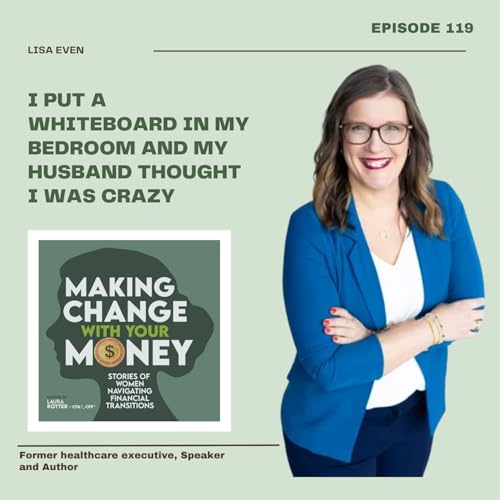
  • I Put a Whiteboard in My Bedroom and My Husband Thought I Was Crazy
    2026/05/16

    Imagine you're sitting on the couch one evening, looking at your spouse, and suddenly the words just come out: "I'm exhausted. All we do is chase our responsibilities."

    At some point or another, you've probably heard yourself asking: When did life become this never-ending list of tasks? When did I start scheduling heartworm medicine for the dog on my calendar but not anything that actually brings me joy? When did I forget that life is supposed to feel good sometimes?

    Maybe you've tried to fix this. You've told yourself you'll relax after the next project wraps up. You've promised yourself a vacation once the kids are older, once you get that promotion, once you have more money saved. But here's what actually happens: the promotion comes, the project ends, and somehow you're just as busy, just as burned out, just as far from joy as you ever were.

    Because waiting for joy to find you doesn't work. The "afters" never come. And in the meantime, you're spending 90,000 hours of your life—40 years—in the workforce, showing up busy, stressed, and depleted.

    This was exactly where Lisa found herself. She grew up with a father who taught her that hard work was the badge of honor in their family. She learned early that if you don't have enough money, you work more. And she took that lesson into her corporate career as a healthcare executive, outworking everyone around her, believing that exhaustion was the price of success.

    Until the night she looked at her husband and said, "I want to put something else on our calendar. Something fun. I want to chase joy like it's my job."

    He looked at her confused and said, "Okay, what do you want to do?"

    And she realized: she had no idea.

    So she went to Home Depot, bought a giant whiteboard, brought it home, and asked her husband to hang it in their bedroom. He said, "Lisa, people don't put whiteboards in bedrooms." And she said, "We do."

    That whiteboard became the place where she and her family started building a joy list—things they used to do, wanted to do, could do. And she learned that if you wait for joy to come after everything else is done, you'll be waiting forever.

    If you've ever found yourself showing up to work, to your family, to your life as "busy"—if you've ever felt like you're going through the motions just to keep the wheels turning—this conversation is for you.

    This is a conversation about giving yourself permission to schedule joy with the same seriousness you schedule everything else. Because here's the truth Lisa discovered: joy doesn't happen to you. You happen to it.

    Guest: Lisa is a former healthcare executive turned author and speaker who teaches corporate leaders how to create impact while actually enjoying their lives. Her book "Joy Is My Job" introduces practical frameworks for building joy into busy lives.

    Resources:

    • Joy Is My Job
    • Facebook
    • LinkedIn
    • Instagram
    • Website
    続きを読む 一部表示
    44 分
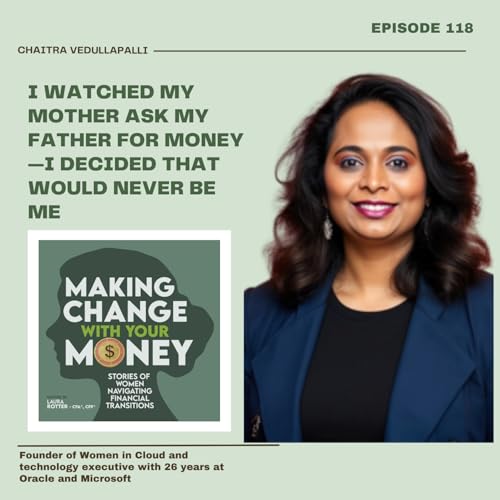
  • I Watched My Mother Ask My Father for Money—I Decided That Would Never Be Me
    2026/05/02

    Growing up in India, Chaitra Vedullapalli watched her mother and grandmother ask men for money. Not because there wasn't enough, but because that's just how it worked. She hated it. At eight years old, she became an entrepreneur selling handkerchiefs at her mother's social gatherings. The moment cash landed in her hand and she could buy what she wanted without permission? Magical. That moment sparked a lifelong commitment to agency over money.

    Chaitra spent 26 years in tech at Oracle and Microsoft, working on billion-dollar strategies. She was one of the youngest executives to reach the Oval Office, discussing multi-billion dollar contracts. But what came next defines her: founding Women in Cloud to help women entrepreneurs scale, leading capital campaigns to build community centers, investing in Hollywood films, and now building a $100 million fund.

    The breakthrough? Her family's "invest formula"—a framework she and her husband developed on day one of marriage to evaluate every financial decision. Six questions: Does it generate income? Expand network? Appreciate over time? What's the exit? How protected? Tax advantages? They score every investment against these criteria, creating a common language that eliminates money fights.

    But the real revelation came from Tim Ferriss's "The 4-Hour Work Week" and million-dollar mindset planning. Chaitra wrote down everything that would make her feel like a millionaire: business class travel, monthly nice dinners with her kids, experiential trips with friends, investing $50,000 quarterly in causes that matter. Then she calculated the cost. Her jaw dropped—less than $200,000. She realized if they had that base covered, everything else could flow toward impact. No stress. No zeros-chasing. Just memories and democratizing access.

    Chaitra's grandmother taught her: "If you want to change the world, give the first check to that community." It's not about permission. It's about agency. Whether you're navigating financial conversations with a partner, building a business, or using money for impact, Chaitra shows that money is energy meant to flow—toward fun, your future, and the change you want to see.

    Guest: Chaitra Vedullapalli, founder of Women in Cloud and technology executive with 26 years at Oracle and Microsoft

    Resources:

    • Women in Cloud
    • Website: Chaitra Vedullapalli
    • LinkedIn
    続きを読む 一部表示
    44 分
adbl_web_anon_alc_button_suppression_c
まだレビューはありません