エピソード

  • NASA's playbook: what happens in the first 72 hours
    2026/05/21
    Humanity’s closest thing to a first-contact plan is a few-page, non-binding SETI Post-Detection Protocol: verify the signal, tell the IAA/IAU and the UN Secretary-General, and don’t reply without “international consultation.” Problem: it’s basically a gentlemen’s agreement (Jill Tarter’s words), UNOOSA has no first-contact mandate, there’s no timeline, and nobody’s actually named as having authority to speak for Earth. Meanwhile the protocol mostly covers radio signals — not weird physical stuff like Oumuamua, which was spotted after it passed the Sun and sparked peer-reviewed debate (including Avi Loeb arguing an artificial origin couldn’t be ruled out). In 2026 terms, a private lab, company, or even a grad student could find something first and go public or transmit a message with zero legal barrier.
    続きを読む 一部表示
    12 分
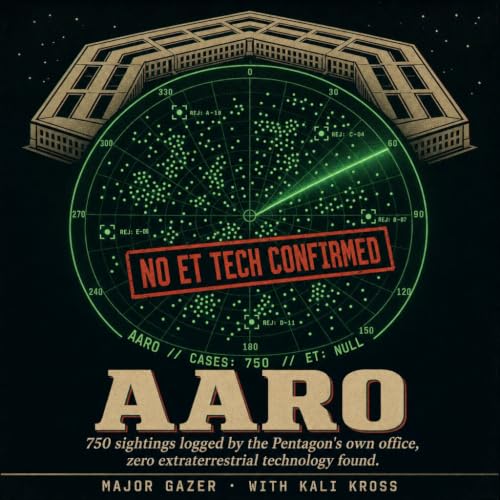
  • AARO reviewed 750 UAP cases and found no extraterrestrial technology
    2026/05/09
    The guy who literally ran the Pentagon’s UFO office (AARO), physicist/intel vet Sean Kirkpatrick, says the big “aliens being interviewed” document doesn’t exist anywhere — not classified, not hidden, not pending. Meanwhile the new UAP/UFO file dump is being hyped like instant disclosure, but it’s mostly a “start the review process” directive plus AARO’s 2024 finding: 750+ sightings logged, some still unresolved, and zero evidence of extraterrestrial tech or beings.
    続きを読む 一部表示
    11 分
  • Proxima B A Nearby World Awaiting Discovery
    2026/05/02
    Meet Proxima b: a 1.3-Earth-mass rock just 4.2 light-years away, whipping around a red dwarf every 11 days—likely eternal day on one side, night on the other. Astronomers spotted it in Proxima Centauri’s wobble (radial velocity), led by Guillem Anglada-Escudé—not by a direct image. It’s in the habitable zone but blasted by ~250x Earth’s X-rays; Breakthrough Starshot wants 0.2c chip-size laser sails to fly by and beam back pictures in about 24 years.
    続きを読む 一部表示
    11 分
  • Observation Shapes Quantum Outcomes In The Double Slit
    2026/04/25
    One electron, two slits: the double-slit experiment builds a wave-like interference pattern—until you add a which-path detector and the stripes vanish. Reality acts shy. This piece tours superposition, the observer effect, delayed-choice twists, decoherence (why your cat isn’t smeared), and how entanglement powers quantum computers and quantum encryption. It even pokes the big one—does consciousness collapse the wave function, or is information the real bedrock of reality?
    続きを読む 一部表示
    15 分
  • Breakthrough Listen Scanning The Sky For Alien Technosignatures
    2026/04/19
    Alien radio waves could be passing through you right now — and a $100M SETI push is scanning 1M stars and 100 galaxies for technosignatures. Think 500‑ft Green Bank so sensitive it could hear a cell phone on Mars, petabytes of cosmic static, a 72‑second Wow Signal, and the brutal lag: a message from 500 light‑years means 1,000 years per back‑and‑forth.
    続きを読む 一部表示
    11 分
  • Outer Orbits Whisper Of A Massive Hidden Planet
    2026/03/07
    Planet Nine alert: a 5–10 Earth-mass world may lurk 400–800 AU past Neptune, its gravity clustering Kuiper Belt orbits with just a 0.4% chance of being random. Caltech’s Mike Brown (the PlutoKiller) is leading searches from Hawaii and Chile, with the Vera Rubin Observatory poised to spot a faint, slow-moving dot—or reveal something weirder, like a primordial black hole.
    続きを読む 一部表示
    11 分
  • Beyond The Big Bang Where Time Itself Began
    2026/02/28
    Stop asking what came before the Big Bang—before didn’t exist. 13.8B years ago spacetime turned on, and its afterglow hums in 1% of old TV static. We know it happened because galaxies are racing away, the cosmic microwave background is the 380,000-year afterglow, and the H/He/Li mix matches—yet our math fails at the first instant, so maybe it’s multiverse, a cosmic loop, quantum nothing, or simply that before isn’t real.
    続きを読む 一部表示
    11 分
  • Enceladus Shoots Water Could Hydrothermal Vents Nurture Life
    2026/02/21
    A billion miles away, a moon is firehosing ocean water at 800 mph—and it’s loaded with salt, organics, and chemical energy. Enceladus shoots 300‑mile plumes from four 80‑mile “tiger stripes,” even feeding Saturn’s E‑ring; Cassini flew through them 23 times and found molecular hydrogen and silica—classic hydrothermal vent chemistry. Next up: NASA’s Enceladus Orbilander (launch ~2030s, arrive ~2040s) to sniff those plumes for biosignatures—maybe microbes—in a global ocean.
    続きを読む 一部表示
    14 分