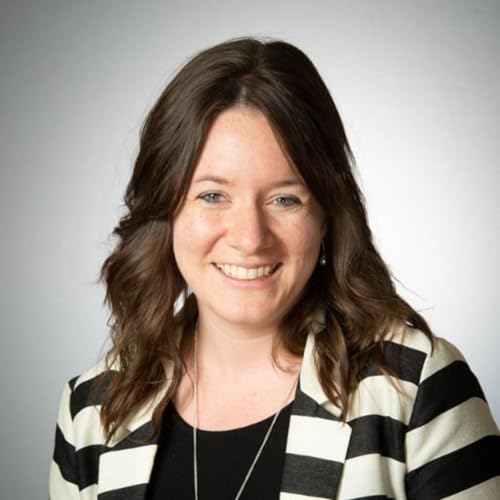
• Disability Care in the Community: With Guest Jenny Price
    2026/07/30
    We talk with Jenny Price about home and community based services for people with disabilities. We touch on the history of people with disabilities, what it took to gain the current levels of public support for care in the community as well as why so many people in the disability community are concerned about loosing such supports. We talk about why it is important for people to receive services in their choice of settings.

    Jenny is the Executive Director for the Wisconsin Board for People with Developmental Disabilities. Prior to this, she was an award winning journalist reporting for the Associated Press.

    Read the full article "Community care enriches lives for the disabled, but advocates say feds are pulling back support" by Erik Gunn.

    Watch the documentary Where's Molly which is mentioned in the episode.

    If the above links aren't working, copy/paste these URLs:
    https://wi-bpdd.org/index.php/2026/05/14/wi-bpdd-welcomes-jenny-price-as-new-executive-director/
    https://www.yahoo.com/news/us/articles/community-care-enriches-lives-disabled-084509649.html
    https://www.youtube.com/watch?v=RwRUyA2OpbU

    Become a supporter of this podcast: https://www.spreaker.com/podcast/love-doesn-t-pay-the-bills-highlighting-the-value-of-family-caregiving--5692861/support.

    Follow us on Facebook or Bluesky.
    Subscribe to Lisa's newsletter on Substack.
    続きを読む 一部表示
    35 分
  • The Impact of H.R. 1 on Medicaid: With Guest Mary-Beth Malcarney
    2026/07/23
    Mary-Beth Malcarney returns to update us on the impact of H.R. 1, the so called "big beautiful bill" on Medicaid and those who depend on it. We talk about the variety of responses from different states to this legislation and what may still be coming as the bill takes full effect.
    Read about the impact of H.R. 1 on Medicaid: https://familiesusa.org/resources/the-big-budget-bill-one-year-later-millions-lose-coverage-millions-more-remain-at-risk/

    Mary-Beth is a senior advisor on Medicaid Policy for Families USA. She previously worked at the National Academies of Medicine, advising the Social Security Administration on updating disability policies as they related to the health of transgender people.

    Want to let CMS(Centers for Medicaid and Medicare Services) know how work requirements impact you? See the FamiliesUSA work requirements guide:

    https://familiesusa.org/wp-content/uploads/2026/07/Families-USA-Medicaid-Work-Reporting-Requirements-IFR-Comment-Guide.pdf

    Become a supporter of this podcast: https://www.spreaker.com/podcast/love-doesn-t-pay-the-bills-highlighting-the-value-of-family-caregiving--5692861/support.

    Follow us on Facebook or Bluesky.
    Subscribe to Lisa's newsletter on Substack.
    続きを読む 一部表示
    33 分
  • When ordinary childhood experiences require extraordinary care: With Guest Lenore Eklund
    2026/07/09
    Lenore Eklund is the Illustrator of "Where is the manual for this!?" and mom to a medically complex child. We talk about the planning and work that goes into kids with disabilities having ordinary(and extraordinarily beautiful) childhood experiences. We talk about what happens when communities around the family take some of that planning off the primary caregiver's shoulders and when they don't. And why it's all worth it!

    Read Lenore's substack
    Get Lenore's book Release: A NICU Fairytale
    Follow Medical Motherhood, also featuring "Where is the manual for this!?" with excellent reporting about raising and advocating for children with extraordinary care needs.

    Become a supporter of this podcast: https://www.spreaker.com/podcast/love-doesn-t-pay-the-bills-highlighting-the-value-of-family-caregiving--5692861/support.

    Follow us on Facebook or Bluesky.
    Subscribe to Lisa's newsletter on Substack.
    続きを読む 一部表示
    27 分
  • Link Arms to Improve Medicaid Home and Community Based Services
    2026/06/18
    Direct Service Providers (DSPs) both paid family members, and nonfamily are critical to the wellbeing, autonomy and safety of people with disabilities. DSPs provide support with bathing, dressing, eating, transportation and more. Medicaid's home and community based services(HCBS) is specifically designed to ensure that people with high disability related care needs remain in their communities while being safe and thriving. Recent federal government actions, with the specified goal of eliminating fraud have raised questions about the entirety of HCBS and paying family caregivers. The three guests appearing today wrote an article about this entitled "The caregivers you've never heard of are in crisis"We discuss the importance and value of HCBS, the power of caregiver voices, why HCBS is too important to cut and actually saves a lot of money in addition to it's very real impact on quality of life for care recipients. We emphasize the mportance of all of us coming together to protect and in fact, expand, improve and enhance HCBS. We all agree that it's important to stop fraud, however it is also extremely important to provide necessary services for disabled people.Quoted in the episode is an article published by KFF, written by Elizabeth Hinton, Jessica Mathers, and Robin Rudowitz. They say “There are no reliable measures of fraud against Medicaid…Recent analysis of the FY 2023 HCFAC report found no beneficiary fraud in the listing. Providers convicted (of different kinds of fraud against Medicaid and Medicare) included ambulance service providers, durable medical equipment suppliers, diagnostic labs, nursing homes, pain clinics, pharmacies, physical therapists, physicians, and substance use treatment providers… Medicaid Paid an Estimated 94.9% of Total Outlays Properly, and Improper Payments are Mostly Due to Insufficient Information...What is known about fraud in Medicaid is that it’s not unique to Medicaid (fraud also occurs in Medicare and private health insurance) and is mostly committed by providers. There are checks on fraud, waste, and abuse at both the federal and the state levels“Also mentioned are examples of family member advocacy that are really impactful. One is the families which advocated for Tensy's Law in Oregon, starting at about 13 minutes in this video. And another example was at some recent Medicaid legislative hearings in Ohio. Have some tissues handy before you watch these! Diane Wilush began her career in social work in 1977 at a state institution in Miami. She served as President and CEO of United Cerebral Palsy of Georgia and United Cerebral Palsy of South Carolina in the early 2000s. After retiring from her CEO roles in Georgia and South Carolina, Diane continues her work as the part-time Senior Director of Public Policy and Advocacy for UCP of Georgia. In addition, she stepped into the role of Interim President and CEO of UCP National in the fall of 2025, continuing her commitment to leadership and advocacy at the national level.Barbara Merrill joined the staff of ANCOR in 2012 as Vice President, Public Policy, and since 2014 has served as Chief Executive Officer. Barbara has been a leader in the disability field since 1992, working first as an advocate and later as an attorney and state legislator whose diverse background has been united by a commitment to strengthening community providers and the services they deliver to people with I/DD. Among her many accomplishments, she successfully orchestrated the passage of legislation to increase wages for Maine’s direct support professionals and to codify Maine’s Mental Health Parity law. In 2002, Barbara became the first Executive Director of the Maine Association for Community Service Providers.Kendra E. Davenport, MPL, CFRE, is President and CEO of Easterseals, a leadingorganization that makes a lasting difference in the lives of 1.5 million people each yearby providing essential services to children and adults with disabilities, older adults,veterans, and their families. Kendra oversees the National Office and a federatednetwork of 70 Affiliates whose markets cover 48 states and Washington, D.C.For more than three decades, Kendra has been a leader and innovator in the nonprofitsector, with a consistent focus to facilitating critical services and interventions withorganizations specializing in health and human services and disability rights, ensuringeveryone can lead full lives.If the links above aren't working for more detailed biographies and topic information, copy/paste the following into your browser:The article on caregivers in crisis: https://thehill.com/opinion/healthcare/5883644-home-community-care-crisis/Diane Wilush: https://ucp.org/about-ucp/national-staff/Kendra Davenport: https://www.easterseals.com/about-us/people/kendra-davenport-mpl-cfreBarbara Merrill: https://www.ancor.org/people/barbara-merrill/KFF's article on Medicaid Fraud: https://www.kff.org/medicaid/5-...
    続きを読む 一部表示
    41 分
  • The Vital Importance of Paid Family Leave: With Guest Elizabeth Milligan Cordova
    2026/06/11
    Elizabeth Milligan Cordova is an educator, early childhood advocate, and parent. She currently works for TEACH Colorado, helping to expand and strengthen early childhood education pathways. Across all of her roles, she remains deeply committed to advancing equity in education at every level.A parent to two young children, ages four and one, Elizabeth spends much of her time playing Go Fish, watching ballet performances in her kitchen, and doing dishes and laundry. Her youngest baby, Madeline, was born prematurely at 33 weeks and has benefited from Colorado’s early intervention services. Elizabeth loves yoga, running, travel, and reading, and treasures living close to her parents, sister, and brother-in-law.

    Elizabeth wrote this opinion piece about paid leave: https://www.usatoday.com/story/opinion/voices/2026/05/21/paid-leave-employees-pregnancy-childbirth/90163849007/

    She and her daughter feature in the documentary Lifelines

    On this episode of Love Doesn't Pay the Bills, Elizabeth shares in depth about her experience with her baby in the NICU, and the importance of Paid Leave for all employees. She expresses very clearly how much positive impact strong support including paid leave has during a difficult postpartum and caregiving experience.


    Become a supporter of this podcast: https://www.spreaker.com/podcast/love-doesn-t-pay-the-bills-highlighting-the-value-of-family-caregiving--5692861/support.

    Follow us on Facebook or Bluesky.
    Subscribe to Lisa's newsletter on Substack.
    続きを読む 一部表示
    32 分
  • Replay of What If We Really Believed That Care Is A Part of Everyone's Life?: With Guest Emily Kenway
    2026/06/04
    This episode was originally published on June 20, 2023

    We're joined by Emily Kenway, the author of "Who Cares: The Hidden Crisis of Caregiving, and How We Solve It". "Who cares" is a very loving memoir of Emily's own caregiving experience. It also is a great work of advocacy by imagining the changes that would happen throughout our world if we started from the default assumption that all people will be caregivers at some time in their lives.

    https://www.emilykenway.com/about

    Become a supporter of this podcast: https://www.spreaker.com/podcast/love-doesn-t-pay-the-bills-highlighting-the-value-of-family-caregiving--5692861/support.

    Follow us on Facebook or Bluesky.
    Subscribe to Lisa's newsletter on Substack.
    続きを読む 一部表示
    35 分
  • Care Stories and Themes: With Guest Kat McGowan
    2026/05/28
    Kat McGowan is a journalist whose life was changed by family caregiving. She was a 2024-25 Rosalynn Carter Mental Health Journalism Fellow, and developed a series for NPR about caregiving and mental health.

    We discuss common themes Kat noticed in her interviews as well as advice to someone ready to tell their own care story in a meaningful way.

    Become a supporter of this podcast: https://www.spreaker.com/podcast/love-doesn-t-pay-the-bills-highlighting-the-value-of-family-caregiving--5692861/support.

    Follow us on Facebook or Bluesky.
    Subscribe to Lisa's newsletter on Substack.
    続きを読む 一部表示
    32 分
  • The workforce holding our healthcare system together: With Christine Villabona-Kuntz
    2026/05/21
    Christine Villabona-Kuntz joins us to discuss her article in USA Today "I'm one of 48 million unpaid caregivers. Health care collapses without us". Christine is a nurse, and her perspecitve on care changed when she also became the family caregiver to her own mother.

    We discuss the crisis facing family caregivers and people in need of care. There are 43 million family caregivers in the United States: a labor force holding together our healthcare system. What do we have in common? Many of us are exhausted, and in need of real supports that allow us to continue this work feasibly. Christine urges legislative advocacy whenever possible.


    Become a supporter of this podcast: https://www.spreaker.com/podcast/love-doesn-t-pay-the-bills-highlighting-the-value-of-family-caregiving--5692861/support.

    Follow us on Facebook or Bluesky.
    Subscribe to Lisa's newsletter on Substack.
    続きを読む 一部表示
    33 分