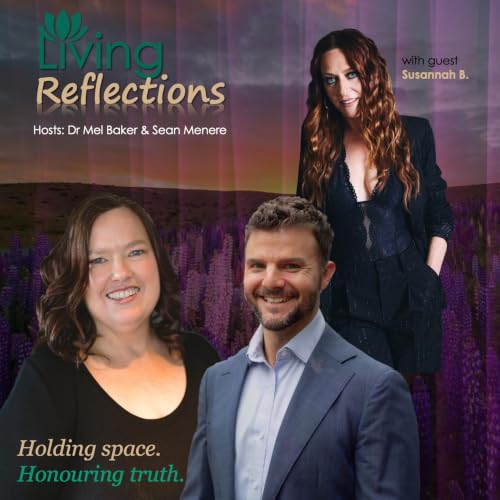
『Living Reflections』のカバーアート

Living Reflections

Living Reflections

著者: Dr Mel Baker and Sean Menere
無料で聴く

【Amazonプライム会員限定】今ならプレミアムプランが4か月 月額99円。

10月19日まで。※適用条件あり
Living Reflections is a podcast that holds space and honours truth — within us, between us, and in the stories we carry. Created by Dr Mel Baker and co‑hosted with Sean Menere, the program explores layered themes like a magazine for the soul. Each episode offers a different kind of truth. Whether listeners seek depth, lightness, or quiet clarity, there is something here for everyone. Come as you are. Be witnesses. Be held. In a world that rushes past our inner lives, Living Reflections is a pause. A breath. A return.Dr Mel Baker and Sean Menere 心理学 心理学・心の健康 衛生・健康的な生活
エピソード
  • Returning to Alignment: Presence, Truth, and the Courage to Lead from Love | Dr Mel Baker and Mark Worthington
    2026/09/17

    In this episode, I sit with author, coach, and leadership guide Mark Worthington for a conversation that moves far beyond management theory. Together, we explore compassionate leadership as a way of being - a return to inner alignment, presence, truth, and self-compassion that reshapes how leaders show up in their work and in their lives.

    Mark speaks to the quiet ways alignment begins: when leaders operate from old patterns, childhood conditioning, or corporate habits that have nothing to do with who they truly are. We talk about the unconscious mind—the part of us making most of our decisions—and how leaders often act from ego rather than soul, prioritising short-term gains or external validation while their teams absorb the cost of their instability.

    Throughout the conversation, we explore the perfectionism trap and the belief that love or worthiness must be earned through flawless performance. Mark's work in Show Me the Harmony opens a doorway into a different way of leading—one rooted in pure intention rather than perfection. When leaders shift from performing to being present, anxiety softens, innovation rises, and boundaries become an act of self-respect rather than fear.

    Presence becomes a central thread: the energetic foundation of compassionate leadership. We talk about how easily leaders slip into future-past thinking, worrying about next week or replaying yesterday, and how digital distraction erodes the ability to truly listen. Presence, Mark reminds us, is only accessible through the energy of love, and without it, leaders cannot honour the people they serve.

    We also explore leadership in the age of AI. While AI accelerates intellectual processes, it cannot feel, intuit or discern truth. Mark speaks to the ethical risks of leaders who are misaligned, and the necessity of grounding technology in love, integrity and human intelligence. The heart's capacity for infinite intelligence remains the defining difference between human leadership and machine efficiency.

    The conversation closes with the path to harmony—presence, truth, intention and compassion—and the invitation for leaders to take responsibility for their belief structures. Life's challenges become mirrors for growth, and leadership becomes an inner practice long before it becomes an outer expression.

    This episode is a reminder that compassionate leadership is not a style. It is a way of being. And leaders cannot guide others toward harmony without first returning to alignment within themselves.

    続きを読む 一部表示
    39 分
  • Masculine Leadership in Practice | Sean Menere
    2026/09/01

    In this solo episode, co-host Sean Menere steps into a conversation many people talk about but few are willing to inhabit fully: what compassionate leadership actually looks like in practice, especially for men. Drawing on sixteen years as an air traffic controller, a decade spent training others, and a period of profound personal upheaval, Sean removes the corporate gloss and speaks from lived reality rather than theory. His message is clear: compassionate leadership isn't soft, isn't optional, and isn't the slogan printed on the break-room poster. It costs something. And it may be one of the most underrated skills available to us.

    Sean explores the way performance often masks struggle, how it gets rewarded and even promoted, yet quietly keeps people at arm's length. He speaks to the difference between performing connection and actually allowing someone access to the part of us that isn't performing at all. That moment of access, he argues, is where leadership begins. He shares what compassion looks like as a decision, and how boundaries create safety rather than restrict it. In one of the most striking insights of the episode, Sean explains why compassion is often more effective when we do less but at exactly the right moment.

    Drawing from personal experience, aviation principles, research, and the three core practices of the men's group he founded, Sean offers a grounded framework for relational leadership: the leader goes first in sharing something real and unresolved, no fixing, and strict confidentiality because trust is built through consistency. He closes the episode with a challenge for listeners to explore in the week ahead, inviting a shift from concept to practice.

    If this conversation resonates, share it with a man in your life who might need to hear it. Leave a comment, subscribe to Living Reflections, and join us for the next episodes in the Leadership series.

    Sean Menere is a registered counsellor, mental health coach, and founder of Solid Foundations Counselling in Melbourne.

    *Special thanks to the artists of Pixabay for their royalty-free music.

    続きを読む 一部表示
    41 分
  • Leading with compassion in the world | Dr Mel Baker and Susannah B
    2026/08/26

    In this Sacred Space conversation, host Dr Mel Baker sits down with musician and community arts facilitator Susannah B for an intimate exploration of creativity, healing, and the lifelong practice of self-compassion. Together, they trace the inner landscape behind Susannah's music, the emotional honesty of her songwriting, and the deep wisdom she's gathered from decades of working with marginalised communities.

    What unfolds is more than a conversation about music. It's a reflection on the courage required to face the negative inner voice, the tenderness of motherhood, the longing for validation, and the quiet truth that external success can never fill internal voids. Susannah's story is one of service, stillness, and learning to step into "far more" than we believe we are.

    She grew up in Manhattan during the 1970s and 80s surrounded by creativity and grit. Her father was a fashion photographer, and her mother, Carol Hall, was a celebrated composer-lyricist. That artistic household shaped Susannah B deeply but it also cast a long shadow.

    For Susannah B, songwriting isn't about fame or performance, it's deeply personal. Her songs function as anthems to herself, tools for processing grief, anger, confusion, and hope. Music became her way of encouraging herself when no one else could. One of her earliest examples is Talkin' to Myself to address the negative inner voice. The song became a kind of spell she could sing to herself, a practice in self-love.

    Susannah B's work extends beyond music. For years, she's led acappella singing sessions with formerly incarcerated men at a sober living facility in LA. "Their mood had changed," she recalls. Her approach was simple: "It's not about how it sounds, it's about how it feels." Singing together lifts spirits and built community and belonging. She has also worked with teen mothers in LA public high schools, helping them write and perform plays. She's watched kids transform.

    We talked about motherhood and the lesson in letting go. And from there the conversation drifts into the need for validation out of her childhood experience. She saw firsthand, even a hit Broadway show lasting five year, couldn't fill her mother's internal voids. "It just became really small after a while," Susannah B reflects. That's a lesson she carries with her: no amount of external achievement can substitute for internal healing.

    Susannah B believes that self-compassion often comes later in life for people who've spent years serving others. Both she and Mel identify as highly sensitive people who prioritised everyone else first. "We sometimes overlook ourselves," Mel notes. For Susannah B, learning to love herself didn't happen until she forced to reckon with that negative inner voice - again and again.

    Her closing message is simple by profound: the answer is always within. It comes from stillness, from silence, from listening. This truth inspired one of her songs, Far More, which came out of a spiritual experience.

    You can listen to Susannah B's music on Spotify and all major streaming platforms.

    *Susannah B photo by Jen Rosenstein.

    **Special thanks to the artists of Pixabay for their royalty-free music.

    続きを読む 一部表示
    38 分
adbl_web_anon_alc_button_suppression_t1
まだレビューはありません