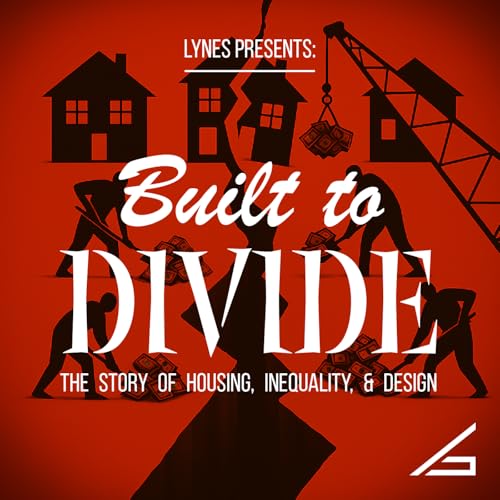
『LYNES Presents: Built to Divide』のカバーアート

LYNES Presents: Built to Divide

LYNES Presents: Built to Divide

著者: LYNES // Gābl Media
無料で聴く

このコンテンツについて

Built to Divide is a cinematic audio documentary that unearths how America’s homes became the front lines of inequality. From land giveaways to red lines, gated communities to algorithmic rent hikes—each episode reveals the forces that shaped not only where we live, but who gets to belong. Guided by host Dimitrius Lynch Jr., an award-winning architect with a storyteller’s eye for systems and design, this series traces how policy, psychology, and profit converged to build division into the very architecture of everyday life. Through vivid historical narratives, archival sound, and modern parallels, Built to Divide exposes how the dream of homeownership became both symbol and weapon—binding generations to debt, geography, and identity. Across twelve episodes, listeners journey from the dawn of land speculation to today’s algorithmic landlords, uncovering how the built environment reflects our deepest social divides—and what it will take to design something better.Copyright 2025 LYNES // Gābl Media アート 政治・政府 政治学 社会科学
エピソード
  • 05: Shock & Awe
    2025/12/17

    In August 1971, Richard Nixon went on television and detonated the global financial system. By severing the U.S. dollar from gold, the Nixon Shock ended Bretton Woods, ushered in fiat money, and unleashed a new era of credit, speculation, and inequality. What followed wasn’t just inflation and currency volatility—it was a fundamental rewiring of housing, wealth, and power.

    In this episode of Built to Divide, Dimitrius Lynch traces how the end of the gold standard collided with housing policy, stagflation, and a rising market-first ideology. As public housing construction collapsed, Section 8 vouchers expanded, the mortgage interest deduction quietly became America’s largest housing subsidy, and real estate lobbying reshaped Washington. Jimmy Carter framed housing as a moral obligation—but crisis, inflation, and backlash undercut reform. Then came Milton Friedman, Margaret Thatcher, Ronald Reagan, and the think-tank machine, turning deregulation, tax cuts, and privatization into governing doctrine.

    The result? Housing shifted from shelter to leverage. Neighborhoods hardened. Inequality accelerated. McMansions replaced porches. Master-planned enclaves rose as public responsibility retreated. And the rails were laid for subprime lending, securitization, and collapse.

    This is the episode where money floats, housing fractures, and the modern economy takes its irreversible turn.

    Episode Extras - Photos, videos, sources and links to additional content found during research.

    Episode Credits:

    Production in collaboration with Gābl Media

    Written & Executive Produced by Dimitrius Lynch

    Audio Engineering and Sound Design by Jeff Alvarez

    続きを読む 一部表示
    1 時間 8 分
  • 04: The Pivot
    2025/12/10

    In the summer heat of Birmingham, children faced police dogs and fire hoses. On a bus in Montgomery, a 15-year-old refused to stand. From Claudette Colvin to Rosa Parks, from Greensboro counters to the March on Washington—the Civil Rights Movement shook America awake. Yet, even as laws changed, maps and mortgages quietly redrew the lines of belonging.

    In this episode of Built to Divide, Dimitrius Lynch tracks what happened after the marches. The Civil Rights Act outlawed discrimination, but zoning boards found new tools to enforce it. Highways tore through Black neighborhoods in San Francisco and Detroit. Urban renewal became “Negro removal.” Birmingham forced the country to look. Kennedy named it a moral crisis. Johnson created HUD, appointing Robert C. Weaver, the first Black cabinet secretary. Then came the pivot—Section 235, 236, vouchers, block grants, Pruitt-Igoe, Moses vs. Jacobs, Nixon’s New Federalism, and a shift from building homes to subsidizing rent.

    This is the story of how a movement won rights—but lost ground in planning rooms, mortgage offices, and zoning maps. How public housing gave way to vouchers. How the market replaced the public builder. And how America traded homes as social infrastructure for housing as financial asset.

    If you want to understand why affordability collapsed, why public housing withered, why vouchers fall short, and how modern inequality took shape—Episode 4 shows the pivot point.

    Episode Extras - Photos, videos, sources and links to additional content found during research.

    Episode Credits:

    Production in collaboration with Gābl Media

    Written & Executive Produced by Dimitrius Lynch

    Audio Engineering and Sound Design by Jeff Alvarez

    続きを読む 一部表示
    51 分
  • 03: The Great Reset
    2025/12/03

    What happens when the machinery of war is turned loose on the home front? In this episode of Built to Divide, host Dimitrius Lynch traces how the end of World War II, the GI Bill, and federal housing policy combined to build the largest middle-class expansion in U.S. history—while quietly deepening racial and economic division.

    Beginning with the surrender in Tokyo Bay and the massive demobilization of Operation Magic Carpet, Lynch follows millions of returning veterans back to a country racing to answer a simple question: Where will they all live? The answer reshaped the nation. FHA and VA loans, the rise of Fannie Mae, and the secondary mortgage market drove homeownership from 43% to nearly 62% by 1960, cementing the single-family house as the centerpiece of the American Dream.

    But this “great reset” came with a price. Lynch unpacks how zoning laws, redlining, racial covenants, and underwriting standards drew hard lines around who could belong in postwar suburbia. He contrasts the inclusive vision of Case Study Houses and Eichler Homes with the mass-produced segregation of Levittown, where black families were explicitly barred and violence met the first to cross the color line.

    From John Dean’s warning about homeownership “booby traps” to the weaponization of media by business elites like Henry Regnery, this episode reveals how corporate interests used patriotism, racial fear, and Cold War anxiety to roll back New Deal gains and reframe government as the enemy. Along the way, Lynch explores how Fannie Mae’s privatization, the birth of American Express credit cards, and the cultural glorification of the nuclear family turned housing into a speculative asset, a consumption engine, and a source of isolation.

    We end in Roseto, Pennsylvania, where a community’s disappearing social bonds literally changed its heart attack rates—proof that how we house ourselves shapes how we live, connect, and survive.

    If you want to understand how postwar housing policy, suburbanization, zoning, media, and finance fused into a system that still determines who gets stability and who gets left behind, this episode shows how the board was reset—and who it was reset for.

    Episode Extras - Photos, videos, sources and links to additional content found during research.

    Episode Credits:

    Production in collaboration with Gābl Media

    Written & Executive Produced by Dimitrius Lynch

    Audio Engineering and Sound Design by Jeff Alvarez

    続きを読む 一部表示
    1 時間 4 分
まだレビューはありません