エピソード

  • The Higher Education Hustle with Christopher Grillo
    2026/11/19
    In this episode of Keep Hustling, host Aaron Gordon sits down with Christopher Grillo, who spent nearly two decades inside higher education, including ten years as an associate dean at Boston College, before building a company to fix what he saw there. The turning point was a student who walked into his colleague's office asking why she got no financial aid. She was not on the list because her parents had taken the loans and she was quietly paying them back. Nobody in the room had seen that before. What follows is a conversation about everything families get wrong about college, starting with the idea that writing a check is the plan. Christopher argues that the real work begins freshman year of high school, that your major matters more than the name on the diploma, and that debt is simply risk by another name. Then, with about six minutes left, he takes the microphone and turns it on Aaron: when is the hustle over for a family, and do you have a number? Aaron's answer is the clearest statement of what this show is about that he has given in 160 episodes. Get To Know Christopher Grillo Christopher Grillo is an investor, entrepreneur and higher education researcher, and the co-founder and CEO of Irnerius, an AI-powered college decision platform built for students, parents and counselors. The company combines student preferences, university data, career outcomes and financial analysis so families can compare schools on salary and debt by major rather than on reputation alone. It is based in Westwood, Massachusetts, and takes its name from the Italian jurist credited with founding the University of Bologna. He spent nearly twenty years in higher education before that, including roughly a decade as associate dean of finance and administration at Boston College's Connell School of Nursing, and he taught as adjunct faculty in the MBA program at the Carroll School of Management. His academic work focuses on the economics and finance of higher education, specifically student and parental debt, tuition pricing, financial transparency, and whether institutions themselves are viable. His doctoral research at Boston College's Lynch School of Education and Human Development, titled Shifting the Burden, examined how parents make decisions about federal Parent PLUS borrowing and what they believe the consequences will be. He holds a bachelor's degree and an MBA in finance from Boston College's Carroll School of Management, and a master's in higher education from the Rossier School of Education at the University of Southern California. He has served on the board of trustees of St. Columbkille Partnership School in Brighton, Massachusetts, since 2018. He grew up in New Jersey. Website LinkedIn Youtube Instagram Facebook X 3 Key Listener Takeaways 1. Your major matters more than the name on the diploma. This is the line that should cost people the least and save them the most. Christopher puts it plainly: you will earn more as a nurse out of Montclair State than as a political science major out of Princeton, at least early on. A great school is not automatically a great school for your field, and there is a real difference between an engineering school and a school that happens to offer engineering. Pick the work first, then pick the place. 2. Debt is just risk wearing a different word. Christopher borrows the framing from Dave Ramsey and then makes it concrete. His rule of thumb is to clear all student debt within ten years on no more than ten percent of your starting salary, so an accountant starting at seventy thousand should not be carrying payments above seven. The reason is not thrift, it is freedom. He describes a young man now at a very good law school who could only go because he took on nothing as an undergraduate. 3. The hustle does not end, it changes shape. Christopher flips the format near the end and asks Aaron the question nobody asks him: when is the hustle over for a family, and is there a number? Aaron's answer is that the hustle never stops but it evolves, and it should only stop when it stops inspiring you. Chris's addition is the warning underneath it, that no parent should end up seventy years old still carrying debt they took on for a child's education. Show Overview 00:00 Thanks to Brett and the Salty Adjuster for the introduction 01:06 A Jersey guy who is somehow not a Jets or Giants fan 01:37 The night Aaron offered his son a way out of the Jets 02:42 Twenty years in higher education, fifteen at Boston College 03:11 The student who got no aid because her parents took the loans 03:58 The epiphany nobody in the room had seen before 04:31 Why he came at this from value rather than from finance 04:53 Thirty million people with some college and no degree 06:02 If nobody had to borrow, should everyone go 06:10 The difference between should go and should get to go 07:16 How the values around college got misaligned 08:11 When a family should actually start the conversation 08:56...
    続きを読む 一部表示
    31 分
  • Take the Stage and Hustle with Toni Caruso
    2026/11/12
    In this episode of Keep Hustling, host Aaron Gordon talks with Toni Caruso, who has spent more than thirty five years backstage producing events and working with hundreds of speakers. She traces the whole career back to a July birthday nobody wanted to come to, which taught her young how to throw a party people actually put in the calendar. That became proms, then corporate holiday parties, then rooms of two thousand people, until COVID shut the business down overnight. What came back was different. Events stopped being about headcount and became about the experience, and conversion goes up in the smaller room because people get to know and trust you faster. The back half is a clinic on why you should tell your story and how to make speaking pay. Tell it from the scars and not the wounds, because nobody can learn from a story you are still inside of. Treat the stage as a business rather than a passion project. And when the nerves hit, understand that you are not nervous, you are excited, and the two feel identical in the body. Get To Know Toni Caruso Toni Caruso has spent more than thirty five years behind the scenes producing events and working with hundreds of speakers, across entertainment, corporate and business to business work. Her own description of the arc is from backstage to front stage. She is Executive Managing Director of eWomenNetwork, where she oversees six chapters across the Dallas area, and Executive Director of eWomenSpeakersNetwork. She is the founder of Academy4Speakers, and she runs Caruso Signature Events, which produces live signature events including workshops, conferences and bootcamps. She is the author of Speaking, It's a Business, a playbook for treating the stage as a revenue-generating business rather than a passion project. It covers turning a message into a monetizable asset, designing talks that lead to clients, understanding which stages actually pay you back, matching offers to your audience and your time on stage, and tracking close rates like any other business number. Her speaking topics include I Want to Get Paid to Speak, Stage It Right, Let's Put Butts in Seats, and The ROI is in the Room. She was born in Northern California and spent most of her life in Southern California before moving to Texas in 2021. She now lives in the Dallas area. Website Caruso Signature Events LinkedIn Youtube eWomenNetwork Speaker Profile Buy Toni's Book 3 Key Listener Takeaways 1. Tell it from the scars, not the wounds. Toni is firm that you cannot tell a story you are still living inside of, because if you have not come out the other side, the audience has no proof it can be survived. The example she uses is a hypothetical: two divorce attorneys, one who watched her parents go through it and one who lost the house, the accounts and the kids and rebuilt anyway. Same credential, completely different trust. Wait until you are on the far side, then tell it. 2. The room got smaller, and that is good news. Before COVID the whole business was headcount, five hundred and six hundred and nine thousand people in a room. That broke, and what replaced it is better for most people building a business from the stage. Conversion rises in the smaller room because people get to know, like and trust you faster. Everyone still wants a packed house, but filling seats is harder than it has ever been now that any connection can happen over a Zoom link. 3. Speaking is a business, and most people run it like a hobby. This is the hardest part of the episode and the most useful. Flights, hotels, Ubers and meals come out of your pocket if nobody is covering them. Toni's point is not to chase a speaking fee, it is to know your audience, get on the right stage, and match the offer to the time you have. A five thousand dollar program pitched to a cold room in twenty minutes will fail. The same twenty minutes with the right offer can beat any appearance fee. Show Overview 00:00 A New Yorker refuses to believe the background is real 01:33 How a person ends up running large corporate events 02:04 The July birthday that taught her to throw a party people show up to 02:51 From proms to corporate holiday parties 02:58 Aaron's hot take on what event planners worry about for nothing 03:33 Before COVID it was all numbers 03:52 After COVID it became the experience 04:44 Why putting people in seats is harder than it has ever been 05:16 Keynotes against breakout sessions and round tables 06:03 What COVID did to a generation's ability to connect 06:36 The line from her bio: stand up, speak up, show up 07:24 Why someone forty years into a career should tell their story now 07:49 Tell it from the scars, not the wounds 08:33 Two divorce attorneys, and which one you hire 09:24 You are talking to one person in that audience 09:37 Most people have far more to share than they think 10:34 What to do when you are young and think you have no story 11:01 The roofing company that found its pitch 12:03 Problem, ...
    続きを読む 一部表示
    26 分
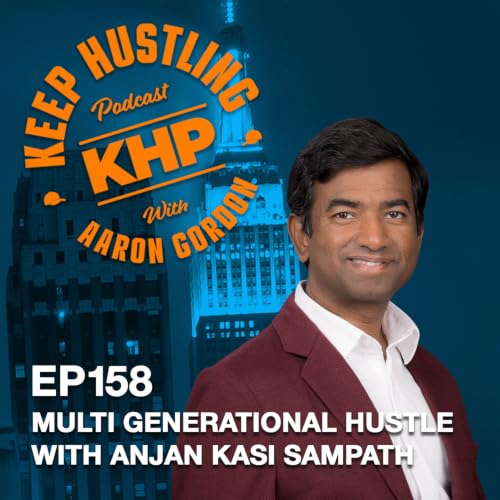
  • Multi Generational Hustle with Anjan Kasi Sampath
    2026/11/05
    In this episode of Keep Hustling, host Aaron Gordon sits down with Anjan Kasi Sampath, a Gen Z leadership coach who spent most of a twenty five year corporate career as a software architect before turning to what he calls the most expensive problem in business today. Aaron opens by warning that the two of them may land on opposite sides of this one, then spends the episode genuinely testing him. Is Gen Z actually different, or does every generation get called difficult by the one above it? Anjan's answer is that Gen Z is the first to say the quiet part out loud, and that they have traded automatic deference to authority for a demand for authenticity. From there the two work through the COVID cohort who never learned the unwritten rules of an office, the collision between speed of innovation and depth of experience, and the realization that managers and their young reports are making the identical complaint in different words. Anjan closes with advice for both sides and a line worth repeating: stop showing your work, start showing your thinking. Get To Know Anjan Kasi Sampath Anjan Kasi Sampath is a Gen Z Leadership Coach who works on both sides of what he calls the most expensive problem in corporate today. With twenty five years of corporate experience as both a manager and an early-career professional, he does not take sides. His stated mission is to close the gap between how managers lead and how Gen Z performs, by building the habits that make trust possible on both sides. His method is habit-based. Not inspiration and not mindset, but observable, repeatable behaviors that survive deadline pressure. As he frames it, managers do not struggle with workload, they struggle with trust. He came to this work from software. He spent most of his career as a software architect building fault-tolerant systems in finance and property insurance, including high-frequency merchant retrieval systems and insurance claim processing platforms, and he holds a master's degree in telecommunications. He is a TEDx speaker, a John Maxwell certified coach, a District 48 Toastmasters International speaking champion, and was named Tampa Bay Best Speaker in 2021. His TEDx talk, Emotional Collaboration: A New Way Teens Handle Overwhelm, makes the case that emotion is not the enemy of a good decision. He has been featured in Business Innovators Magazine. He is the founder of VISIONx Leadership Coaching, a six-module framework built on visibility, influence, self-leadership, identity, ownership and navigation, delivered through keynotes, workshops and coaching. The program has been run with college students and early-career professionals in both the United States and India. Website - https://www.anjankasispeaks.com/ LinkedIn - https://www.linkedin.com/in/anjan-kasi-sampath-033a326/ Facebook - https://www.facebook.com/anjan.k.sampath TEDx Talk - https://www.youtube.com/watch?v=YD2FH0aHCSg 3 Key Listener Takeaways 1. Both sides are making the exact same complaint. This is the moment the episode turns. Managers say they feel like they are babysitting a generation that will not follow basic instructions. That same generation says it is being micromanaged and treated like children. Aaron points out that these are not two different problems, they are one problem described from two chairs, and almost nobody on either side notices. The teams that fix it are the ones who spot the alignment hiding inside the friction. 2. Authority still gets respect. It just no longer buys trust. Anjan is careful here, and it is worth hearing him out. Gen Z has not stopped respecting hierarchy. What has changed is that a title alone no longer creates connection. A leader who speaks about their own highs, lows and vulnerabilities gets instant buy-in from this generation, where a leader who leads with the org chart does not. That is a new pattern, and it is not going back. 3. Build systems, not goals. Anjan's closing thought, which he credits to James Clear, is that you should never make yourself the end goal. Build the systems instead, because the moment you sense you are drifting off course, a system is the thing you can actually fine tune. Goals cannot be adjusted mid-flight. Systems can, and that is the only real leverage any of us carry. Show Overview 00:00 Two people who may land on opposite sides of this 01:09 Melding generations, and why almost nobody works on it 01:37 The Gen Z reports who thought nothing like he did 03:10 What actually separates Gen Z from every generation before 04:18 Authenticity beats authority 05:20 Is it really so bad that they question hierarchy 05:59 The cohort who entered the workforce in isolation 06:39 Who needs the leadership, Gen Z or the generation above them 07:12 Untrained behaviors that cost good people their visibility 08:14 The Jetsons, Elon Musk, and the value of questioning reality 08:35 Speed of innovation against depth of experience 09:19 The most misunderstood thing about each generation 10:...
    続きを読む 一部表示
    26 分
  • Hustle Before You're Ready with Haley Thams
    2026/10/29
    In this episode of Keep Hustling, host Aaron Gordon welcomes the first second-generation guest in the show's history. Haley Thams is the owner and CEO of Plimsoll Media, the agency behind the video and social content for this podcast, and she is the daughter of Todd Thams from episode 65. She bought the agency from Bradley Flowers at twenty one, fresh out of college, having never worked a corporate job in her life. Her reasoning was that if she took a nine to five first she would never find her way back to entrepreneurship, so she chose the scarier option while she was young enough to recover from it. Aaron pushes on why someone already running a company would add teaching early morning cycle classes, and the answer turns out to be about isolation rather than ambition. The conversation then gets unusually honest. Aaron gives her live on-air criticism about undercharging for work she keeps absorbing, she defends why she does it, and neither of them backs down. She closes with the line she lives by: show up before you're ready. Get To Know Haley Thams Haley Thams is a Midwesterner with a passion for content, and the owner and CEO of Plimsoll Media. Whether a brand is starting from scratch or already has a built following, she makes the work personal. She grew up in Iowa and is a graduate of Iowa State University's Greenlee School of Journalism and Communication, with a degree in Public Relations and Business Marketing. Some of her proudest work at Iowa State was writing for the Iowa State Daily, building her own online portfolio, and working as an intern. She finished her degree a semester early in December 2022, and the next month, at twenty one, she bought Plimsoll Media from Bradley Flowers, before she had ever worked a corporate job. Nearly four years later she runs the agency from Chicago. Plimsoll handles strategy-led media days, short-form and long-form capture, content systems and distribution, workflow automation, and ongoing advisory built on real performance data. Among its clients, Plimsoll produces the video and social content for this podcast and for Aaron's NY Risk Advisor channels. Since May 2025 she has also taught cycle classes at SALT Fitness Chicago, where her TikTok, @haley_thams, has built a following of more than 3,000 riders and fans. Haley is the first second-generation guest in Keep Hustling history. Her father, Todd Thams, is episode 65, Maintaining The Hustle. Bradley Flowers, who founded her company and later sold it to her, is episode 4, Finding Freedom Through The Hustle. Website - https://plimsollmedia.com/ LinkedIn - https://www.linkedin.com/in/haley-thams/ Instagram - https://www.instagram.com/plimsollmedia/ Tik Tok (Plimsoll Media) - https://www.tiktok.com/@plimsollmedia Tik Tok (Haley) - https://www.tiktok.com/@haley_thams Youtube - Facebook - 3 Key Listener Takeaways 1. Show up before you're ready. Haley's closing line is the whole episode in five words. She is candid that she carries imposter syndrome, does not know everything, and is not the best at any one thing, but she shows up present and ready to work anyway. The alternative, waiting until you feel qualified, is how people end up twenty years down the road regretting what they never tried. 2. Most people will give you a chance. The job is not to waste it. Aaron reveals a phone call that happened before the sale, where Bradley told him he was fairly sure Haley would figure it out. The client base stayed because they trusted the handoff. Aaron's point to any young person listening is that the chance is usually there for the taking, and the fear of being too young or not being taken seriously is mostly self-inflicted. 3. Saying I will figure it out is good business. Doing it for free is not. This is the sharpest exchange in the episode. Haley will learn anything a client needs rather than hand them off, which is exactly why she keeps clients. Aaron tells her live on air that she is terrible at pricing that work, and that doubling a workload without adjusting the fee is bad hustle. She pushes back that she does not want to charge people who believed in her early. Both positions are worth hearing. Show Overview 00:00 The first multi-generational guest in show history 01:26 Who Haley is and what Plimsoll Media does 01:52 Why add spin instructing on top of running a company 02:10 The isolation nobody warns you about with remote work 03:16 Moving to Chicago knowing exactly one person 04:22 Not joining the class, leading it 05:26 Why this was never about a second paycheck 07:07 Buying a business at twenty one 07:23 The deal with Bradley Flowers, and no corporate job ever 08:42 If I take the nine to five, I never come back 09:24 Should more young people take the swing 10:11 No systems, no processes, no idea how the money worked 11:00 The people who quit just short of the goal 11:29 The phone call Bradley made before the sale 12:28 Most people will give you a chance, do not blow it 13:39 The three clients who ...
    続きを読む 一部表示
    26 分
  • Anonymity and Hustle with The Salty Adjuster
    2026/10/21
    In this episode of Keep Hustling, host Aaron Gordon does something he has not done in 156 episodes. He interviews a guest he cannot see, whose voice has been altered, and whose name he does not know. The Salty Adjuster is a career catastrophe claims professional who launched a podcast in May 2026 and was inside Apple's Top 100 in the Careers category in two countries within the first month, without ever revealing an identity. The anonymity started as job protection and turned into the product. With nothing to run past HR or legal and no corporate image to protect, the show calls itself the claims conversation unfiltered, and Aaron digs into what that freedom actually buys. They get into what the public gets wrong about claims adjusters, why a claim is a legal contract rather than a payday, and the two hardest days in the work: underpaying someone who deserved better advice, and paying someone who did not deserve it at all. The Salty Adjuster also explains the strange math of a double life, where a side hustle nobody at work can know about gives back more energy than the day job takes. Get To Know The Salty Adjuster There is no personal bio for this guest, and that is by design. The Salty Adjuster is a career catastrophe claims professional who hosts anonymously. The identity stays hidden for employment reasons, because the day job employer does not know the podcast exists. Aaron has never met the Salty Adjuster and would not recognize the Salty Adjuster on the street. The show is the claims conversation, unfiltered. It blends humor, hard-earned wisdom, industry insight and authentic storytelling about the people and issues shaping claims, with conversations spanning catastrophe response, careers, leadership, burnout, technology, mental health and the very human work of helping people recover after loss. It launched in May 2026 and found its audience almost immediately. Within its first month on the air it ranked among the Top 100 Apple Podcasts in the Careers category in both the United States and Canada, a category with more than 12,000 shows. Listeners now tune in from more than 32 countries, and the audience runs across adjusters, carrier and TPA professionals, restoration experts, insurance leaders and entrepreneurs. In October 2026 the show was named a finalist for the 2026 Signal Awards in the Best Trailer category. Guests have included Bryan Falchuk, best-selling author and President of PLRB; Meg McKeen, founder of Adjunct Advisors; workplace mental health leader Cal Beyer; Chris Luiz, CEO of Scout InsurTech; Laurel Jordan of Datos Insights; Tony Cañas of Insurance Nerds; and two names Keep Hustling listeners already know, Michael Balarezo from episode 149 and Curtis Goldsborough, LO$$ RATIO, from episode 75. The show is produced by CoVerse Communications, founded by executive producer Brett McKenzie, the Producer Brett referenced throughout this episode. The team also includes associate producer Heather Blevins, known in the industry as The Insurance Rebel, assistant producer Sophia Fouse, Dan Jackson on creative and production, and visual designer Quinn McGowan. Listen on Spotify Listen on iHeart Instagram LinkedIn Patreon 3 Key Listener Takeaways 1. Going around the box beats living inside it. Most people hear the rules and ask how much of their idea will survive them. The Salty Adjuster treated the corporate guardrails as irrelevant rather than binding and built the thing anyway, just without a name attached. Aaron calls that a unique spin on the hustle, and the key is that nothing about it is dishonest or illegal. It is simply a refusal to accept that the only options are permission or silence. 2. Nobody in claims is trying to beat you. The line that should travel furthest out of this episode is that none of it is personal. Claims have been paid to people the adjuster would never socialize with, and denied to people the adjuster genuinely liked. The best possible outcome is nothing out of your pocket beyond the deductible and nothing extra into it either, because being made whole is the entire job. 3. The right side hustle pays you back in energy. The usual assumption is that a second pursuit drains the first. Here it runs the other way. A recording day that starts with exhaustion ends with enough momentum to carry the rest of the workday, which is why the show survives alongside a full claims workload instead of competing with it. Show Overview 00:00 A different kind of episode, and Aaron's disclaimer 02:03 Building something big with no spotlight on you 03:08 Aaron's producer Brett conspiracy theory 03:59 Team sports, a creative outlet, and employment reasons 04:38 The webcam question nobody wanted to think about 05:10 The freedom of never running it past HR or legal 05:49 Does your employer know you have a podcast 06:25 The kid who still wants to touch the hot stove 07:36 Three thousand people listen, and this meeting is about a file note 08:50 Everyone likes a ...
    続きを読む 一部表示
    25 分
  • The Chaplain's Hustle with Harland Merriam
    2026/10/15
    In this episode of Keep Hustling, host Aaron Gordon sits down with Harland Merriam, a Presbyterian pastor, a retired Army colonel with thirty two years of service, a real estate investor, and the author of Profit Seeks Purpose. Harland has spent a career asking people the questions they tend to avoid, and he has a name for the one that stops successful people cold. I have achieved everything I set out to achieve, so is this all there is? The conversation keeps circling back to an idea Harland calls the pause. Not quitting and not slowing down for its own sake, but stopping long enough to ask why am I doing this and who am I becoming, then letting the answer set the next direction. Aaron and Harland work through what the military teaches about trust and commitment, why a purpose can hold steady while an identity keeps changing, and what happens to a person whose entire sense of self is their job when the job goes away. Harland also explains why he facilitates a weekly mastermind of accomplished entrepreneurs, a room built for the doubts nobody posts on LinkedIn. Get To Know Harland Merriam Harland Merriam is an author, entrepreneur, coach, and Presbyterian pastor with more than fifty years of experience helping people discover purpose, develop character, and lead with integrity. After decades of ministry, military chaplaincy, and leadership, Harland entered the world of multifamily real estate investing, where he discovered that many successful entrepreneurs share the same quiet question: "I've achieved success, but is this all there is?" That question inspired his book, Profit Seeks Purpose, and continues to shape his work today. Harland now brings together faith-driven entrepreneurs in small mastermind communities where they find clarity, encouragement, accountability, and the courage to take their next faithful step. His passion is helping leaders build businesses that not only create profit but also bless people, strengthen communities, and leave a meaningful legacy. He served in the Army Chaplain Corps with both Reserve and Active Duty units across thirty two years, achieving the rank of Colonel and finishing his military career as Division Chaplain in the 90th and the 75th Divisions. As a Presbyterian minister he led congregations in Martinsville, Virginia, Raleigh, North Carolina, Dallas, Texas, and Beaumont, Texas. He is also a graduate of Stetson University, where he majored in Mathematics and Physics, and where he now serves as University Chaplain. His real estate work includes a local portfolio of rental properties and a syndicated 129 unit apartment complex in Tallahassee, and he leads a monthly meetup that teaches local investors how to invest wisely and ethically. He and his wife Barbara, whom he has known since kindergarten, live in DeLand, Florida. Website Personal Website LinkedIn Facebook Buy Harland's Book Read the First Chapter 3 Key Listener Takeaways 1. The pause is part of the hustle, not a break from it. Harland makes the case that the adjustments that matter almost always arrive after a deliberate stop and a hard question. Why am I doing this, and who am I becoming? Hustling harder in a direction you have never questioned is just passing time with more effort. 2. Your purpose can hold steady while your identity keeps changing. For years Harland answered the question of who he was with his title, chaplain and pastor. When the uniform came off, the purpose of serving people did not disappear, it expanded. Aaron and Harland agree that it is fine to define yourself by your work, as long as the work is not the only thing holding your purpose up, because careers end and purpose should not end with them. 3. Doubt belongs in the room. Quoting his friend Rabbi Hyman, Harland offers that faith and doubt are two sides of the same coin and you cannot have one without the other. That is the reason he facilitates a weekly mastermind of highly successful entrepreneurs, a space built for the failures, the errors, and the questions that never make it into the LinkedIn version of a life. Show Overview 00:00 Meet Harland Merriam 00:42 Thirty two years of military service 01:40 The one word behind all of it 02:49 The pause and the question that redirect a life 03:12 What the military teaches about commitment 04:13 A mission bigger than today 05:02 Trusted with everything at twenty one 07:11 University chaplain, fifty years older than his students 08:07 Purpose stays, identity evolves 09:23 How to commit when purpose keeps changing 11:35 Taking off the uniform and expanding the purpose 12:09 The first chapter, a man who turns outward 13:54 Rabbi Hyman on faith and doubt 14:42 A mastermind where the LinkedIn mask comes off 16:05 Complete does not mean perfect 20:11 When the job becomes the whole purpose 22:20 Two 14ers in Colorado with his son 23:17 Profit and purpose need each other 24:20 Harland's closing quote
    続きを読む 一部表示
    26 分
  • Pause, Pivot and Hustle with Dr. Bill Sodeman
    2026/10/08
    In this episode of Keep Hustling, host Aaron Gordon sits down with Dr. Bill Sodeman, a business coach in Toledo who spent more than thirty years inside dotcoms, nonprofits, and universities before building a business of his own. Aaron opens by reading a line from Bill's bio, an unwavering commitment to excellence, and asking where it comes from. The answer goes back to graduate school in the eighties and nineties and W. Edwards Deming's work on continuous improvement, the ideas Detroit passed on and Toyota and Honda built an era on. Aaron then catches something in how Bill talks about slowing down. Bill never says stop, he says pause, and Aaron names why that matters: a stop means you quit, while a pause still leaves room for a pivot. Bill makes the case for five or ten minutes of Lego as a real reset, explains why vacation is when he gets most creative, and tells the story of the art student who found better ways to be creative in business school than in the studio. He also has a question he puts to his students. Forget what could go wrong, what happens when everything goes right? Get To Know Dr. Bill Sodeman Bill Sodeman earned a Ph.D. in Strategic Management and Information Systems from the University of Georgia. He holds an MBA from Rollins College, and a BA in Studio Art from the College of William and Mary. He has served in a number of leadership roles during his 30 plus year career in dotcoms, non-profits, and higher education. His roles included Chief Information Officer, Chief Learning Officer, and Faculty President. As a management and information systems professor, and as a published author, he has examined topics such as the use of artificial intelligence and big data in human resources management; corporate innovation; ESG investing; and stadium naming rights agreements. In early 2025, Bill established a Focal Point Business Coaching franchise in the Toledo area, in pursuit of his lifelong goal of building his own business. As a consultant and Focal Point Certified Business Coach, Bill advises and supports business owners and executives to achieve results they otherwise could not achieve on their own. His areas of expertise include leadership development, strategic planning and implementation, continuous improvement, emotional intelligence, coaching, mentoring, corporate training, and stakeholder management. Bill works with pro bono clients at non-profit organizations, and is a board member for the International Veterinary Organization. He works out daily, and has competed in many running events, including an ultramarathon and several marathons. He likes to travel around the world, and continues to pursue his interests in urban architecture and photography. His motto is "Ite Inflammate Omnia." Website - https://billsodeman.focalpointcoaching.com/ Coaching Profile - https://focalpointcoachingohio.com/coaches/bill-sodeman/ LinkedIn - https://www.linkedin.com/in/billsodeman/ 3 Key Listener Takeaways 1. A pause is not a stop. Bill never uses the word stop, he uses pause, and Aaron is the one who names why that distinction carries weight. A stop means you quit. A pause leaves every option open, including going back the same direction with more energy or turning a full one hundred eighty degrees. Aaron takes it one step further: thirty seconds of thinking before you fall asleep can change the direction of a life, and the people who treat the world as only stop or go are the ones who never reach the next level. 2. Continuous improvement is the whole game. The philosophy Bill picked up in graduate school is simple and almost nobody runs it. Do not wait for something to break before you make it better. You do not have to be at the top of your industry's technology, Aaron notes, you just cannot afford to be at the bottom, and the only way to stay off the bottom is to keep adjusting while things are still working. 3. Prepare for success, not just for failure. Bill calls it the lottery question. Nobody wakes up expecting to win, so when something enormous actually lands, people are unprepared for it. He trains students to ask what happens when everything goes right, because the person who assumes they will fail gets blindsided by their own win, while the person who has already pictured it can act the moment it arrives. Show Overview 00:00 Meet Dr. Bill Sodeman 01:05 Where continuous improvement came from, Deming and Toyota 02:02 Why everyone says it and almost nobody does it 03:17 What losing your leverage looks like 03:52 Thriving in a world that will not slow down 04:21 Time blocking, journaling, and the Pomodoro timer 05:08 Why Bill says pause and never says stop 05:44 The AI device Aaron wants in his shower 06:08 Aaron on why a pause still allows a pivot 07:24 The case for five or ten minutes of Lego 09:05 If I retire, I expire 09:45 Aaron's client and the idea born on a honeymoon 11:32 The art student who got more creative in business school 13:10 A childhood on the move and ...
    続きを読む 一部表示
    22 分
  • The AI Hustle with Jason Wright
    2026/10/01
    In this episode of Keep Hustling, host Aaron Gordon sits down with Jason Wright, founder of Intentionally Inspirational and an early adopter who was testing AI inside ActiveCampaign five or six years ago, well before most people had heard of ChatGPT. The feature was predictive sending, it beat regular sends by four to seven percent, and nobody cared at the time. What makes the conversation useful is that Jason has since talked himself down. Back in March he was telling everyone to get on the bandwagon or get left behind, working harder than he ever had in his life. Then he noticed that nothing goes straight up forever. His position now is narrower and more honest: AI is excellent where the answer is black and white, and useless where it is not. Ask it how many ounces are in a pound, not how to fix your marriage. From there they get into his book on crushing fear and self-doubt, the choose-your-hard argument for betting on yourself, and a long detour into cigars and bourbon that turns out to be about the same thing. He closes with four words: go or get off the pot. Get To Know Jason Wright Jason Wright is the founder and CEO of Intentionally Inspirational, the marketing and automation agency he launched in 2015. He did not start out as an AI guy. He started out as an entrepreneur who was tired of watching good businesses fail because of bad marketing. It was not his first business. His first taste of entrepreneurship came at fourteen, running lawn care and landscaping, with more fishing tackle as the motivation. He was told to go to college, get a degree, and get a real job, so he did. After seven years in corporate America, he had enough for one lifetime. He built Intentionally Inspirational on one belief: that small businesses and entrepreneurs deserve the same quality of marketing that big companies pay millions for. The difference, as he puts it, is that they actually do the work themselves. No white labeling, no outsourcing to an overseas team, no faking it until they make it. Over the past ten years the agency has worked with more than 725 accounts across ActiveCampaign, GoHighLevel, MailChimp, ConvertKit and others, building hundreds of funnels, running Meta ad campaigns, and setting up email automation systems for service businesses. Then AI showed up and changed everything. A few years back they were dabbling with machine learning features inside ActiveCampaign, well before the current wave. When it became clear this was not just hype, they went all in. Today the work comes down to two things: fixing the offer and filling the calendar with qualified leads, with AI and automation as the method rather than the point. He is the author of The Backwards Route To Forward Progress: 7 Solutions For Crushing Fear, Self-Doubt and Limiting Beliefs. He also hosts the Intentional AI Daily podcast, where he shares practical AI strategies, real world workflows, and honest takes on where the technology is headed. He runs the Smoke, Flow & Grow community on Skool, where cigars, smoked meat, bourbon and a little bit of business get discussed around the fire pit. With his wife he recently launched Bluebird Keepsakes, making personalized keepsakes on three lasers. He lives in St. Marys, Georgia. Website - https://intentionallyinspirational.com/ LinkedIn - https://www.linkedin.com/in/thejasonwright/ Youtube Facebook Instagram Buy Jason's Book Jason's Podcast Smoke, Flow & Grow on Skool 3 Key Listener Takeaways 1. Put AI in its lane. Jason's test is whether the answer is black and white. Numbers, analysis, a screenshot of a program you have never opened, how many ounces are in a pound while you are cooking. All of that it handles instantly. Ask it about your marriage and you are, in his words, asking a pizza for advice. It can also argue with you convincingly while being wrong, so run everything past your own logic test. 2. Choose your hard. His answer to anyone stalling on a leap. You can live a hard life from trying something and having it fail, or a hard life working for somebody you hate inside a safe and miserable job. Either way it is hard, so pick the version you would rather be living. He has failed more times than he can count, and his wife stopped counting the business ideas a decade ago. 3. Culture is not a waste of time. The cigar lounge is what Jason calls the great equalizer, where a blue-collar guy and somebody extraordinarily wealthy sit next to each other and nobody cares who anybody is. Aaron adds the part that makes it rare: forty-five minutes where nobody reaches for a phone. Find your version, whether that is a fire pit, a fishing boat, or a golf course, because the ideas tend to show up there. Show Overview 00:00 Meet Jason Wright 04:29 Cigars, bourbon, and business around the fire pit 08:19 Where AI helps, and the lasers at Bluebird Keepsakes 10:45 Getting AI to explain fourth grade math 15:34 Choose your hard 17:41 The cigar lounge as the great equalizer 22:11 What to ...
    続きを読む 一部表示
    29 分