エピソード

  • Junk Refund Show, August 20, 2026
    2026/08/21
    Junk Refund Show with Alan J. Cook Turning Junk Into Opportunity: Dignity, Resourcefulness, AI, and Life Lessons Summary Junk Removal With a Refund Alan J. Cook opens by explaining the business model behind 1-800-JUNK-REFUND. Customers pay for junk removal, but items that appear reusable or saleable may be offered for resale instead of being sent directly to a landfill. If an item sells, the customer receives 35% of the sales price while the company handles the work. Cook also describes the company's use of Ben & Jerry's gift cards as a customer perk. The episode repeatedly frames this approach as a way to create value from belongings that might otherwise be discarded. A Utah Trip, Family, and The Lord of the Rings Cook discusses an overnight trip from Maryland to Utah, where he hopes to attend a class taught by his son-in-law during Brigham Young University Education Week. He describes the class as exploring spiritual connections between the teachings of Jesus and The Lord of the Rings, while noting that this is not the class's formal title. He reflects warmly on his daughter, son-in-law, and their young family, and he also explains that a brother-in-law's planned presentation was canceled after a family medical emergency in Sweden. The travel discussion includes Cook's willingness to sleep in airports and his use of a low-cost annual airline pass. These stories establish a broader theme of resourcefulness, family connection, and making the most of limited resources. The Warren Buffett Friendship Lesson A major personal story centers on Cook's tradition of mailing Warren Buffett a few dollars at Christmas to buy breakfast at McDonald's. Cook says Buffett responded with handwritten notes, and the exchange developed into a lighthearted long-distance friendship. What matters most to Cook is Buffett's remark that it was good of him to think of him, which Cook interprets as a reminder that even extremely wealthy people value friendship and being remembered. He uses the story to broaden the show's idea of “junk” beyond physical clutter and toward the importance of meaningful human relationships. The lesson he draws is that personal connection can matter more than possessions, status, or net worth. Dignity in the Middle of a Cleanout Cook describes a large cleanout in Arlington, Virginia, involving a homeowner who is moving and dealing with health concerns. Although the crew had already removed about nine and a half box-truck loads, the homeowner still had personal computers, files, electronics, and sleeping arrangements in the house. Cook says that even under deadline pressure, a junk removal company should not simply sweep through a person's final belongings without respect for ownership and dignity. He emphasizes treating customers the way he would want to be treated and allowing them appropriate control over their possessions. The story becomes one of the episode's clearest statements about ethics in service work. Reusing What Others Throw Away The episode offers several examples of discarded items being turned back into useful assets. Cook describes acquiring a rusty four-by-eight-foot trailer from the Arlington job and plans to repair it for use in the business. He also discusses an SUV that had been headed for scrap but may be reused, along with another discarded SUV that is already serving as a company vehicle. A separate story describes collecting scrap metal from curbside items and turning a small $10 recovery into an example of how repeated small gains can offset business expenses. Cook also explains how furniture, jewelry, books, and even a Chrysler Sebring convertible have been resold so that former owners, buyers, and the business can all benefit. AI, Marketing, and Incremental Decluttering In the final portion, Cook explains how AI has changed his approach to business development. He says Microsoft Copilot helped him build large mailing databases of real estate offices and gas stations, replacing a slow manual research process with spreadsheets that can feed directly into mailing labels and postcard campaigns. He connects his experimentation with AI to developments at BBS Radio and says the technology has encouraged him to think more broadly about automation, content creation, and business growth. The episode closes with a practical decluttering recommendation: buy contractor bags and fill just one bag each week for donation, recycling, or disposal. Cook's final message is that people can reduce clutter and stress by working gradually, one piece at a time, while learning to let go of things they no longer need.
    続きを読む 一部表示
    54 分
  • Junk Refund Show, August 27, 2026
    2026/08/28
    Junk Refund Show with Alan J. Cook From Scrap Metal to Cross-Country Flights: Turning Junk Into Opportunity and Taking Action Summary Turning Junk Into Value Alan J. Cook opens the episode by describing the business model behind 1-800-JUNK-REFUND and the idea that not everything removed from a home should automatically be treated as trash. He explains that the company charges for junk removal while also identifying items that may be worth selling, with proceeds potentially returned to the customer. He describes hidden valuables that can turn up during cleanouts, including money, jewelry, collectibles, and other unexpected finds. He also explains a three-part marketing approach built around lower pricing, Ben & Jerry’s gift cards, and the promise to sell worthwhile items rather than discard them. The larger theme is that a junk-removal business can create value by looking more carefully at what other people are ready to throw away. Scrap Metal, Copper, and Customer Growth The host then describes how free scrap-metal pickups can become both a revenue stream and a source of future junk-removal customers. He discusses the high value of copper compared with ordinary scrap metal and recounts picking up two discarded air-conditioning units after being selected from roughly 100 interested respondents on Facebook Marketplace. The load later brought in $318 at a scrap yard, illustrating why the company is willing to collect certain metal items for free. He also tells the story of a customer named Dave, who first encountered the company through a free scrap pickup and later used a 20% discount card on a much larger moving-related junk-removal job. The segment presents free pickups as a practical way to build trust, create leads, and turn discarded material into usable business value. Saving for Grandchildren and Organizing the Day Cook connects his scrap-metal cash to a personal savings habit by describing two envelopes he maintains for his young granddaughters. He says he puts $5 a day into each child’s savings and discusses how consistent contributions over many years could grow substantially through compounding. He presents the practice as another way of reducing future financial stress by starting early and putting time to work. He then shifts to personal productivity, recalling his years with FranklinCovey and describing how he now uses the Todoist app instead of a paper day planner. For him, moving tasks out of his head and into a simple prioritized list helps clear mental clutter and gives him a concrete way to get things done. Eight States in Thirty-Six Hours A major portion of the episode follows Cook’s unusually fast and inexpensive cross-country trip. He describes driving to Philadelphia, flying through Denver to Utah, spending time with family, visiting an aquarium, checking on friends dealing with a serious health crisis, stopping at the BYU Creamery, and attending his son-in-law’s Education Week presentation about spiritual lessons from The Lord of the Rings. From Utah he continues through Phoenix and Los Angeles, visits a temple, then takes a $16 Frontier Airlines flight to Orlando before working his way through Charlotte and back to Philadelphia. He says the journey put him in eight states in about 36 hours and uses the experience to contrast modern mobility with the much slower travel of the 1800s. The trip becomes an example of his broader belief that modern life offers extraordinary opportunities when people are willing to search for unconventional options. Reusing Equipment Instead of Buying It Back in the junk-removal business, Cook describes another form of reuse: turning discarded equipment into operating assets. He talks about SUVs, a rear cargo carrier, tools, and a four-by-eight-foot trailer that were acquired through hauling jobs rather than purchased in the usual way. The trailer needs rust removal, paint, sides, and a fold-down back, but he sees it as a future money-making tool for smaller jobs. He also recounts dismantling an air-conditioning unit with tools that had themselves been discarded, recovering copper and other valuable material for scrap. His enthusiasm comes from the circular nature of the process: customers pay to have things removed, and some of those same things can then reduce his company’s costs or create additional income. Speaking Up and Trying to Make Change The final segment moves from physical junk to the idea of clearing frustration from one’s life by taking action. Cook discusses his church involvement and his belief that signage at a Washington, D.C., church building should face oncoming traffic and eventually be replaced by an electronic sign capable of displaying changing messages and multiple languages. He says temporary A-frame signs promoting a Wednesday Bible study have helped draw people to the class, strengthening his belief that better visibility could have a wider impact. After years of thinking about the issue and discussing it with ...
    続きを読む 一部表示
    1 時間 2 分
  • Junk Refund Show, August 6, 2026
    2026/08/07
    Junk Refund Show with Alan J. Cook Do What You're Asked: Scrap Metal, Setbacks, and Finding Joy in the Work Summary A Live Workday on the Road Alan J. Cook broadcasts while driving from Northern Virginia into Washington, D.C., between scrap-metal pickups, giving the episode the feel of a live working day rather than a studio conversation. He describes using an aging pickup truck with 281,000 miles, a failing cylinder, and no working air conditioning while continuing to move from one job to the next. That setting becomes part of a broader message about refusing to let ordinary setbacks stop forward progress. Throughout the hour, the host connects the practical realities of junk removal with his larger theme of getting unwanted clutter out of one's home, garage, business, and life. The Cost of Making an Assumption A major story centers on a house cleanout for a longtime realtor client. Cook explains that he had been paid to remove six specific items while also being asked separately to estimate the removal of everything else in the house. He assumed the broader cleanout had been authorized and began hauling additional property without first confirming the instruction. When the homeowner objected and requested replacements for items including televisions and a PlayStation 4, Cook accepted responsibility for the mistake. His lesson is simple and repeated throughout the story: do what you are asked to do, verify before going beyond the instruction, and do not assume that an estimate automatically means approval to proceed. Three Vehicles and a Business Built from Discards Cook describes how three different vehicles support different layers of his junk-removal business: a 16-foot stake-body truck for large cleanouts, a pickup truck for medium-sized jobs and scrap metal, and a 2007 Chevy TrailBlazer for small jobs in tighter urban areas. The TrailBlazer is especially meaningful because a customer once paid the company to remove it, yet after repairs it became a productive business asset. He talks about filling each vehicle, selling or recycling what has value, and using free scrap-metal pickups as a way to generate revenue and find future junk-removal customers. The larger point is that discarded things can sometimes be repurposed into useful, income-producing tools rather than simply treated as waste. Gratitude, Faith, and Small Acts That Matter The episode shifts into personal reflections when Cook remembers a church friend named Skip, whose apartment he recently cleaned out after Skip's death. A print of Jesus on the apartment wall leaves a strong impression on him, and he speaks warmly about Skip's character and an upcoming funeral at which he has been asked to say the opening prayer. Cook also offers an encouraging update about Frances Seay, a member of his congregation recovering after a brain aneurysm, while making clear that friends and family are praying for her. Later, he tells a lighter story about a client who left a homemade jar of honey along with payment for dismantling a trampoline, using the gesture as an example of how small acts of generosity can become memorable parts of everyday work. Saving Money, Letting Time Work, and Enjoying the Journey Cook promotes a discounted radio-show voucher for local junk removal and then discusses the Upside app, which he says has accumulated more than $1,100 in cash back for him over roughly two and a half years. He uses that example to make a broader point about patience, accumulation, and putting time on your side instead of always looking for immediate results. He is considering using the accumulated money toward a Bermuda cruise and invites listeners who have visited Bermuda to call the show. The episode repeatedly returns to the idea that useful financial gains can come from consistent small actions, whether that means recycling scrap, recovering value from discarded goods, earning cash back on routine purchases, or patiently allowing benefits to accumulate. Family, Simple Pleasures, and Value Hidden in the Ordinary Near the end of the show, Cook talks about a fast weekend trip to North Carolina to visit his nephew's family and four young girls under the age of seven. He describes biscuits and gravy, a child's overstuffed novelty purse, roller-skating, and a family dinner at Chick-fil-A as examples of the joyful chaos that makes time with family worthwhile. Back at work, he discusses a 670-pound commercial saw obtained from Closet America that he hopes to resell for $3,000, again emphasizing the value that may be hidden in something another party no longer wants. He closes with more everyday moments - ice water in 94-degree heat, a McDonald's stop, learning how to activate Apple Pay, and heading to another scrap-metal pickup - reinforcing the episode's central outlook: work hard, stay adaptable, notice the good around you, and keep finding useful ways to turn apparent junk into opportunity.
    続きを読む 一部表示
    57 分
  • Junk Refund Show, July 30, 2026
    2026/07/31
    Junk Refund Show with Alan J. Cook Hidden Value in What Others Throw Away Summary A Trampoline Job and an Unexpected Gift Alan J. Cook opens the episode while leaving a completed trampoline-removal job in Sandy Spring, Maryland. He explains how he dismantled the structure, separated the springs, mats, poles, and metal, and used tools that had previously been discarded on other jobs. The customer had left a check taped to the trampoline and added a jar of fresh honey from beehives in the backyard. Cook uses the experience to illustrate both the practical side of junk removal and the value of thoughtful customer relationships. He also recommends using before-and-after photographs to show prospective clients the visible impact of a service. Slowing Down to Work Better The host shifts from the job itself to the importance of rest and mental clarity. After making a house payment, he rewarded himself with breakfast and returned home for additional sleep instead of immediately rushing into more work. He describes the tension self-employed people may feel between starting early and allowing themselves enough rest to be effective. In the fast-paced Washington, D.C., area, he argues that slowing down can help people clear their minds and approach the day with more energy. He connects this theme to a performance by singer Sissel that he recalls as carrying the message "Slow Down." Cash Back and Practical Savings Cook discusses the Upside app as a way to earn cash back on purchases such as gasoline, restaurant meals, and groceries. He says he has accumulated more than $1,100 over roughly two and a half years and hopes to use the money toward a cruise to Bermuda. He explains how users can link a payment card or upload receipts and describes a monthly bonus tied to completing 21 qualifying uses. He also shares a promotional code, while noting that referrals may generate additional rewards. The segment reflects his broader interest in finding small, repeatable ways to recover value from ordinary expenses. Using Artificial Intelligence to Grow a Small Business After finding a quiet office complex from which to continue the show, Cook describes using Microsoft Copilot to build a mailing list of approximately 800 real estate offices in the Washington, D.C., area. He contrasts the automated process with his former method of researching and entering addresses one at a time. The new spreadsheet allows him to send about 90 promotional postcards per day for a discounted junk-removal offer tied to America's 250th birthday. He expects that even a small response rate could generate substantial cleanout work. He also explains that the campaign creates paid work for an unemployed member of his church who applies labels and stamps to the postcards. The Junk Refund Model and a Win-Win Philosophy Cook explains that his company sorts hauled material into four categories: actual trash, recyclable metal and wire, donatable goods, and valuable items that can be sold. When saleable items generate money, the company returns part of the proceeds to the customer. He connects this model to the win-win principle he learned through FranklinCovey and Stephen Covey's The 7 Habits of Highly Effective People. The host also promotes a discounted pickup-truck-load voucher for listeners in the Washington, D.C., metropolitan area. Later, he recounts his long-running Christmas-card exchange with Warren Buffett as an example of humor, initiative, gratitude, and creative relationship-building. Decluttering Gradually and Reusing Discarded Assets In the final segment, Cook recommends clearing clutter gradually by filling one heavy-duty bag each week and rotating among trash, recyclables, donations, and items for sale. He describes a multigenerational estate cleanout to show how accumulated possessions can become an expensive burden for surviving family members. He urges listeners to compare junk-removal prices by truck capacity and cites jobs where his company charged less than larger competitors. He then tells the story of a discarded 2007 Chevrolet TrailBlazer and tools acquired through previous cleanouts, repaired, and put back to work in the business. The episode closes with his belief that discarded property can still produce value, that artificial intelligence can expand opportunity, and that removing physical and mental clutter can improve life.
    続きを読む 一部表示
    58 分
  • Junk Refund Show, July 23, 2026
    2026/07/24
    Junk Refund Show with Alan J. Cook Stacking the Odds: Scrap Metal, AI Marketing, and the Power of Small Wins Summary A Free Metal Pickup Becomes a Major Office-Cleanout Lead Alan J. Cook opens the episode while transporting a truckload of metal from a Washington, D.C., media company's office consolidation. He explains how Facebook Marketplace can generate low-revenue scrap pickups that create valuable new client relationships. By removing several truckloads of metal for free, earning scrap value, and offering the company a discounted price for the remaining nonmetal material, he believes both sides can benefit. The company avoids a much larger competing quote, while his business gains a substantial cleanout opportunity and additional recyclable material. AI Transforms a Slow Prospecting Process The host describes how artificial intelligence has accelerated both radio-production support and his own business marketing. He praises BBS Radio's ability to turn completed programs into summaries, graphics, and other customized promotional materials shortly after a broadcast. He also discusses a filmed entertainment example in which AI creates a conversation between a performer and a younger version of himself. Inspired by those applications, Cook begins using Microsoft Copilot to build organized lists of real-estate offices for direct-mail outreach. Direct Mail, Realtor Referrals, and Scalable Growth Cook contrasts the labor required to earn $3,000 from low-value scrap metal with the efficiency of receiving one profitable whole-house cleanout referral from a realtor. He uses AI-generated spreadsheets, mailing labels, and self-designed postcards to contact approximately 90 to 100 real-estate offices per day. His strategy is based on repeatedly increasing the number of opportunities and allowing a small response rate to produce meaningful work. He believes the same system could target restaurants, gas stations, storage facilities, leasing companies, and offices in multiple cities, eventually supporting franchise expansion. Cash Back and Compounding Small Amounts After parking near the scrap yard, Cook explains how he uses the Upside app to accumulate cash back on purchases he would make anyway, particularly gasoline. He reports building a balance of more than $1,100 over roughly two and a half years and considers using the money for a cruise. The larger lesson continues in his discussion of setting aside small amounts of scrap-metal cash for his young granddaughters. By saving consistently and allowing time and investment growth to compound, he believes modest daily contributions can become meaningful education funds. Knowing the Starting Number Reduces Fear Cook then applies his numbers-based philosophy to personal weight. Photographs taken at a high-school reunion and later at church caused him to question how he looked, but he had avoided weighing himself for years. When he finally stepped onto a scrap-yard scale, the number was lower than he feared, and the uncertainty disappeared. He says that knowing the starting point allowed him to make practical choices, monitor progress, and lose several pounds through an active work routine, salads, water, and smaller daily food decisions. Turning Discarded Equipment into Income-Producing Assets The episode concludes with examples of equipment that clients paid Cook to remove and that he later used to earn additional income. He describes snow blowers used for winter work and a 2007 Chevrolet TrailBlazer that became a useful small-hauling vehicle after repairs. Although the SUV later required an expensive transmission replacement, he views the repaired vehicle as a debt-free business asset that can earn back its cost. The story reinforces the episode's central theme: identify overlooked value, use available tools creatively, and let repeated small advantages accumulate into larger results.
    続きを読む 一部表示
    57 分
  • Junk Refund Show, July 16, 2026
    2026/07/17
    Junk Refund Show with Alan J. Cook Not All Junk Is Junk Finding Value, Clearing Bottlenecks, and Facing the Truth Turning Everyday Frustrations Into Better Business Alan J. Cook opens the episode by applying his "get the junk out" philosophy to customer service and business credibility. He critiques a Burger King survey offer that advertises a free Whopper while requiring an additional purchase, arguing that a reward loses credibility when conditions make it feel less than free. He contrasts that experience with Qdoba's simpler survey reward of free chips and salsa. A story about donating blood for a supposedly free round of golf reinforces the same lesson: promotional language should match what customers actually receive. For Cook, removing "junk" from a business means eliminating practices that frustrate customers, weaken trust, or create unnecessary conditions. Do Not Become the Bottleneck Using the example of a man named Leonard who is trying to clear his deceased brother's heavily cluttered home, Cook warns against allowing good intentions to slow an urgent estate cleanout. He describes a three-level house filled to the point that file cabinets cannot even be reached because hallways are blocked. In his view, one person trying to inspect every document and object can become the bottleneck when a home needs to be prepared quickly for sale. Cook recommends recognizing when a project has become too large for a do-it-yourself approach and bringing in enough help to move efficiently. He also emphasizes that reusable or valuable items can be sold or donated rather than automatically thrown away. Learning to See Value Others Miss Cook moves from a growing appreciation for soccer into a practical lesson about scrap-metal values and resale opportunities. He explains how different metals can bring dramatically different prices, with steel near the low end and copper, brass, clean aluminum, and certain insulated wires worth substantially more. An anecdote about a man earning more from a stroller and suitcase full of copper than Cook earned from a large truckload illustrates why sorting matters. He then describes selling old BMW wheels and tires that had been sitting in his truck, producing a cash sale and a refund for the original customer. The stories reinforce the show's recurring principle that not all junk is junk and that knowing what something is worth can turn disposal into recovery. Deals, Predictions, and the Win-Win Test The episode includes practical observations about fuel rewards, small tool sales, political predictions, and a used riding lawn mower. Cook says he is skeptical when anyone, including a president, claims certainty about future gasoline prices or other markets, drawing on his prior experience as a stockbroker to argue that future prices cannot be known with certainty. He also describes earning money from small tool sets that another company might have discarded. His story about selling a Craftsman riding mower becomes a lesson in fair dealing when a mechanical problem appears during delivery. Rather than turning the transaction into a confrontation, buyer and seller renegotiate, and Cook praises the result as a Stephen Covey-style "win-win" outcome. Relationships, Speaking Up, and Removing Mental Clutter Cook then shifts from physical junk to personal and relational issues. He recounts learning that someone he was dating had previously been in what was described as a common-law marriage and says conversations with family-law attorneys led him to take the unresolved legal status seriously. He urges listeners encountering similar circumstances to do their homework and research the legal status rather than making assumptions. In another example, he discusses a church-council meeting where a participant repeatedly apologized for raising a concern. Cook argues that respectful disagreement is exactly what decision-making groups need, because unspoken concerns cannot be solved. For him, getting "junk" out of the mind can mean putting a difficult issue on the table so a group can address it honestly. Know Where You Are Before You Move Forward The closing portion returns to junk removal with a large apartment cleanout, a 400-pound weight set, and a comparison with a larger national junk-removal company. Cook says his company charged less, then immediately put the usable weight equipment up for sale so the client could potentially receive money back. He closes with a personal story about avoiding a scale because he feared bad news, only to discover that he weighed 15 pounds less than expected. That experience becomes the episode's final life lesson: whether the issue is weight, finances, a credit score, clutter, or another problem, people need an honest starting point before they can make progress. Knowing the truth about where you are, Cook argues, turns uncertainty into a plan and makes improvement possible.
    続きを読む 一部表示
    1 時間 1 分
  • Junk Refund Show, July 2, 2026
    2026/07/03
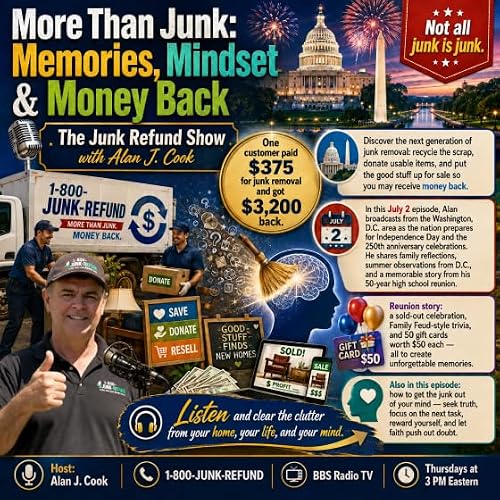
    Junk Refund Show with Alan J. Cook Junk, Generosity, and the Freedom to Clear Your Mind Episode Summary A Fourth of July Broadcast From the Nation's Capital Alan J. Cook opens this July 2nd edition of The Junk Refund Show with a personal greeting, a birthday song for his sister Carolyn, and a reflection on the joy of growing up in a large, close-knit family. Broadcasting from the Washington, D.C. area during the Fourth of July season, he describes the heat, the crowds, the increased traffic, bus activity, security changes, and the special atmosphere around the nation's capital as people gather for Independence Day celebrations. Family Traditions That Become Real Success Stories The episode turns toward the value of family traditions, especially through Alan's story about his friend Robert, who gathers dozens of family members every Fourth of July at Deep Creek Lake in western Maryland. Alan frames this kind of yearly gathering as a genuine success story, not because of the location or activities, but because of the love, commitment, and continuity that hold a family together over time. A 50-Year Reunion Built Around Memory, Fun, and Generosity Alan spends a major portion of the show recounting his 50-year high school reunion in Utah. After volunteering to handle the entertainment, he created a Family Feud-style trivia program tied to the class's 1976 bicentennial graduation year. He also contacted political offices for congratulatory videos, brought in a classmate who performs as Abraham Lincoln, arranged a mini concert from musician Kurt Bestor, and helped build an evening designed to be memorable rather than routine. The Gift Card Surprise That Became the Heart of the Night One of the central stories involves Alan purchasing fifty $50 gift cards, paying $2,500 in cash, and secretly preparing to give them away during the reunion trivia game. He describes the comic and memorable experience of buying the cards at Safeway, watching them ring up and activate one by one, and later giving them to classmates. The gesture became a symbol of the evening's spirit, creating joy, surprise, gratitude, and shared memories. Why Reunions Matter More Than Appearances Alan reflects on the emotional power of seeing classmates after 50 years, including old friends, a ninth-grade best friend, and a former girlfriend he had not seen in decades. He acknowledges that people change and may avoid reunions because of age, hardship, or self-consciousness, but he encourages listeners to attend anyway. For him, the deeper value is reconnection, shared history, honoring classmates who have passed away, and creating moments that last. Getting the Junk Out of the Mind In the final part of the show, Alan connects the junk removal business to mental and emotional clutter. Inspired by a 7-Eleven clerk who asked how to get the junk out of one's head, Alan offers advice about seeking truth, focusing only on the next right task, not trying to control the entire future, choosing faith over doubt, and rewarding oneself after hard work. His examples range from golf and business marketing to surviving a hot day of physical labor with a Chick-fil-A peach shake as a simple reward. Faith, Celebration, and the Spirit of America Alan closes with reflections on Independence Day, America, soccer, the excitement of World Cup fans, and the need to look for the good even when the world feels uncertain. He encourages listeners to keep faith ahead of doubt, enjoy the Fourth of July safely, stay cool in the heat, and continue clearing junk not only from homes and garages, but from the mind, heart, and life.
    続きを読む 一部表示
    1 時間 1 分
  • Junk Refund Show, May 21, 2026
    2026/05/22
    Junk Refund Show with Alan J. Cook Hidden Value in a House Cleanout: Scrap Metal, Norman Rockwell Finds, and the Refund Model A Cleanout Leads to Unexpected Finds Alan Cook broadcasts after working on the cleanout of a home in Damascus, Maryland, following the deaths of the homeowners. He says the job was referred through a real estate contact and describes removing household contents for disposal, recycling, donation, or possible resale. He emphasizes that estate cleanouts can uncover items that initially appear ordinary but may have resale value. How the Refund Model Works Cook explains the premise of 1-800-JUNK-REFUND as he presents it: customers pay for removal, while selected items may be sold and a portion of sales proceeds returned to the customer. He states that the company recycles metal and wire, donates suitable goods, disposes of unusable material, and returns 35 percent of sales proceeds on eligible items selling for more than $20. Building a Business From a Pickup Truck Cook recounts losing a sales position while supporting a family and serving in a volunteer church leadership role. He says he began using his pickup truck to earn income through removal work, eventually expanding the business through realtor referrals, Groupon promotions, affiliates in other regions, and low-cost travel that he says allows him to pursue larger jobs outside Maryland. The Economics of Scrap Metal A large portion of the episode focuses on scrap-metal collection. Cook discusses separating ordinary steel, cast iron, aluminum, wire, brass, and copper because he says each category brings a different price at the scrap yard. He recounts observing regular scrap haulers, including a hardworking local collector using a riding mower and trailer, and two young men enthusiastically cashing in copper. Using Resale Research to Identify Value Cook describes finding two three-dimensional Norman Rockwell Triple Self-Portrait figurines during the cleanout. While parked during the broadcast, he searches completed eBay listings and says one comparable smaller figurine sold for about $25 while a larger version sold for about $125. He uses this example, along with past jewelry and sterling-silver finds, to illustrate why he believes potentially valuable household items should be researched before disposal. Work, Gratitude, and an Everyday Routine As the episode closes, Cook reflects on enjoying the unpredictability of junk removal and the satisfaction clients express after decluttering. He thanks BBS Radio TV, invites listeners to contact the company, and ends with a personal aside about his Wendy’s Cobb Salad, water, and small Frosty routine, which he says is helping him reduce his weight while still enjoying a treat.
    続きを読む 一部表示
    1 時間