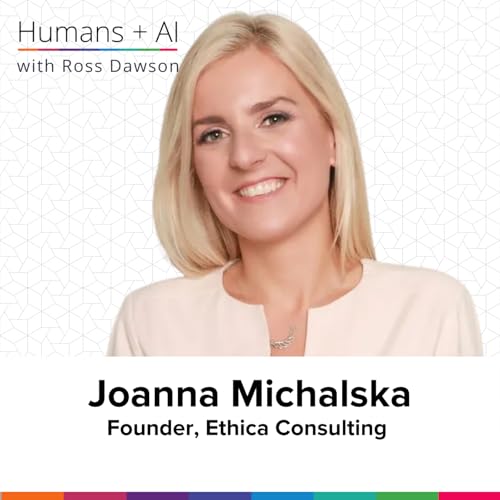
『Joanna Michalska on AI governance, decision architectures, accountability pathways, and neuroscience in organizational transformation (AC Ep36)』のカバーアート

Joanna Michalska on AI governance, decision architectures, accountability pathways, and neuroscience in organizational transformation (AC Ep36)

Joanna Michalska on AI governance, decision architectures, accountability pathways, and neuroscience in organizational transformation (AC Ep36)

無料で聴く

ポッドキャストの詳細を見る
“Determining accountability, the ability to intervene, the time to intervention, the time to stop, pause, change, alter—there are so many different layers that need to be thought through.” –Joanna Michalska About Dr Joanna Michalska Dr Joanna Michalska is Founder of Ethica Group Ltd., Co-Founder of The Strategic Centre, and an advisor to boards on AI risk, ethics, and governance. She holds a PhD in Strategic Enterprise Risk Management and has twenty years’ experience leading enterprise risk, strategy and transformation at J.P. Morgan and HSBC. Website: ethicagroup.ai LinkedIn Profile: Dr Joanna Michalska What you will learn How boards and executives can rethink governance and accountability in the age of AIThe importance of embedding governance into organizational ecosystems for agile, responsible AI adoptionHow to map and assign human accountability for both automated and hybrid AI-human decisionsThe decision architecture needed for scalable oversight, intervention, and escalation pathwaysPractical examples of effective AI oversight in areas like fraud detection and exception handlingSteps for complying with new regulations like the EU AI Act, including inventorying AI systems and risk tieringWhy human qualities like emotional intelligence, psychological safety, and honest communication are critical in AI-driven organizationsHow leaders can foster organizational resilience and help teams adapt by building AI literacy, retraining, and supporting personal growth Episode Resources Transcript Ross Dawson: Joanna, it’s a delight to have you on the show. Joanna Michalska: Well, thank you for having me, Ross. Ross Dawson: So, AI is wonderful, but it also brings us into a whole lot of new territory where we have to be careful in various ways. I’d love to just hear, first of all, the big framing around how boards and executive teams need to be thinking about governance and accountability as AI is incorporated more and more into work and organizations. Joanna Michalska: I think we’re all very excited about the capability that exists today to help us enhance our performance and the way we think about strategic execution for our organizations. It has multidimensional consequences for how we adapt it. What’s very important right now is, as executives and boards think about accelerating their ambitions and growth plans, there needs to be awareness of two components. First, how do we as leaders, as humans, need to adapt to that new environment? There are new conditions, or perhaps existing conditions that really need to be enhanced. They’re very important to exist in order to be able to adapt and to scale. Second, do we actually have the right systems in place to enable that scale? I think it’s important to recognize that, yes, governance has always existed, but the way it existed was more as external supporting scaffolding, rather than being built into an organizational ecosystem. We also need to have the right leadership in place to ensure that decisions are made in the right way and the organization is designed in a much more robust, agile way. These two conditions are critical for not only increasing adoption, but also doing so in a safe and responsible way, especially as we expand our ambitions for the future. It’s exciting, but there’s also a lot of caution and a lot of questions being asked by executives at this time. Ross Dawson: Yes and I guess the more we can address those concerns upfront, the more it enables us to do. I have this idea of minimum viable governance—at least having some governance in place so we don’t go too badly astray. But I always think of governance for transformation as: how do you set governance not as a brake to slow you, but in fact to accelerate you, because you have confidence in how you’re going about it? Joanna Michalska: Absolutely! I think the mindset shift is very important, because governance, to your point, has always been seen as a compliance-driven thing that we must do because regulators require us to, and we need to demonstrate we have these policies and procedures in place and the right people in the right positions. Now, what the new environment is requiring of us—as executives, even board members—is a different set of responsibilities that really cannot be assumed as pre-existing. In this accelerated environment—let’s call it that, rather than just “AI,” because it’s so overused and can mean so many different things—where the automation rate is fast and overtaking everything, governance needs to change. It can’t be an afterthought or something we designed at one point in the past and now just try to fit into what’s happening. It really needs to become a well-designed, living organism. It needs to organically evolve. It needs to have the right people with the right accountability that is well understood. Accountability that was designed in the past needs to be looked at, discussed, and ...
adbl_web_anon_alc_button_suppression_c
まだレビューはありません