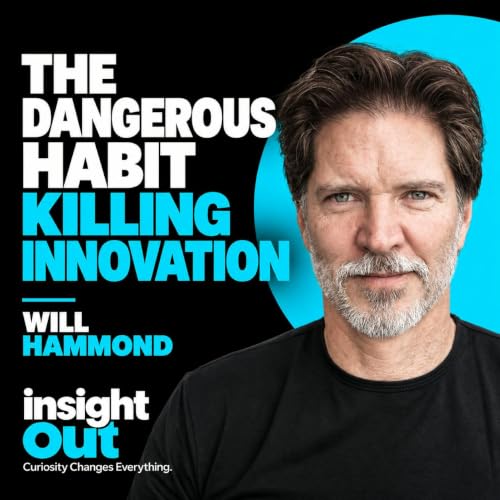
『Insight Out : Big Ideas for the Modern Entrepreneur』のカバーアート

Insight Out : Big Ideas for the Modern Entrepreneur

Insight Out : Big Ideas for the Modern Entrepreneur

著者: Billy Samoa Saleebey
無料で聴く

Every successful business journey begins with an insight—an idea, a unique approach, or an innovative solution. Insight Out explores these internal revelations and how they’ve been turned outward into actionable strategies, systems, and results. Through intimate conversations with elite business leaders, founders, and entrepreneurs, we unravel the insights that have driven their success and learn how they’ve transformed these insights into extraordinary business outcomes.© 2024 Insight Media マネジメント・リーダーシップ マーケティング マーケティング・セールス リーダーシップ 経済学
エピソード
  • The Dangerous Habit That's Quietly Killing Innovation in Your Company | Will Hammond
    2026/06/12
    How do you escape incrementalism in a world that rewards sameness? How do you stop solving the same problems differently and start thinking in ways that create seismic change? My guest Will Hammond believes the answer starts with seeing creativity not as a talent for the lucky few, but as a skill, a discipline, and in many ways a responsibility. But today is about more than creativity. It's about asking better questions, thinking better, and doing what it takes to break free. In this episode of Insight Out, I sit down with Will Hammond, a creative leader who has spent years running major agencies including Saatchi & Saatchi and DDB, and is now on a mission to teach left brain thinkers how to unlock elite creative thinking. We dive deep into the hidden trap that keeps most leaders stuck in incremental growth and how to break free from it. Throughout our conversation, Hammond shares powerful stories and real world examples that bring his concepts to life. Like the time a creative director tendered his entire department's resignations, dated six months out, as a commitment device to force breakthrough work. Or the envelope exercise where team members wrote down their wildest dreams for the year, sealed them shut, and achieved every single goal in eight months instead of twelve. And then there's the Emerald Nuts Super Bowl story, a powerful lesson in solving a distribution problem through perception rather than logistics. He then breaks down the key practices of an elite creative thinker: why subtraction is more powerful than addition when trying to unlock better ideas, how to know if you're solving a business problem or a thinking problem, and why "stop waiting for permission" might be the most underrated leadership advice of all. Hammond doesn't just leave us with theory. He offers practical exercises you can use on a Tuesday at 2 pm to start thinking differently today. Join us as we explore these insightful themes and discover how elite creative thinking can reshape not just your business, but your life. In this episode, we discuss: [00:00] Introducing Will Hammond [03:31] The bomb blast, the mugging, and the Palisades fire [05:39] Why “creativity” became a trigger word [14:42] How to make creativity cultural in a business [18:59] The portfolio idea [21:55] The Saatchi & Saatchi resignation bet [24:24] “What is the biggest role your company can play in society?” [32:52] Why subtraction beats addition [36:42] Solving the wrong problem because it’s framed too narrowly [44:33] Seismic growth vs. incremental growth [47:23] Diagnosing a thinking problem vs. a business problem [50:50] What underperforming and “cruising” companies have in common [52:36] What to diagnose first when brought in to help a leadership team [59:07] Where to find Will and how to work with him Notable Quotes [04:31] "The more we set a goal, the more we drive toward something – opportunities suddenly start appearing that you didn't have before." – Will Hammond [05:07] "The act of writing something down – it is now real, because it exists in the world. If you have a goal and you just have it in your head, it's kind of not really a goal." – Will Hammond [07:19] "Creativity is solving problems. Your broom breaks. You don't have another broom. You grab a stick and duct tape. That is being creative." – Will Hammond [16:55] "When everybody in a company is excited about kicking the competition's butt, you've bonded everybody against a singular mission. It breaks down silos." – Will Hammond [25:17] "Every single company in the world is in service of another human somewhere else." – Will Hammond [30:30] "Nobody gets promoted for doing their job. People get promoted because they have an idea that they execute that brings more revenue or makes people happier." – Will Hammond [32:15] "Don't ask or wait for permission. Just do it. There is no such thing as 'should.'" – Will Hammond [35:16] "In the craziest thing we could do is a golden thread your brain would never have gotten to because it's too scared." – Will Hammond [41:22] "If you appear big, people take you seriously." – Will Hammond [44:35] "Seismic growth and incremental growth don't take more energy. The only difference is dedication." – Will Hammond [51:34] "If you rest on your laurels, you're going backwards. Even if you are moving forwards, it hasn't caught up with you yet. But you will be behind the eight ball." – Will Hammond [56:00] "The greater your vision that you bring to AI, the more powerful it is." – Will Hammond Will Hammond Website: https://www.backwardbrilliance.com/ LinkedIn: https://www.linkedin.com/in/will-hammond Email: will@backwardbrilliance.com Billy Samoa Saleebey LinkedIn: ⁠https://www.linkedin.com/in/billysamoa/ Email: ⁠billy@podify.com⁠ and ⁠saleebey@gmail.com⁠ Insight Out Website: ⁠https://www.insightoutshow.com/ Learn more about your ad choices. Visit megaphone.fm/adchoices
    続きを読む 一部表示
    1 時間 4 分
  • Why Jeff Bezos Leaves an Empty Chair in Every Meeting | Mitchell Levy
    2026/05/22
    Have you ever felt like your business is hitting revenue targets but missing something bigger? Like your team is busy, but not truly fulfilled. Like you’re succeeding on paper, but if you were on your deathbed, you’d wish you’d done things differently. Most leaders operate inside a hidden trap: short‑termism. We measure quarterly earnings, optimize employees like machines, and accidentally sacrifice the very people who make the company run. The result? 20% of employees are happy. The other 80% are checked out or actively working against you. In this episode of Insight Out, I sit down with Mitchell Levy – TEDx speaker, PhD candidate, author of 60+ books, and the creator of the Executive Abundance framework. Mitchell has interviewed over 500 thought leaders on credibility, built multiple six‑figure businesses, and spent 18 months researching why companies lose their way even when they’re profitable. Mitchell reveals why 98% of people can’t articulate their purpose in 3–9 words (and why that’s a crisis), how a single sentence from a friend forced him to pivot his entire business, and why the “empty chair” at Amazon’s executive table might be the most powerful retention tool you’re not using. He also shares his controversial take on AI, remote work, and why forcing people back to the office proves we haven’t updated our metrics since the 20th century. If you’ve ever struggled to explain what you do, wondered why your team feels disconnected, or suspected that shareholder value shouldn’t be the only scorecard, this conversation will change how you lead. In this episode, we discuss: [00:00] Why Mitchell pivoted despite building a career on credibility [02:29] From credibility to clarity [07:03] "Sell them what they want, deliver what they need" [09:03] What is the Executive Abundance engine? [12:16] The Silicon Valley software story: releasing 50% buggy code [15:47] The five stakeholder groups and why investors come fourth [17:07] The Deming and Japan calisthenics example [23:40] What "community" really means and how it's been overlooked [27:11] The ecosystem vs. the engine: what's the difference? [32:49] The four Cs of the Executive Abundance engine [34:10] What is clarity and why do 98% of people lack it? [47:26] Defining executive abundance in plain language [48:14] Where to find Mitchell and the book launch details Notable Quotes [07:05] “Sell them what they want. Deliver what they need.” — Mitchell Levy [08:47] “I cannot change anyone. I cannot teach anyone. But I can allow somebody to see a framework and if they can see a framework and insert themselves inside it, they can change themselves.” — Mitchell Levy [11:45] “We act and become what we measure.” — Mitchell Levy [13:56] “There are companies where 20% of employees are happy and 80% are either checked out or aggressively working against the company.” – Mitchell Levy [15:20] “Companies say, I care about my employees and I care about my customers. But then you look at the numbers and the answer is no, we don't.” — Mitchell Levy [18:30] “No one on their deathbed ever says, ‘I wish I’d made more money.’ They say, ‘I wish I’d taken better care of my family. I wish I’d spent more time with my kids.’” – Mitchell Levy [20:07] “If you take care of your employees, they’ll take care of your customers. If you take care of your customers, they’ll take care of your investors.” – Mitchell Levy [23:30] “He [Bezos] would leave an empty chair in every meeting for the customer.” – Mitchell Levy [33:15] “98% of people think they have clarity. 98% don't.” — Mitchell Levy [42:30] “There's an audience I add a lot of value to.” — Mitchell Levy [47:26] “Abundance is not about money. It's about bringing quality of life to five different stakeholder groups, not just one.” — Mitchell Levy [49:41] “If we optimize the employee out of the equation, what happens to the economy, which is a consumer driven economy?” — Mitchell Levy Mitchell Levy Website: mitchelllevy.com Book: Executive Abundance LinkedIn: https://www.linkedin.com/in/mitchelllevy/ Billy Samoa Saleebey LinkedIn: ⁠https://www.linkedin.com/in/billysamoa/ Email: ⁠billy@podify.com⁠ and ⁠saleebey@gmail.com⁠ Insight Out Website: ⁠https://www.insightoutshow.com/ Learn more about your ad choices. Visit megaphone.fm/adchoices
    続きを読む 一部表示
    55 分
  • Why the Lowest-Paid Person Knows What Your Business Is Missing - Gary David
    2026/05/01
    What if the janitor in your building knows more about your business than your CEO? What if the person you overlook the most holds the exact insight that could save your company millions? And what if the only reason you have not heard it is because no one ever thought to ask? According to sociologist Gary David, that is not a hypothetical but a pattern. In every organization, the people at the lowest point of the org chart often have the clearest view of what is actually happening on the ground. But leaders rarely talk to them. They design strategies from the top down, rely on the wrong signals, and then wonder why their customer first initiatives are burning out employees and weakening morale. Gary has spent 26 years at Bentley University teaching business students to think like sociologists: to study systems rather than just individuals, to map stakeholders from the ground up, and to understand that data without context can easily mislead. In this episode, we explore why the Starbucks mobile order shift created unintended pressure points, how a well intentioned grant tied to underage drinking distorted crime data, and why the janitor in The Breakfast Club might have understood the system better than anyone else in the room. Because if you are not designing with people, including the ones who clean the floors and staff the front desk, you are not really designing at all. In this episode, we discuss: [00:00] Why systems matter more than individuals [01:57] What shaped Gary’s interest in human behavior [03:56] Why we act differently in different settings [07:09] The power of social identity [10:45] Discovering sociology and thinking at scale [13:08] Bringing sociology into business [16:31] Where leaders fail at “including people” [18:38] Why the lowest levels have the best insights [21:04] The Starbucks breakdown of experience design [27:32] Limits of design thinking [30:15] Inside-out problem solving [36:07] Thinking about data at a small scale [39:00] The key question before acting on data [41:00] Business, ethics, and real-world impact [46:00] The role of business in society [50:22] Co‑creating the first DEI major in the country [55:12] What Bentley grads do differently [58:30] What other business schools should copy from Bentley [01:00:15] Where to learn more and connect with Gary Notable Quotes [00:05] "We have to look at people within context, people in systems, and how those attempts we have at making things better can ripple in ways that are unanticipated." – Gary [00:33] "Before you act on the data, critically examine your data, make sure you know where it's coming from and what's creating it." – Gary [19:12] "The people at the lowest point of an org chart can have the greatest insight in terms of how to improve things, but no one ever talks to them." – Gary [17:07] "Focusing on customer experience to the detriment of employee experience resulted in a worse overall experience and actually degraded their brand." – Gary [33:39] "Data plus context equals information. Data itself doesn't say anything." – Gary [34:53] "People don't leave an organization, does that mean it's a good organization? No. It just means people may not have the ability to leave." – Gary [54:35] "I can start to notice things I otherwise would never have noticed. And that noticing becomes an opportunity for designing and innovating." – Gary [58:36] "100% of customers are people, 100% of employees are people. If you don't understand people, you don't understand business." – Simon Sinek (quoted by Gary) Gary David Website: https://www.garycdavid.com/ LinkedIn: linkedin.com/in/gary-c-david YouTube: https://www.youtube.com/@garydavid9535/videos Podcast: Experience By Design Billy Samoa Saleebey LinkedIn: ⁠https://www.linkedin.com/in/billysamoa/ Email: ⁠billy@podify.com⁠ and ⁠saleebey@gmail.com⁠ Insight Out Website: ⁠https://www.insightoutshow.com/ Learn more about your ad choices. Visit megaphone.fm/adchoices
    続きを読む 一部表示
    1 時間 6 分
adbl_web_anon_alc_button_suppression_t1
まだレビューはありません