エピソード

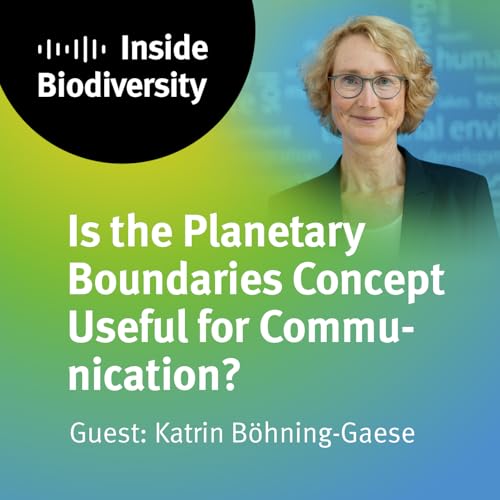
  • Is the Planetary Boundaries Concept Useful for Communication?
    2026/02/03
    In this episode, Professor Katrin Böhning-Gaese, scientific director of the Helmholtz Centre for Environmental Research – UFZ, and podcast host Dr. Volker Hahn discuss the Planetary Boundaries framework, focusing not only on the science but also considering the value of this framework for communication. Other questions at the heart of this episode are: Where has communication on climate and biodiversity gone wrong? Is there a tendency to exaggerate risks and understate progress? What are the consequences of catastrophizing rhetoric for mental health and people’s readiness to act? What can biodiversity communication learn from climate communication, and vice versa? Most importantly, how can researchers and the media do better?
    続きを読む 一部表示
    31 分
  • How Does Climate Change Reshape Conservation Policy?
    2026/01/06
    In this episode of Inside Biodiversity, Volker Hahn speaks with iDiv's sabbatical guest Miguel Bastos Araújo (Spanish Research Council at the National Museum of Natural Sciences, Madrid), one of the leading experts on species distributions and climate change. Araújo explains how species are shifting their ranges due to climate change, why some traditional protected areas are reaching their limits, and how conservation policy should adapt to a changing climate. The conversation explores how scientific evidence can inform policy and why effective conservation requires navigating multiple, often competing, rationalities. A thought-provoking episode on climate change, biodiversity, and the science-policy interface.
    続きを読む 一部表示
    37 分
  • Can Biospheric Tipping Points Scale up to Planetary Boundaries?
    2025/12/04
    In this episode, Prof. Marten Scheffer from Wageningen University & Research explains critical transitions and tipping points, from shallow lakes and coral reefs to tropical rainforests. Together with host Dr. Volker Hahn, he explores whether local tipping points can be scaled up to a biospheric planetary boundary, and how uncertainty shapes our understanding and communication. Scheffer explains why he believes the concept of tipping points remains relevant for policy and management—even when we do not know where they lie.
    続きを読む 一部表示
    36 分
  • Can We Detect Tipping Points in the Biosphere?
    2025/11/06
    Are there tipping points in ecosystems — and if so, can we detect them before the system tips? In this episode of Inside Biodiversity, host Volker Hahn talks with Helmut Hillebrand, professor at the University of Oldenburg and the Helmholtz Institute for Functional Marine Biodiversity, about the science and the politics behind thresholds, regime shifts, and planetary boundaries. Hillebrand says, “Thinking about biodiversity in binary ways, about below and above a threshold, is the wrong way of thinking about how biodiversity works and how we rely on biodiversity.”
    続きを読む 一部表示
    39 分
  • How Detrimental Are Non-Native Species?
    2025/10/02
    Not every species introduced by humans becomes a problem – but some do, especially on islands. In this episode of Inside Biodiversity, invasion biologist Marten Winter (iDiv and Leipzig University) explains how we define alien vs. invasive species, why the raccoon is a management challenge for Europe, and why management is particularly tricky in places like Australia. We also discuss the ethical dilemmas of controlling species such as the red fox – and whether it is possible to identify non-native species without knowing their origin.
    続きを読む 一部表示
    40 分
  • Can We Go Back to Eden?
    2025/09/04
    What should we really aim for in nature conservation—and who gets to decide? In this episode of Inside Biodiversity, science writer Emma Marris challenges long-held ideas about wilderness, ecosystem integrity, and invasive species. She argues that conservation is driven by human values—not objective science—and calls for a more democratic, transparent approach to setting goals for nature. If you’ve ever wondered whether “naturalness” is an illusion or why change in ecosystems isn’t always a loss, this thought-provoking conversation will make you see biodiversity in a whole new light.
    続きを読む 一部表示
    33 分
  • How Has Biodiversity Changed Over Millions of Years?
    2025/08/07
    Why has biodiversity decreased over the past 20 million years? Why did large mammals, such as giant sloths, tapirs, and mammoths, go extinct at the end of the last ice age, some 50,000 to 10,000 years ago? Why are there many fewer mammal species today than there “should be”? In this episode, we speak with Prof. Susanne Fritz, research group head at iDiv and the Friedrich Schiller University Jena, about biodiversity change over very long time scales. She shares insights into how past extinction events shaped today’s ecosystems — and what that might mean for the future.
    続きを読む 一部表示
    37 分
  • How Concerning Is Biodiversity Change?
    2025/07/03
    While some biodiversity change trends are deeply worrying, such as the decline of common bird species in North America, others offer hope, such as the recovery of rare birds: “I've seen in my lifetime species that were locally extinct come back, and rivers that were dead come back to life,” says Inside Biodiversity guest Henrique Pereira. “And that's because there's been so much positive development from environmental policy in Europe and in other countries in the world.”
    続きを読む 一部表示
    39 分