『Illustrating Leadership』のカバーアート

Illustrating Leadership

Illustrating Leadership

著者: Jessica Wright
無料で聴く

Sharing stories of the people who influenced us and discussing how to lead with heart in this day and age.2023 出世 就職活動 経済学
エピソード
  • Illustrating Leadership Lesson: The Relationships That Matter
    2026/06/24

    In this episode of Illustrating Leadership, I had the joy of talking with Shoshana Allice, a neuro-inclusive leadership coach and the founder of Decolonizing Leadership.

    Shoshana has spent nearly 30 years in leadership development, and her work has become increasingly focused on the intersection of neurodivergence and leadership. Through her own late-diagnosed neurodivergence, her family experience, and her work with clients, she has developed a deep commitment to helping people rethink what leadership can look like.

    And that is really the heart of this conversation.

    Leadership does not have to look one way.

    It does not have to sound one way.

    It does not have to fit the old model of power, control, perfection, and certainty.

    When I asked Shoshana about a leader who shaped her, she shared about Karen, a manager she worked with for nearly eight years.

    Karen created a team culture rooted in relationship. Almost every morning, the team gathered for coffee. Often, they were not talking about work. They were getting to know each other as human beings.

    What mattered to them.
    What frustrated them.
    What lit them up.
    What was happening in their lives.

    That relational foundation changed how the team worked together. They knew how to lean into one another's strengths. They knew how to collaborate. They knew how to support one another as people, not just as roles.

    For Shoshana, that leadership still stands the test of time.

    Karen saw what each person needed in order to thrive. She did not manage everyone exactly the same way. She led from the same principle, but adapted her approach to the human being in front of her.

    That is such an important distinction.

    We also talked about values, curiosity, neuroinclusion, and what it means to decolonize leadership. Shoshana described decolonizing leadership as the ongoing work of questioning the assumptions we have inherited about power, authority, control, and what a "real" leader is supposed to look like.

    Instead of power over, what if leadership became power with?

    Instead of control, what if leadership centered connection?

    Instead of maintaining the status quo, what if leadership helped more people feel seen, heard, included, and able to contribute?

    Shoshana left us with a simple but powerful tool: curiosity.

    Curiosity helps us pause before assuming.
    Curiosity helps us stay open when we are triggered.
    Curiosity helps us ask better questions.
    Curiosity helps us build more human-centered leadership.

    And maybe that is where rethinking leadership begins.

    Not with having all the answers.

    But with being willing to ask better questions.

    Connect with Shoshana

    Check out Shoshana's website and definitely send her a connection request on LinkedIn!

    Connect with Jessica

    Learn more about how your host supports leaders by visiting her website...and definitely send a connection request on LinkedIn and let her know you listened to this podcast!

    続きを読む 一部表示
    38 分
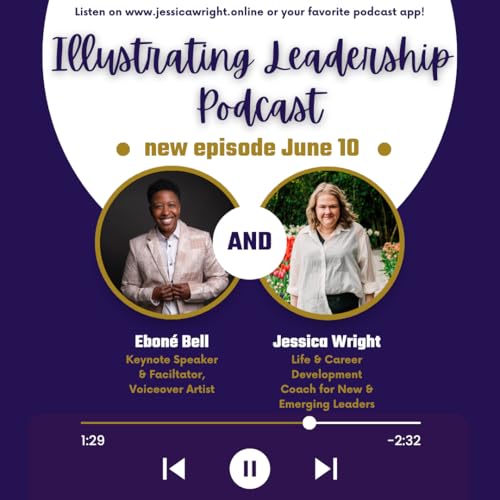
  • Illustrating Leadership Lesson: Creating Opportunity
    2026/06/10

    In this episode of Illustrating Leadership, I had the joy of talking with Eboné Bell, a speaker, storyteller, facilitator, and voiceover artist whose work centers on leadership, confidence, allyship, belonging, and connection.

    And connection really is the thread.

    Eboné chose to highlight Madam C.J. Walker, an entrepreneur and community builder whose leadership continues to inspire her. What stood out most was not only Madam Walker's business success, but the way she used that success to create opportunity for others.

    She did not build only for herself.

    She built with her community in mind.

    Eboné shared how Madam C.J. Walker put her products in the hands of Black women across the country, giving them a path to financial opportunity. She listened to the women who worked with her. She gave back through scholarships and community support. She understood that leadership is not just about what we create, but who we lift as we create it.

    That idea reminded me of something my mom used to say when I was little:

    Leave the room better than you found it.

    At the time, she probably meant the actual room. Pick up the pillow. Put things away. Notice what needs care.

    But those words have become something much bigger for me.

    Leave the relationship better.
    Leave the conversation better.
    Leave the leader better.
    Leave the space better.

    That is the kind of leadership Eboné brings into her work, too. Whether she is speaking about allyship, confidence, Black history, LGBTQ+ inclusion, or leadership, her goal is to help people feel more connected and more able to act.

    Because authenticity is not just about being seen.

    It is also about creating the conditions for other people to show up more fully, too.

    As Eboné said near the end of our conversation: lead with authenticity.

    It matters.

    Connect with Eboné

    Make sure you check out Eboné's website and go say hi on LinkedIn and Instagram!

    Connect with Jessica

    Learn more about how your host supports leaders by visiting her website...and definitely send a connection request on LinkedIn and let her know you listened to this podcast!

    続きを読む 一部表示
    28 分
  • Illustrating Leadership Lesson: Learning Agility
    2026/02/11
    There are some conversations that remind me exactly why the Illustrating Leadership Podcast exists. This one with Angie McDermott did that. Angie has spent her career helping leaders, teams, and organizations grow into their potential. Her work spans global research at Procter & Gamble, leadership and organization development at Dell, running her own business, leading HR in tech, teaching at UT Austin, and now focusing on scaling her impact and legacy work. Across every role and every season, one belief has remained constant for her: Leadership is learned. Not inherited. Not granted by a title. Not reserved for a lucky few. Learned. And honestly, that might be one of the most hopeful leadership messages we can offer, especially right now. Two Leaders, Two Contexts, One Truth In this episode, Angie shared stories of two leaders who shaped her understanding of what effective leadership actually looks like. One was a CEO in a high-growth software company, an environment where everything moves fast and the pressure to perform is constant. The other was the long-time CEO of LifeWorks, a nonprofit in Austin focused on solving youth homelessness through housing, mental health, education, and workforce services. Different sectors. Different pressures. Different day-to-day realities. And yet, the leadership lesson was remarkably similar. Both leaders found ways to merge mission, people, and vision without losing their humanity. Letting Go of the "Born Leader" Myth Angie named something many of us have felt but rarely say out loud. The idea of the "born leader" does more harm than good. The leaders who make the greatest impact are not born with a fixed set of traits. They learn. They adapt. They surround themselves with people who are smarter than they are in specific areas. They stay open to feedback. They grow with the role instead of trying to perform their way through it. When leadership becomes a practice instead of a performance, everything shifts. If leadership is learned, then it is accessible. And it becomes something we are responsible for developing, not something we either have or do not. High Standards and High Care One of the things that stood out most in Angie's description of the software CEO was the balance he held. He expected a lot. He moved quickly. He held high standards. And he listened. He did not need to be the smartest person in the room. He built strong teams by asking good questions, investing in culture, and treating people with respect. Because of that, people were deeply committed to the work and to each other. It was a reminder I come back to often in leadership work. Focusing only on results might get you short-term outcomes. Focusing on people while pursuing results tends to build stronger teams, healthier cultures, and better long-term success. Knowing Who to Call Is a Leadership Skill The nonprofit leader Angie described led in an entirely different kind of pressure. Constant crisis. Limited resources. High emotional stakes. What stood out was not charisma or control. It was clarity and connection. She built genuine relationships across community partners, elected officials, donors, service providers, and the people the organization served. When challenges arose, she did not scramble alone. She knew who to call. That kind of leadership is built quietly over time. Through trust. Through consistency. Through showing up long before there is a crisis. Learning Agility Matters More Than We Think One of the most practical concepts Angie shared was learning agility. Learning agility is the ability to learn from experience and apply those lessons to new and unfamiliar situations. Research suggests it can be more predictive of leadership effectiveness than emotional intelligence or cognitive ability alone. The most important part is this. It is learnable. Leadership growth does not come from consuming more content alone. It comes from reflection. From asking better questions after things go well and after they do not. What worked? What did not? What assumptions did I make? What do I want to repeat? What do I want to do differently next time? Angie talked about building a regular practice of reflection, not as an indulgence, but as leadership training. Leadership does not require perfection. It requires learning. The Pressure to Be Right Immediately Another thread that resonated deeply was the pressure many new leaders feel to have the right answer on demand. Most leadership situations are not emergencies. We often have time to pause, gather information, reflect, and respond thoughtfully. The pressure to decide instantly can cloud judgment and create unnecessary stress. The goal is not to avoid mistakes entirely. It is to learn from them and avoid repeating the same ones in the same way. Leadership Is Will and Skill Near the end of the conversation, Angie shared something that stayed with me. Leadership is will and skill. You have influence. On your team. On your clients. On your ...
    続きを読む 一部表示
    31 分
adbl_web_anon_alc_button_suppression_t1
まだレビューはありません