エピソード

  • CLA: Algorithmic Law for the Cosmos | The Void No Treaty Can Fill |
    2026/03/31

    In September 2022, Elon Musk unilaterally decided not to activate Starlink over Crimea. No tribunal. No appeal. A private individual exercised veto power over a sovereign state's military operation — and the world had to accept it.

    That decision was not illegal. The problem is that no rule existed to prohibit it.

    In this episode, we open CLA: Algorithmic Law for the Cosmos — the book that diagnoses the silent collapse of a legal paradigm designed for a world that no longer exists, and proposes an alternative: the Algorithmic Common Law.

    We walk through the Prologue, Preface, and General Introduction of Volume I:

    • Why the 1967 Outer Space Treaty is structurally incapable of governing corporations that control satellite constellations
    • Why space law's problems are not future problems — they already exist, and the missions that will make them critical are in development
    • What the Algorithmic Common Law (CLA) is, and why it is neither law made by machines nor science fiction
    • The transition from Duty-to-Be to Duty-to-Optimize: how verifiable efficiency becomes a condition of normative validity in environments where inefficiency is lethal
    • Critical Efficiency Validity (VEC), Sovereignty of Evidence, and Algorithmic Dignity as the three pillars of the new paradigm

    The four CLA institutions — THEA, IURUS, EVIDEN, and OACRA — and why they are not utopia but applied institutional engineering for real problems.

    The future of space law is not predetermined. But neither is it open indefinitely.

    School of the Duty-to-Optimize and Sovereignty of Evidence

    📖 CLA Vol. I: https://a.co/d/0c38AaFL 📖 CLA Vol. II: https://a.co/d/03zXi0Sv 🌐 deber-optimizar.mx A production of EDO·OS

    続きを読む 一部表示
    21 分
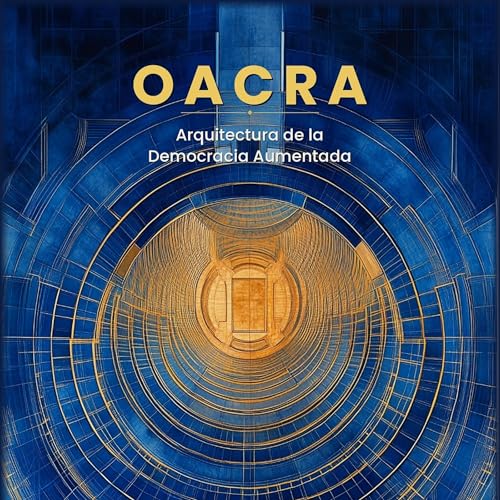
  • OACRA | Preface & Introduction — Algorithmic Governance Without Surrendering Democracy
    2026/03/26

    The AI is already inside the legislative process. Not as a regulated

    institution — as diffuse presence. The question is not whether it will

    influence how laws are made. The question is whether that influence

    happens by democratic design or by technological inertia.

    This episode analyzes the Preface and Introduction of OACRA — Algorithmic

    Office for Enhanced Regulatory Quality — by Jesús Bernal Allende. A complete

    constitutional architecture for Latin America: how to integrate artificial

    intelligence into legislative processes without surrendering popular sovereignty.

    What happened in the Netherlands when an algorithm destroyed 35,000 families.

    Why neutrality in technology does not exist. And why Latin America, precisely

    because of the depth of its institutional challenges, may be the laboratory

    where this kind of innovation proves its value.

    The MRI of the legislative process — extraordinarily powerful, but it never

    makes the decision.

    📖 OACRA: https://a.co/d/0hnR3yT9

    🌐 deber-optimizar.mx

    A production of EDO·OS

    続きを読む 一部表示
    25 分