エピソード

  • Ethics & Privacy - Podcast 04 - Leasing Privacy From Tech
    2026/02/06

    This presentation by Dr. Z defines privacy as a fundamental right. It categorizes privacy into data, physical, behavioral, communication, and decision types. The text also examines the links between privacy and security and legal regulations.

    続きを読む 一部表示
    17 分
  • Ethics & Privacy - Podcast 03 - Utilitarianism & Aesthetic Relativism
    2026/02/04

    Forcing personal or national ethics on others is by itself unethical no matter the good intentions. By extension, the beauty is in the eye of the beholder mentality destroys all standards and makes everything meaningless. This goes for those who "speak their truth" when in fact there are truths and there are falsehoods. No one gets to pick a cat and call it a dog and state that is their truth.

    続きを読む 一部表示
    16 分
  • Security Analytics - Podcast 02 - Machine Learning
    2026/02/04

    This module explores data mining, visualization, and machine learning concepts for security analytics. It details anomaly detection using network traffic. It clarifies machine learning techniques such as Regressions, Näive Bayes, Decision Trees, Random Forests, and KNN. It goes over supervised and unsupervised machine learning approaches.

    続きを読む 一部表示
    17 分
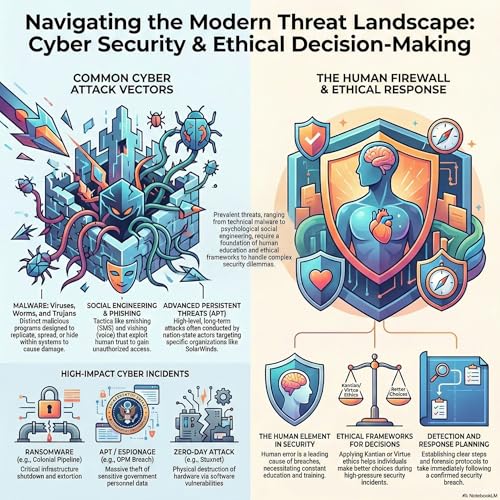
  • Security Analytics - Podcast 01 - Cybersecurity Threats
    2026/02/04

    A short 5-minute video on the variety of cybersecurity threats.

    続きを読む 一部表示
    5 分
  • Ethics & Privacy - Podcast 02 - What If Fraud Is Part Of A Culture?
    2026/02/01

    Thought corruption correlates strongly with wealth and cultural norms, which often dictate behavior more than legal rules alone. Standardized international reforms frequently fail because they ignore local identity and values. Success requires discipline, integrity, and context.

    続きを読む 一部表示
    13 分
  • Ethics & Privacy - Podcast 01 - The Road To Hell Is Paved With Good Intentions
    2026/01/31

    This transcript of an Alan Watts lecture argues that forced improvements and self-conscious righteousness often result in unintended destruction. Watts suggests that when individuals or nations attempt to "do good" without understanding the complex interconnectedness of nature, they frequently create more harm than the problems they intended to solve. He highlights how scientific interference, such as eugenics or medical over-specialization, can disrupt a delicate ecological balance that no single mind fully grasps. True virtue, according to the text, is an effortless and unconscious strength rather than a moralistic crusade imposed upon others. Ultimately, the source warns that the most diabolical actions in history are frequently committed by those convinced of their own complete moral rightness. By attempting to fix the world through conceit, humanity often paves a road to its own ruin.

    続きを読む 一部表示
    17 分