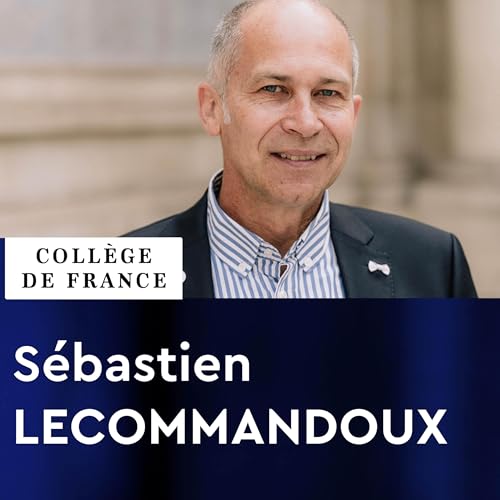
• Colloque - Advancing Biomaterials: Biomimetic and Biohybrid Innovations - Sébastien Lecommandoux : Biohybrid and Dynamic Polymersomes: from Precision Therapy to Artificial Cells
    2025/06/06

    Sébastien Lecommandoux

    Collège de France

    Innovation technologique Liliane Bettencourt (2024-2025)

    Année 2024-2025

    Colloque - Advancing Biomaterials: Biomimetic and Biohybrid Innovations

    Sébastien Lecommandoux : Biohybrid and Dynamic Polymersomes: from Precision Therapy to Artificial Cells

    Sébastien Lecommandoux

    Enseignant-chercheur au Laboratoire de chimie des polymères organiques, Bordeaux INP, professeur invité du Collège de France

    続きを読む 一部表示
    24 分
  • Colloque - Advancing Biomaterials: Biomimetic and Biohybrid Innovations - Molly Stevens : Designing and translating new materials for advanced therapies and disease detection
    2025/06/06

    Sébastien Lecommandoux

    Collège de France

    Innovation technologique Liliane Bettencourt (2024-2025)

    Année 2024-2025

    Colloque - Advancing Biomaterials: Biomimetic and Biohybrid Innovations

    Molly Stevens : Designing and translating new materials for advanced therapies and disease detection

    Molly Stevens

    John Black Professor of Bionanoscience, University of Oxford

    Résumé

    This talk will present recent advances in therapeutic and biosensing materials, with a focus on translational pipelines for clinical application. We have developed scalable fabrication methods to create complex 3D architectures and biofunctionalized surfaces with spatially organized biochemical and topographical cues. Our delivery platforms include high-molecular-weight polymer carriers for saRNA therapeutics and photo-responsive nanoreactors inspired by circadian rhythms. We are also exploring bioinspired soft robotics for targeted, stimuli-responsive drug delivery.

    In diagnostics, we are engineering functionalized nanoparticles for in vivo disease detection, including colorimetric nanoprobes for visual readouts and CRISPR-based, preamplification-free RNA detection (CrisprZyme). We have developed Raman microspectroscopy tools and machine learning techniques for hyperspectral unmixing, enabling the analysis of live-cell and organoid models and tracking nanomedicines in vivo.

    A key innovation is our SPARTA™ platform, which enables high-throughput, label-free characterization of single nanoparticles, supporting the development of nanoparticle therapeutics and exosome diagnostics.

    This talk will explore how these technologies are advancing biomedical innovation and how we are establishing translational pathways to bring them into the clinic—while striving to make healthcare solutions more accessible and equitable.

    Molly Stevens

    Professor Dame Molly Stevens FREng FRS is John Black Professor of Bionanoscience at the University of Oxford (Department of Physiology, Anatomy and Genetics and Institute of Biomedical Engineering) and part-time Professor at Imperial College London and the Karolinska Institute.

    Professor Stevens' multidisciplinary research balances the investigation of fundamental science with the development of technologies and designer biomaterials to address some of the major healthcare challenges across diagnostics, advanced therapeutics and regenerative medicine. The impact of her work is recognised by numerous accolades, including the 2023 Novonordisk Prize.

    Professor Stevens' work has a strong translational drive, focussed on translating scientific innovation into practical solutions to benefit patients and society. She is a serial entrepreneur and the founder of four spin-off companies in the diagnostics, advanced therapeutics, and regenerative medicine space. She has been recently appointed as Oxford University Champion for Women and Diversity in Entrepreneurships.

    続きを読む 一部表示
    28 分
  • Colloque - Advancing Biomaterials: Biomimetic and Biohybrid Innovations - Timothy J. Deming : Enhancing biomimicry via polypeptide side-chain modifications
    2025/06/06

    Sébastien Lecommandoux

    Collège de France

    Innovation technologique Liliane Bettencourt (2024-2025)

    Année 2024-2025

    Colloque - Advancing Biomaterials: Biomimetic and Biohybrid Innovations

    Timothy J. Deming : Enhancing biomimicry via polypeptide side-chain modifications

    Timothy J. Deming

    Professeur, UCLA

    Résumé

    Our lab has pursued development of methods to allow selective incorporation of diverse functionality into synthetic polypeptide materials. Specifically, we have developed synthetic methods that allow a robust variety of modifications to nucleophilic thioether containing side-chains in both methionine and alkylated cysteine residues. Here we show such modifications can create synthetic polypeptides that can mimic environmentally responsive coacervate formation as has been observed in cytosolic proteins. We also show how modifications can be performed simultaneously on both segments of aqueous block copolymer assemblies resulting in materials that can respond to biologically relevant stimuli.

    Timothy J. Deming

    Timothy J. Deming received a B.S. in Chemistry from the University of California, Irvine in 1989, and graduated with a Ph.D. in Chemistry from the University of California, Berkeley, in 1993. After a NIH postdoctoral fellowship at the University of Massachusetts, Amherst with David Tirrell, he joined the faculty in the Materials Department at the University of California, Santa Barbara in 1995. Here he held appointments in the Materials and Chemistry Departments where he was promoted to Associate Professor in 1999 and Full Professor in 2003. His appointment is now as Distinguished Professor of Bioengineering and Chemistry and Biochemistry at the University of California Los Angeles. He served as the Chairman of the Bioengineering Department at UCLA from 2006 to 2011. He is a leader in the fields of polypeptide synthesis, self-assembly of block copolypeptides, and use of polypeptides in biology, for which he has received awards from the National Science Foundation, the Office of Naval Research, The Arnold and Mabel Beckman Foundation, the Alfred P. Sloan Foundation, the Camille and Henry Dreyfus Foundation, the Materials Research Society, and the IUPAC Macromolecular Division. He is also a Fellow of the American Institute of Medical and Biological Engineering, and recently received the Fulbright-Tocqueville Distinguished Chair Award. Professor Deming has a long track record of training students for performing ethical, rigorous research and for organizing their data for presentations and publications. He is active in the bioinspired materials community, recently served as an Associate Editor for Biomacromolecules, and has been an Editorial Advisory Board member for Macromolecular Bioscience, Soft Matter, Macromolecules, and Biopolymers.

    続きを読む 一部表示
    34 分
  • Colloque - Advancing Biomaterials: Biomimetic and Biohybrid Innovations - Raffaele Mezzenga : Amyloid-metal biohybrids for health and environmental remediation
    2025/06/06

    Sébastien Lecommandoux

    Collège de France

    Innovation technologique Liliane Bettencourt (2024-2025)

    Année 2024-2025

    Colloque - Advancing Biomaterials: Biomimetic and Biohybrid Innovations

    Raffaele Mezzenga : Amyloid-metal biohybrids for health and environmental remediation

    Raffaele Mezzenga

    Professeur, ETH Zurich

    Résumé

    Amyloid fibrils interact with metal ions via metal-ligand supramolecular interactions whose energy is of the order of tens to hundreds of KBT. The occurrence of the 20 essential amino acids in food-based amyloid fibrils derived from inexpensive animal and plant proteins, including from food waste, combined with the extreme aspect ratio of the amyloids, allow for an affordable, yet universal toolbox to produce multifunctional hybrids which can serve in a multitude of applications and technologies. In this talk I will provide several examples of food amyloid fibrils interacting with metal ions and nanoparticles for both health and environmental remediation, some of which have made it into real technologies. Taking β-lactoglobulin amyloids as a model amyloid system derived from whey, a by-product of cheese making process, I will show how metal ions can be adsorbed from water and wastewater solutions by amyloid-based filters for water purification purposes, or how gold ions can be adsorbed and processed from amyloid aerogels to recycle gold from e-waste. I will also show how iron atoms can be coordinated to β-lactoglobulin amyloids to deliver highly bioavailable Fe(II) for iron fortification, or to design hydrogels capable of performing cascade enzymatic reactions for alcohol detoxification in vivo.

    Raffaele Mezzenga

    Raffaele Mezzenga is full professor at ETH Zurich since 2009. His research focuses on the self-assembly of proteins, polymers, liquid crystals, food and colloidal systems. He is a Highly Cited Researcher (Clarivate, 2023) in the cross-field discipline, with more than 450 publications and 20 patents. His work has been recognized by several prestigious international distinctions such as the 2017 Fellowship and the 2013 Dillon Medal by the American Physical Society, the 2013 Biomacromolecules/Macromolecules Young Investigator Award by the American Chemical Society, the 2011 American Oil Chemists' Society Young Scientist Research Award, and the 2004 Swiss Science National Foundation Professorship Award.

    続きを読む 一部表示
    40 分
  • Colloque - Advancing Biomaterials: Biomimetic and Biohybrid Innovations - María J. Vicent : Polypeptide-Based Nanomedicines: Enhancing Tropism and Overcoming Biological Barriers
    2025/06/06

    Sébastien Lecommandoux

    Collège de France

    Innovation technologique Liliane Bettencourt (2024-2025)

    Année 2024-2025

    Colloque - Advancing Biomaterials: Biomimetic and Biohybrid Innovations

    María J. Vicent : Polypeptide-Based Nanomedicines: Enhancing Tropism and Overcoming Biological Barriers

    María J. Vicent

    Professeur, CIPF Valence

    Résumé

    Polypeptides play a crucial role in areas like nanomedicine, where their biological function is governed by intricate structural features. Studying structure-activity relationships is essential to optimize polypeptide-conjugate designs, as minor structural changes can lead to unexpected yet highly effective biological outcomes. We have addressed traditional synthetic limitations by using controlled NCA polymerization and rigorous characterization, producing well-defined architectures. Post-polymerization modifications introduce various functional groups and orthogonal reactive sites, enabling a wide range of polypeptide configurations, such as diblock copolymers and star-shaped structures. These can self-assemble into supramolecular nanostructures with unique biological properties, including tissue specificity, subcellular targeting, and potential brain delivery. Through a bottom-up strategy and the strategic design of polymer-drug linkers, in vitro and in vivo assessments have shown these systems to be non-toxic, with enhanced cellular uptake and extended half-life and accumulation in specific tissues like lymph nodes, mitochondria, and the brain. These findings position our polypeptide-based nanosystems as promising therapeutics.

    María J. Vicent

    Professor María J. Vicent leads the Polymer Therapeutics Lab at the Príncipe Felipe Research Center (CIPF) since 2006 and became its Scientific Director and Cancer Program Coordinator in 2024. She also oversees the Screening Platform, part of the EU-OpenScreen infrastructure, and currently serves as president-elect of the Controlled Release Society (CRS). Additionally, she is Editor-in-Chief of Advanced Drug Delivery Reviews. Her research focuses on designing innovative nanopharmaceuticals through Polymer Therapeutics to address unmet clinical needs in diagnostics and therapy. Her work has been supported by national and EU grants, including ERC-funded projects like MyNano, Polymmune, and Polybraint, as well as NanoPanTher and other public-private initiatives. María has received multiple accolades such as the Idea and Samyang awards and Women in Science honors. She is a Fellow of the National Academy of Inventors (FNAI), the AIMBE College of Fellows (since 2019), and the CRS College of Fellows (since 2021). With over 155 peer-reviewed publications and 15 patents, her innovations have led to six technology licenses, one of which helped launch the spin-off Polypeptide Therapeutic Solutions S.L. in 2012. The company, rebranded as Curapath after its acquisition by Arcline in 2021, is now a leading CDMO with over 100 employees.

    続きを読む 一部表示
    41 分
  • Colloque - Advancing Biomaterials: Biomimetic and Biohybrid Innovations - Sam Stupp : Role of Supramolecular Motion in Cell Signaling
    2025/06/06

    Sébastien Lecommandoux

    Collège de France

    Innovation technologique Liliane Bettencourt (2024-2025)

    Année 2024-2025

    Colloque - Advancing Biomaterials: Biomimetic and Biohybrid Innovations

    Sam Stupp : Role of Supramolecular Motion in Cell Signaling

    Sam Stupp

    Professeur, Northwestern University

    Samuel Stupp is Board of Trustees Professor of Materials Science and Engineering, Chemistry, Medicine, and Biomedical Engineering at Northwestern University. He also directs Northwestern's Center for Regenerative Nanomedicine. Stupp's interdisciplinary research is focused on developing self-assembling supramolecular nanostructures and materials for functions relevant to renewable energy, regenerative medicine, and robotic soft matter. He is a member of the U.S. National Academy of Sciences, the U.S. National Academy of Engineering, the American Academy of Arts and Sciences, the Royal Spanish Academy, the National Academy of Sciences of Latin America, the National Academy of Sciences of Costa Rica, and the U.S. National Academy of Inventors. Stupp has won numerous awards over the course of his career, including three American Chemical Society national awards: the Award in Polymer Chemistry, the Ronald Breslow Award for Achievement in Biomimetic Chemistry, and the Ralph F. Hirschmann Award in Peptide Chemistry. He recently received the 2022 Materials Research Society Von Hippel Award, the highest honor awarded by this society. Other awards include the Department of Energy Prize for Outstanding Scientific Accomplishment in Materials Chemistry, the Materials Research Society Medal Award, the Royal Society of Chemistry Award in Soft Matter and Biophysical Chemistry, and the Nanoscience Prize from the International Society for Nanoscale Science, Computation, and Engineering, which recognizes lifelong achievement in the field.

    続きを読む 一部表示
    47 分
  • Colloque - Advancing Biomaterials: Biomimetic and Biohybrid Innovations - Kazunori Kataoka : Self-Assembling Polymer Nanosystems: Towards Clinical Translation of Smart Drug Delivery
    2025/06/06

    Sébastien Lecommandoux

    Collège de France

    Innovation technologique Liliane Bettencourt (2024-2025)

    Année 2024-2025

    Colloque - Advancing Biomaterials: Biomimetic and Biohybrid Innovations

    Kazunori Kataoka : Self-Assembling Polymer Nanosystems: Towards Clinical Translation of Smart Drug Delivery

    Kazunori Kataoka

    Professeur, iCONM - University of Tokyo

    Résumé

    Self-assembling polymer-based nanosystems, particularly polymer micelle-type drug delivery systems (PM-DDS), have emerged as powerful platforms for the smart delivery of therapeutic agents. Constructed through the spontaneous organization of precision-engineered block copolymers, these nanoscale carriers—typically 10 to 100 nm in size, comparable to viruses—feature a core–shell structure that enables both efficient drug encapsulation and excellent biocompatibility. While initially developed for small-molecule delivery, PM-DDS technology has rapidly evolved to accommodate more complex modalities such as nucleic acid and protein therapeutics, as well as imaging contrast agents. This presentation will focus on recent advances in PM-DDS, with particular emphasis on systems designed for the delivery of nucleic acid-based drugs including siRNA, antisense oligonucleotides (ASO), and mRNA. Highlighted examples include platforms that have progressed to clinical evaluation, underscoring the translational potential of these self-assembling nanocarriers in addressing intractable diseases.

    Kazunori Kataoka

    Prof. Kazunori Kataoka is the Center Director of the Innovation Center of NanoMedicine, Kawasaki Institute of Industrial Promotion, and Professor Emeritus at the University of Tokyo. For over four decades, he has made pioneering contributions to the fields of biomaterials, particularly in drug delivery and targeting, non-viral gene delivery, and nanomedicine. He has authored more than 600 peer-reviewed publications, which have garnered over 100,000 citations (h-index: 168), and has been recognized as a Highly Cited Researcher by Clarivate Analytics for nine consecutive years since 2016. His many accolades include the Clemson Award from the Society for Biomaterials (2004), the Founder's Award from the Controlled Release Society (2006), the NIMS Award from the National Institute for Materials Science (Japan, 2009), the Humboldt Research Award (2012), the Leo Esaki Prize (2012), the Gutenberg Research Award (2015), the Princess Takamatsu Cancer Research Fund Prize (2017), the Biomaterials Global Impact Award (2023), and the Clarivate Citation Laureate in Chemistry (2023). He is an International Member of the U.S. National Academy of Engineering (since 2017), and a Fellow of the U.S. National Academy of Inventors (since 2017). In 2018, he was awarded the honorary degree Doctor Honoris Causa (Dr.h.c.) by Johannes Gutenberg University Mainz, Germany

    続きを読む 一部表示
    37 分
  • Colloque - Advancing Biomaterials: Biomimetic and Biohybrid Innovations - Patrick Couvreur : Advanced nanomedicines for the treatment of severe diseases
    2025/06/06

    Sébastien Lecommandoux

    Collège de France

    Innovation technologique Liliane Bettencourt (2024-2025)

    Année 2024-2025

    Colloque - Advancing Biomaterials: Biomimetic and Biohybrid Innovations

    Patrick Couvreur : Advanced nanomedicines for the treatment of severe diseases

    Patrick Couvreur

    Professeur invité, Collège de France

    Résumé

    Even if new molecules are discovered to treat severe diseases, the clinical efficacy of conventional chemotherapeutics is hampered by drug resistance and non-specific biodistribution. Advanced nanodevices may overcome some of these limitations. This will be illustrated by several advanced nanomedicine platforms:

    The design of biodegradable doxorubicin-loaded polyalkylcyanoacrylate nanoparticles for the treatment of the multidrug resistant hepatocarcinoma (a nanomedicine with phase III clinical trials ended).

    The construction of nanoparticles made of metal oxide frameworks (NanoMOFs), a highly hyperporous material obtained by the complexation of iron oxide clusters with diacids.

    The "squalenoylation", a technology that takes advantage of the squalene's dynamically folded molecular conformation, to link this natural and biocompatible lipid with drug molecules to achieve the spontaneous formation of nanoassemblies (100–300 nm). These squalene-based nanoparticles are using the circulating LDL as "indirect" carriers for targeting cancer cells with high expression of LDL receptors. The application of the "squalenoylation" concept to the treatment of cancer and neurological disorders will be discussed too.

    Patrick Couvreur

    Patrick Couvreur is a Professor Emeritus at Université Paris-Saclay and a member of the French Academy of Sciences. He held the Liliane Bettencourt Chair of Technological Innovation at the Collège de France in 2010 and is also a member of the Institut Universitaire de France (IUF). A world-renowned expert in drug delivery and nanomedicine, his research focuses on the use of nanotechnologies to develop targeted therapies for severe diseases, particularly cancer and central nervous system disorders. He has founded three start-ups, one of which was listed on the stock exchange and led the development of a nanomedicine that reached phase III clinical trials for the treatment of resistant hepatocellular carcinoma. Professor Couvreur is also a member of the French National Academy of Medicine, the Academy of Technologies, and served as President of the French Academy of Pharmacy in 2020. Internationally, he is a member of the U.S. National Academy of Medicine, the U.S. National Academy of Engineering, the Royal Academy of Medicine of Belgium, the Royal National Academy of Pharmacy in Spain, and the Japan Academy of Pharmaceutical Sciences and Technology. He has received numerous prestigious awards both in France and abroad, including the Host Madsen medal, the CNRS Innovation Medal, the Galien Prize, and the European Inventor Award.

    続きを読む 一部表示
    33 分