

Reprogramming the Failing Heart New Frontiers in Cardiac Regeneration and Precision Medicine
カートのアイテムが多すぎます
カートに追加できませんでした。
ウィッシュリストに追加できませんでした。
ほしい物リストの削除に失敗しました。
ポッドキャストのフォローに失敗しました
ポッドキャストのフォロー解除に失敗しました

Reprogramming the Failing Heart New Frontiers in Cardiac Regeneration and Precision Medicine
-
ナレーター:
-
著者:
概要
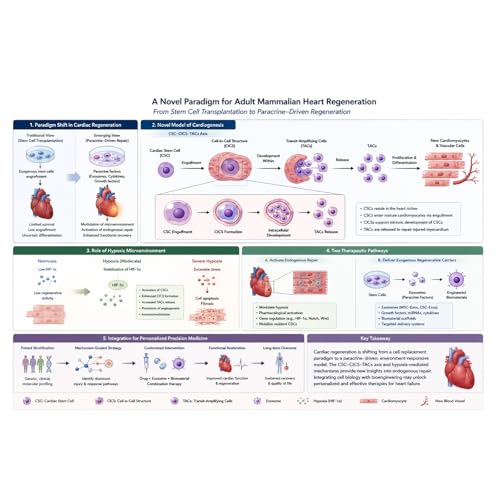
This review paper explores cutting-edge strategies for adult mammalian heart regeneration, with a particular focus on the paradigm shift from traditional stem cell transplantation toward the study of paracrine factors such as exosomes. The authors propose an innovative model of cardiogenesis, suggesting that cardiac stem cells (CSCs) do not directly differentiate into mature cardiomyocytes. Instead, they form intracellular developmental structures known as cell-in-cell structures (CICSs) within mature cardiomyocytes, which subsequently release highly proliferative transit-amplifying cells (TACs) that contribute to tissue repair.
The paper further examines the dual role of hypoxic environments in triggering regenerative mechanisms and compares two distinct therapeutic approaches: activating endogenous repair pathways versus delivering exogenous regenerative carriers. Ultimately, the study aims to integrate advances in cell biology and bioengineering to provide a theoretical foundation for cardiac functional reconstruction within the framework of personalized precision medicine.