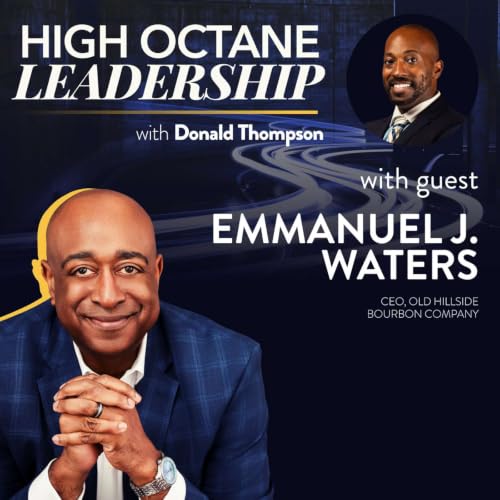
『High Octane Leadership』のカバーアート

High Octane Leadership

High Octane Leadership

著者: Donald Thompson
無料で聴く

Future-proof your leadership with High Octane Leadership, a place where business leaders—whether by title or aspiration—share cheat codes for unlocking workplace excellence, lessons learned along the way, and insider tips for future generations of next-level professionals. With a career rooted in building people and businesses, Donald Thompson is an award-winning CEO, speaker, and author who empowers leaders to scale with purpose. Over the last 25 years, he has helped startups and enterprises alike drive cultural change, unlock performance, and deliver exceptional results through strategic leadership. Find him on LinkedIn, and listen here to learn how you can become future-proof too.580648 マネジメント マネジメント・リーダーシップ 出世 就職活動 経済学
エピソード
  • Less Than 1% of a $40 Billion Industry Is Black-Owned. Emmanuel J. Waters and Old Hillside Bourbon Are Changing That
    2026/06/18
    Old Hillside Bourbon is a premium spirits brand co-founded by Emmanuel J. Waters, built on the history of Black Wall Street, the forgotten Black jockeys of the Kentucky Derby, and Durham's entrepreneurial tradition. The brand entered into a $40 billion industry where African Americans represent 12% of consumers but less than 1% of ownership. In this episode, Donald Thompson sits down with Emmanuel J. Waters, CEO and co-founder of Old Hillside Bourbon, to unpack how a brand rooted in Black Wall Street, the Kentucky Derby's forgotten Black jockeys, and Durham's rich entrepreneurial history is winning gold medals, breaking distribution records, and building something far bigger than a bottle.Episode Long DescriptionOld Hillside Bourbon was never supposed to work. Bourbon experts told the founders not to launch in North Carolina, one of the hardest control states in the country. African Americans spend nearly $3 billion in alcohol annually and own less than 1% of alcohol companies. Emmanuel had never tasted bourbon before co-founding the company. Then they held their first bottle signing in Durham. The line wrapped around the building. People bought six, seven, eight bottles at a time. They sold 50 cases in a single day, breaking a record in the state they were told would kill their brand.In this episode of High Octane Leadership, Donald Thompson and Emmanuel J. Waters dig into what happens when a brand is built on something more powerful than marketing: a story worth telling. From the history of Black Wall Street in Durham to the forgotten Black jockeys who built the Kentucky Derby, Old Hillside is using bourbon as a medium to recover and celebrate the American stories that have been systematically erased. And along the way, they are winning double gold medals at the largest spirits competition in the world.In Episode 186 of High Octane with Donald Thompson, Waters and Thompson discuss what happens when a brand is built on story rather than marketing spend. The most durable competitive advantage is a story nobody else can tell. Old Hillside Bourbon is the proof.Key Talking Points:History, Heritage, and Homage: How Old Hillside Bourbon built its entire brand strategy around three pillars that no legacy competitor can replicate. The Economics of Black Entrepreneurship: Emmanuel breaks down what that gap costs communities and how to close it.The Durham Moment: How selling 300 bottles in a state they were told would kill their brand became the proof of concept that changed everything.The Gold Medal Standard: Why Old Hillside entered the largest spirits competition in the world, what winning a double gold medal proved, and what it means to compete not as the best Black-owned bourbon but as the best bourbon period.The Invisible Generals Project: How Old Hillside is honoring the first Black father and son duo in American military history with a limited edition bottle that turns history into a collectible.Chapter Markers00:00 - Intro: Emmanuel J. Waters and Old Hillside Bourbon01:15 - Military Brat to Silicon Valley to Bourbon Co-Founder: Emmanuel's Origin Story03:30 - Why Bourbon Takes Years to Build and What That Teaches Leaders About Patience07:00 - History, Heritage, and Homage: The Three Pillars Behind the Old Hillside Brand10:00 - Black Wall Street, Durham, and the Responsibility of Black Entrepreneurship12:00 - Navigating a $9 Billion Industry Where Less Than 1% of Owners Look Like You14:30 - How to Support Black-Owned Businesses Without Asking for Free Product17:00 - The Distribution Reality: Licenses, Control States, and Where to Find Old Hillside20:00 - Leadership Lessons from a New CEO: Vision, Risk, and Building a Team to Win22:00 - The Durham Bottle Signing: How Breaking a Record in the Hardest State Changed Everything25:00 - The Gold Medal Standard: Entering the World's Largest Spirits Competition28:00 - The Last Ride: How the Black Jockeys Bottle Became the Bill Payer31:00 - What Do You Have to Lose? Emmanuel's Case for Entrepreneurship35:00 - The Invisible Generals Project: Honoring the First Black Father and Son Military Duo38:00 - How to Connect with Emmanuel J. Waters and Old Hillside BourbonAbout the GuestEmmanuel J. Waters is the CEO and co-founder of Old Hillside Bourbon, a premium spirits brand rooted in the history, heritage, and homage of Black American excellence. A military brat who grew up in Japan and Europe before building a successful career in Silicon Valley's tech industry, Emmanuel came to bourbon not as a lifelong enthusiast but as a storyteller who recognized that the spirits industry was missing the most compelling stories in American history. Under his leadership, Old Hillside has won gold and double gold medals at the San Francisco World Spirits Competition, the largest spirits competition in the world, broken distribution records in one of the country's hardest control states, and built a brand that ships to 49 states and is carried in Whole Foods, Total Wine, and BevMo ...
    続きを読む 一部表示
    41 分
  • MapQuest Co-Founder Chris Heivly Reveals the Fort Framework for Startup Success
    2026/06/04
    SummaryThe Build the Fort Framework is a startup methodology created by Chris Heivly, co-founder of MapQuest, that strips away adult overthinking to return founders to the first-principles instincts that produce successful companies. In this episode of High Octane Leadership, Donald Thompson sits down with Chris, a senior vice president at Techstars who has advised startup ecosystems across four continents, mentored thousands of founders, and helped catalyze more than $75 million in investment capital. The conversation covers what separates founders who win from those who get stuck, why the product you are imagining today is not the one that will make you successful, and what the Build the Fort Framework reveals about customer discovery, community building, and ecosystem design. MapQuest sold for $1.2 billion. Chris Hively has spent every year since teaching founders how to build something that outlasts them.Episode Long DescriptionChris Heivly is the co-founder of MapQuest, the navigation platform acquired for $1.2 billion, and the creator of the Build the Fort Framework, a startup methodology now used across Techstars ecosystems on four continents. As a senior vice president at Techstars, Chris has helped catalyze more than $75 million in investment capital and co-founded Raleigh Durham Startup Week, which grew from 8 volunteers and 400 attendees to 49 volunteer leaders and 1,500 attendees while being designed so that no single person is indispensable to its survival.In this episode of High Octane Leadership, Donald Thompson and Chris Hively dig into the pattern recognition that comes from working with thousands of entrepreneurs across dozens of cities and countries, and why the fundamentals of building a great company have not changed even as the tools around them have. Chris shares why the product you are imagining today is not the one that will make you successful, why great mentorship is peer to peer and never assigned, and why the Build the Fort framework works because it strips away the adult overthinking that kills most ideas before they ever get started. The Build the Fort Framework is a founder methodology that replaces complex startup theory with the same instincts a child uses when building something from nothing: start with what you have, talk to the people around you, and build before you overthink.Donald Thompson and Chris Hively also discuss AI, what it means for founders, and why Chris is more curious about this technology than anything he has seen in decades, and what he and Donald are quietly plotting for the Triangle entrepreneurship community.“Talk to 100 people before you write a single line of code," advises Chris Hively, co-founder of MapQuest and creator of the Build the Fort Framework, drawing on lessons from advising thousands of founders across four continents at Techstars.Key Talking Points:What is the Build the Fort Framework? The Build the Fort Framework is Chris Heivly's startup methodology that replaces complex startup theory with the first-principles instincts most adults have been trained to ignore.Why should founders talk to 100 people before writing code? Talking to 100 potential customers before building anything is the single most important discipline Chris Hively has taught across thousands of founder conversations at Techstars, and most founders still skip it.What is hyper mentorship and why does it outperform assigned mentorship? Hyper mentorship is peer-to-peer, two-directional, and self-selected, and Chris Hively's work across Techstars ecosystems consistently shows it outperforms every formally assigned mentorship program.How do you build a startup ecosystem that outlasts its founders? Raleigh Durham Startup Week grew from 8 volunteers and 400 attendees to 49 volunteer leaders and 1,500 attendees because Chris Hively designed it from the beginning so that no single person is indispensable to its survival.How are founders getting AI wrong? Chris Hively believes founders are applying a powerful new tool to unvalidated ideas, and his answer is the same one the Build the Fort Framework always starts with: talk to 100 people before building anything.Chapter Markers00:00 - Who Is Chris Heivly? MapQuest Co-Founder, Techstars SVP, and Creator of the Build the Fort Framework02:00 - How Does a Geography Major Co-Found a $1.2 Billion Navigation Company? The MapQuest Origin Story04:30 - What Is the Build the Fort Framework and Why Do Most Startup Methodologies Fail Before It?06:30 - Why Every Founder Must Talk to 100 People Before Writing a Single Line of Code08:30 - Why Your Product Idea Today Is Not the One That Will Make You Successful11:00 - The NDA Red Flag: What It Signals to Investors When Founders Ask for One13:00 - The Trough of Disillusionment: Why Fear Stops Founders From Sharing Their Ideas16:00 - Hyper Mentorship vs. Assigned Mentorship: What Actually Works20:00 - Why Vulnerability Is a Leadership Superpower: The Story That Changed Chris Hively's ...
    続きを読む 一部表示
    52 分
  • Wildland Firefighting as a Workforce Reentry Model: Chief Royal Ramey on the Prison-to-Public-Service Pipeline
    2026/05/21
    Chief Royal Ramey moved 3,000 incarcerated individuals into public service careers through wildland firefighting. Here is exactly how he built the pipeline.SummaryThe Forestry and Fire Recruitment Program is a nonprofit workforce reentry pipeline that has moved over 3,000 current and formerly incarcerated individuals into public service careers through wildland firefighting. In this episode, Donald Thompson sits down with Chief Royal Ramey, a 12-year firefighting veteran, 2024 TED Fellow, and the program's co-founder, to examine how a fire line became one of the most measurable career pathways in the United States. After serving six years in prison, Ramey discovered that the discipline and identity structure of wildland firefighting provided what the traditional reentry system had never offered. Today his program operates across multiple states, and he is building toward a national model.Episode Long DescriptionChief Royal Ramey spent six years incarcerated before wildland firefighting gave him a framework for purpose, discipline, and leadership that the traditional reentry system had never provided him. As a 12-year firefighting veteran, 2024 TED Fellow, and co-founder of the Forestry and Fire Recruitment Program, Royal has built one of the most measurable workforce reentry pipelines in the United States, moving over 3,000 current and formerly incarcerated individuals into public service careers across multiple states.In this episode of High Octane Leadership, Donald Thompson sits down with Royal to examine how California's wildland firefighting infrastructure became an unlikely but highly effective model for workforce equity, legislative advocacy, and community reinvestment. The conversation covers Royal's four-step goal achievement framework, the economic argument for expungement, and what organizational leaders can learn from a culture that trains people to run toward the hardest problems. Housing one person in a California state prison costs close to $130,000 annually. Royal's program routes that same public investment toward a six-figure career that generates tax revenue, reduces recidivism, and creates measurable community financial stability."The most destructive conditions produce the most qualified leaders," argues Chief Royal Ramey, 2024 TED Fellow and co-founder of the Forestry and Fire Recruitment Program.Key Talking Points:Wildland Firefighting as a Workforce Reentry Model: The Forestry and Fire Recruitment Program fills a structural gap that exists in 13 states: incarcerated firefighters who serve on the line have no guaranteed pathway into the profession after release. Chief Ramey's nonprofit directly addresses that gap, with documented career outcomes for over 3,000 participants across California and partner states. Expungement as an Economic Investment, Not a Social Handout: Housing one person in a California state prison costs close to $130,000 annually, while a wildland firefighting career generates tax revenue, reduces recidivism costs, and creates a multiplier effect on family and community financial stability. Four-Step Goal Achievement Framework for High-Stakes Environments: Chief Ramey's Four-Step Goal Achievement Framework asks individuals to define the goal, confirm the desire behind it, build a concrete blueprint, and execute without exception. Developed on the fire line, the framework now drives career transition, leadership development, and organizational culture work inside Ramey's program. .Wildland Firefighting Discipline Applied to Business Leadership and Retention: The mindset that produces effective incident commanders maps directly onto corporate retention challenges. Radical accountability, mission clarity, and a culture where every team member understands their contribution are not firefighting-specific virtues; they are the conditions that reduce turnover in any high-performance organization. Climate Crisis and Incarcerated Firefighters as a National Workforce Imperative: Western wildfire frequency is increasing, and the incarcerated firefighter population represents a trained, available, and deeply motivated labor force. CAL FIRE workforce planning and state emergency management agencies have only begun to formally invest in this population as a climate infrastructure asset.Published: May 21, 2026 | High Octane Leadership with Donald Thompson, Episode 184.Chapter Markers0:00 - Intro: Chief Royal Ramey01:40 - From Fire Camp to Public Service: The Journey Out of Incarceration03:30 - Co-Founding the Forestry and Fire Recruitment Program05:00 - How Chief Ramey's Four-Step Framework Moves People from Incarceration to Public Service07:15 - How Wildland Firefighting Converts a Criminal Record into a Public Service Identity10:00 - Focus on What You Can Control: The Leadership Mindset That Changes Everything12:00 - Firefighting as a Lifestyle, Not a Nine to Five14:40 - Legislative Advocacy and the Case for Expungement18:00 - Why Expungement Costs Less Than ...
    続きを読む 一部表示
    38 分
adbl_web_anon_alc_button_suppression_t1
まだレビューはありません