エピソード

  • Episode 142: When Safety Systems Become Weaponized
    2026/05/03

    Organisations often believe they are learning every day, through pre-starts, risk assessments, permits, observations, audits, and reviews. On the surface, the system looks active. Conversations happen. Paperwork moves. Records exist. But look closer.

    In this episode, Brent Sutton from Learning Teams Inc explores how many of these tools have slowly drifted from their original purpose. What were once designed to help people understand work, share experience, and anticipate risk have, over time, become tools for proof, compliance, and control.

    This is not about bad intent. It’s about drift:

    • Before work, learning becomes proof of readiness.
    • During work, curiosity becomes surveillance.
    • After work, reflection becomes reporting.

    As this shift happens, the question quietly changes:

    • From “What do we need to understand?”
    • To “Have we done what’s required?”

    And when that happens, the real story of work, the adjustments, trade-offs, pressures, and problem-solving, starts to disappear.

    This episode challenges listeners to rethink how safety systems are used. Are they helping us learn about work… or are they being used to judge it?

    Because when systems are designed to prove, check, and defend, rather than listen and understand, the road to weaponization begins.

    続きを読む 一部表示
    11 分
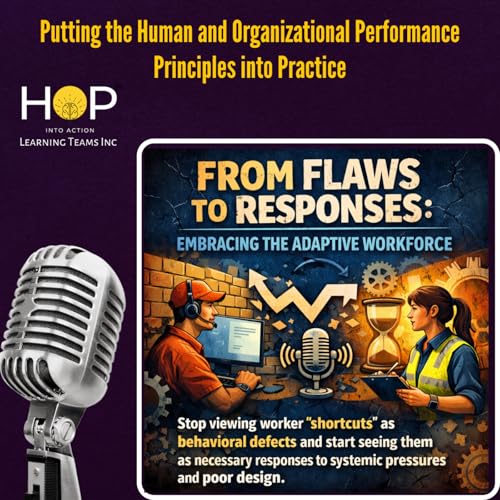
  • Episode 141: From Flaws to Responses: Embracing the Adaptive Workforce
    2026/05/03

    Brent Sutton from Learning Teams Inc explores the notion of workers needing to adapt or deviate from work as imagined in work.

    Ever wondered why work rarely happens exactly as imagined? In real settings, people respond to pressure, poor design, missing tools, interruptions, awkward layouts, and competing goals just to keep the job moving. That matters because the words we use shape what we see. When we call these actions “shortcuts,” “deviations,” or "workarounds" or even “adaptations,” we can still end up implying the person is the problem. But when we call them “responses,” we make the conditions of work visible.

    This podcast explores how worker responses often fall into three broad patterns: responses to uncertainty that help pull work back toward safety, responses that improve workflow under pressure, and everyday responses that become the new normal over time.

    The key message is simple: these responses are not defects in people, they are signals about the system. They show us where work as imagined and work as done no longer line up.

    The practical challenge for leaders is to stop asking, “Why didn’t they follow the rule?” and start asking, “What were they responding to?” That is where learning begins. Tools like the 4Ds help uncover what feels dumb, dangerous, difficult, or different in real work so organisations can improve work design, not just blame the worker.

    続きを読む 一部表示
    24 分