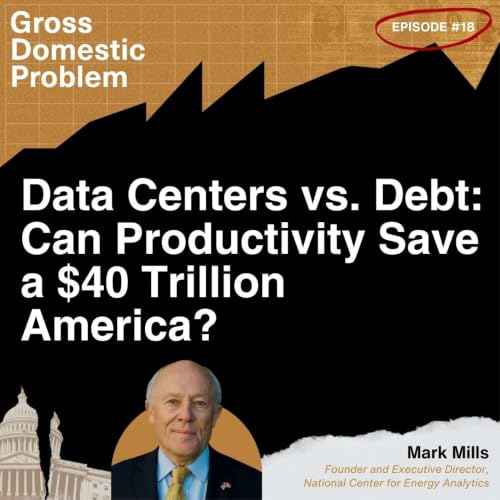
『Gross Domestic Problem』のカバーアート

Gross Domestic Problem

Gross Domestic Problem

著者: William Glass
無料で聴く

Welcome to Gross Domestic Problem — the podcast that unveils America’s biggest financial crisis. Every episode, we break down how we got here, what happens if we don’t act, and the least painful way forward. There’s no do-nothing solution. And every solution requires sacrifice. Ignoring it means handing the burden to the next generation. If that’s unacceptable to you, you’re in the right place. Subscribe now at grossdomesticproblem.com and join the conversation.2025 政治・政府 政治学 社会科学
エピソード
  • $40 Trillion
    2026/08/20

    In this episode of Gross Domestic Problem, William Glass explains the implications of the U.S. national debt surpassing $40 trillion, breaking down the difference between gross and public debt and why both matter. He highlights how the debt has grown much faster than expected, driven by structural budget issues such as mandatory spending on Social Security, Medicare, and Medicaid, as well as rising interest costs on continuously rolled-over government debt. Glass connects the national debt to everyday life through its impact on mortgage rates, business investment, jobs, and long-term economic opportunity, warning that growing debt can crowd out future prosperity. He stresses that the problem is bipartisan and cannot be solved by targeting waste alone, calling instead for serious, proactive reforms to reduce deficits relative to GDP, address entitlement programs before crisis hits, and restore fiscal credibility. Finally, he urges listeners to protect themselves by becoming more financially aware, planning for a potentially tighter economic future, and engaging politically to demand responsible fiscal policy.

    Key topics in today’s conversation include:

    • National Debt Hits $40 Trillion And Why It Matters (0:46)
    • CBO Projections, $600 Billion Overshoot, and Rising Annual Deficits (4:35)
    • How Debt Rollovers And Higher Treasury Rates Increase Interest Burden (6:32)
    • Structural Budget Problems From Mandatory Spending And Demographic Shifts (8:18)
    • Fewer Workers per Retiree And Interest Becoming the Largest Budget Line Item (9:29)
    • How National Debt Drives Mortgage Rates, Business Investment, and Growth (11:36)
    • Social Security Trust Fund Depletion in 2032 (14:04)
    • Eroding National Capacity for Infrastructure and Defense (16:32)
    • What a Serious Fiscal Plan Looks Like: 3% Deficit Target And No Sacred Cows (18:38)
    • Personal Financial Responsibility And Planning for a Tighter Future Economy (20:55)
    • Political Engagement And Demanding Action on the $40 Trillion Debt (23:22)

    Gross Domestic Problem is a podcast from Millennial Debt Foundation focusing on America’s biggest financial crisis. Each episode, we break down how we got here, what happens if we don’t act, and the least painful way forward. There’s no do-nothing solution. Subscribe now at grossdomesticproblem.com and join the conversation.


    Hosted by Simplecast, an AdsWizz company. See pcm.adswizz.com for information about our collection and use of personal data for advertising.

    続きを読む 一部表示
    26 分
  • Taxes Wrapped: Your Secret Receipt From Uncle Sam
    2026/05/06

    In this episode of Gross Domestic Problem, William Glass talks with Daniel Hall, creator of the app Taxes Wrapped, which turns your federal tax bill into a personalized, Spotify Wrapped-style “receipt” showing where your money hypothetically goes. Daniel shares how his background in economics, curiosity, SaaS, and digital experiences led to building the app as a way to make the national debt and federal spending more tangible and engaging. They discuss the psychology of engagement, the deliberate tongue-in-cheek design and randomization of profiles, and how the app itemizes spending down to oddly specific line items to close the distance between “me” and “us” as taxpayers. William uses the app to explore bigger themes: the $39 trillion national debt, the difference between discretionary and mandatory spending, the bipartisan nature of fiscal dysfunction, and the lack of honest public debate about entitlements and interest on the debt. The key takeaway is that tools like Taxes Wrapped can make abstract, overwhelming fiscal issues concrete and personal, nudging citizens to become more informed and engaged in how their government spends on their behalf.

    Key topics in today’s conversation include:

    • Where Does Your Money Go and What Taxes Wrapped Tries to Show (0:40)
    • Daniel Hall Introduction and His Path From AP Economics to Software (2:32)
    • Spotify Wrapped Analogy and Turning Tax Data Into a Personal “Receipt” (4:12)
    • Psychology of Engagement and Inspiration From Mischief’s Provocative Projects (5:39)
    • Framing Taxes as the Price Of Living in a Society and Bridging Citizen and State (7:52)
    • William’s “Permanent Under Secretary” Profile and How Randomization Works (10:06)
    • Under the Hood of ‘Taxes Wrapped’ and Hyper Specific Line Items in the Receipt (15:10)
    • Using the App to Grapple With the $39 Trillion Debt and Voter Accountability (17:18)
    • Discretionary vs Mandatory Spending (23:37)
    • Bipartisan Failure on Deficits and the Need for Honest Fiscal Conversations (28:36)
    • Daniel’s Future Plans for Highlighting Mandatory Spending and National Debt (33:47)
    • Final Thoughts and Takeaways (35:05)

    Gross Domestic Problem is a podcast from Millennial Debt Foundation focusing on America’s biggest financial crisis. Each episode, we break down how we got here, what happens if we don’t act, and the least painful way forward. There’s no do-nothing solution. Subscribe now at grossdomesticproblem.com and join the conversation.


    Hosted by Simplecast, an AdsWizz company. See pcm.adswizz.com for information about our collection and use of personal data for advertising.

    続きを読む 一部表示
    36 分
  • Generational Theft: What Today’s Policy Means for the Young
    2026/04/01

    In this episode of Gross Domestic Problem, William Glass talks with professor and former regulator Jill Cetina about the hidden “plumbing” of the financial system and how policy since 2008 has reshaped risk. They unpack how quantitative easing (QE) worked, why the Fed’s balance sheet exploded, and how QE inflated asset prices, especially housing, while quietly creating banking vulnerabilities through uninsured deposits. Cetina argues that aggressive quantitative tightening (QT) now risks new bank stress, especially in a stagflation scenario where inflation stays high as growth and employment weaken. They explore how energy shocks and potential oil spikes could fuel stagflation, why America’s rising debt and unfixed entitlement promises are pushing us toward fiscal dominance, and how stablecoins and nonbank finance can drain deposits from banks and crowd out real-economy lending. The key takeaway is that the current mix of monetary and fiscal policy is accumulating systemic risk, and younger and mid-career generations need to engage politically, professionally, and by building real-economy businesses and families, if they want the “deal” of the American Dream to remain viable.

    Key topics in today’s conversation include:

    • Introducing Professor Jill Cetina & the Core Question: “Is the Deal Still Real?” (3:32)
    • What the Fed’s Balance Sheet Does & How QE Began in 2008 (8:04)
    • QE’s Side Effects: Codependency with Fiscal Policy (10:26)
    • Housing Affordability Crisis, 3% Mortgages, and “Locked-In” Homeowners (13:32)
    • Asset Inflation Beyond Housing: Stocks, Tech, and the AI Boom (15:53)
    • Jill’s Sharp Critique: Why Current QT Thinking Is Dangerous (17:52)
    • Critique of “Use the Discount Window Instead of Keeping Liquidity” Idea (20:44)
    • Introducing Stagflation: Weak Growth + Sticky Inflation (24:47)
    • Three Vectors of Recession Risk: Oil, Falling Assets, Private Credit Stress (29:30)
    • The Fed’s Policy Shift: Tolerating Higher Inflation Post-COVID (33:16)
    • Why Extending Fed Liquidity to Nonbanks & Stablecoins Is Dangerous (35:59)
    • Defining Fiscal Dominance and How It Warps Policy & Regulation (47:42)
    • AI and Productivity: Why Counting on a Tech Moonshot Is “Nonsense” (50:06)
    • Stablecoins Draining Bank Deposits to T‑Bills = Government Crowding Out (54:26)
    • Why Congress Focuses on Crypto Instead of Fixing Fiscal Policy (57:08)
    • Generational Power Imbalance and “Gambling for Resurrection” (1:00:41)
    • Investing in the Real Economy: Building Useful Businesses (1:05:51)
    • Family Formation as a Real (Non‑Financial) “Asset” for the Future (1:05:06)
    • Closing Thoughts and Mutual Thanks (1:06:12)

    Gross Domestic Problem is a podcast from Millennial Debt Foundation focusing on America’s biggest financial crisis. Each episode, we break down how we got here, what happens if we don’t act, and the least painful way forward. There’s no do-nothing solution. Subscribe now at grossdomesticproblem.com and join the conversation.


    Hosted by Simplecast, an AdsWizz company. See pcm.adswizz.com for information about our collection and use of personal data for advertising.

    続きを読む 一部表示
    1 時間 11 分
adbl_web_anon_alc_button_suppression_t1
まだレビューはありません