• De-Extinction Regrowing Cartilage and Safer Batteries
    2026/07/08
    A massive step forward for de-extinction. A biotech company called Colossal Biosciences (the one bringing back the Wooly Mammoth) has successfully hatched 26 live chicks using an artificial environment. These chicks were born from a 3D-printed lattice structure designed to mimic a natural eggshell, including a membrane that allows for oxygen exchange. While currently using chicken embryos, the ultimate goal is to scale this technology to resurrect the South Island giant moa, an extinct 12-foot bird from New Zealand. Because a moa egg is 80 times the size of a chicken egg, no modern bird could safely lay one, making these artificial shells a necessary gateway for bringing the species back. Next, we look at a breakthrough in safety in our electrified future. Researchers from the Chinese Academy of Sciences have developed "fireproof" sodium-ion batteries that features an internal "smart firewall". Traditional lithium ion batteries can suffer from thermal runaway, a chain reaction where temperatures skyrocket and lead to explosions. This new design uses a liquid electrolyte that solidifies into a physical barrier when internal heat exceeds 150°C (302°F), effectively cutting off the reaction before a fire can start. In tests, these cells maintained their integrity even during nail penetration and external heating up to 300°C.Scientists at Stanford have discovered a way to regrow articular cartilage in joints. Cartilage has almost zero regenerative potential in adults, leading to chronic pain and arthritis for millions. The team found they could trigger the body’s own skeletal stem cells by creating a slight injury, similar to a microfracture, and then using specific chemical signals to "steer" those cells. Chemists at Northwestern University have found a way to turn natural gas into liquid methanol in a single step. Current industrial methods require extreme heat and pressure, emitting millions of tons of CO2 annually. This new process uses pulses of high-voltage electricity to create tiny "lightning bolts" of plasma inside a reactor. These bursts break methane’s bonds at low temperatures, allowing it to recombine into methanol, a versatile chemical used in everything from plastics to cleaner-burning fuels for ships.Carbon-Trapping Wastewater: Scientists found that alkaline wastewater from steel and cement production can safely bind CO2 as bicarbonate, potentially removing 30 million tons of greenhouse gas every year.Ultralight Survival Straw: Lifestraw has released its lightest filter ever, the Sip Essential, which weighs less than one ounce and can filter up to 1,000 litres of water.Brain-Activating Electronics: Researchers created flexible, printed artificial neurons that can generate electrical spikes identical to biological ones, successfully activating real brain cells in lab tests.Sweaters for Houses: A new photothermal "skin" made of coated fabric panels can be attached to exterior walls, absorbing sunlight to raise indoor temperatures and potentially cutting heating bills by 15%.Solar Power After Dark: By stripping balsa wood down to its cellular scaffolding and filling it with a "phase-change" material, scientists created a heat-absorbing sponge that can drive a generator even after the sun goes down.Plastic to Gasoline:A new technique uses molten salts to break down common plastic waste into high-grade gasoline and diesel at relatively low temperatures, making recycling much less energy-intensive.The World’s Largest Flow Battery: In Switzerland, a billion-dollar project is excavating a pit deep enough to house a 2.1 GWh redox flow battery, capable of powering 210,000 households for an entire day.And my favorite quote of the day from the Daily Quote podcast is from Robert Louis Stevenson, who said: "Don't judge each day by the harvest you reap but by the seeds that you plant".You can follow the Daily Quote in your favorite podcast app.That is it for this episode of Great News.
    続きを読む 一部表示
    9 分
  • Repairing the Brain, $20 Hearing Aids, and Turning Parking Lots into Power Plants
    2026/06/25
    The Great News Podcast is brought to you by the Daily Quote, the podcast designed to kickstart your day in a positive way.Today, we’re looking at how the empty space in our cities is being turned into a powerhouse of clean energy. Plus, we’ll explore breakthroughs in repairing the brain, a $20 medical device set to disrupt an entire industry, and why your kitchen pantry might hold the secret to stopping dangerous mosquitoes.Our lead story today focuses on a global shift to turn "stranded assets", specifically, the massive amounts of asphalt used for parking lots, into solar farms. In a bold legislative move, South Korea has passed a national law requiring all parking lots with more than 80 spaces to install solar canopies and carports. This applies to both new and existing lots, aiming to stabilize the local grid while protecting cars from rain and sun. Meanwhile, in France, the Senate passed a policy requiring similar canopies for large lots, which could generate energy equivalent to 10 nuclear reactors. In the U.S., California’s Senate Bill 49 is looking to provide tax incentives for these "miniature power plants," with estimates suggesting that covering just 400 square miles of parking lots could power 6.5 million homes.If you like the Great News Podcast, you’ll love the Great News Letter, because the Great News Podcast is great, but the Great News Letter is greater. Link is in the show notes.Next, we have a double-header of breakthroughs in neurological repair. Researchers at the University of Helsinki have identified two drug molecules that can restart the brain's natural repair process in Multiple Sclerosis by promoting the regrowth of myelin, the protective nerve coating the disease destroys. Simultaneously, a study from the University of Zurich and USC found that stem cell-derived brain cells transplanted after a stroke can actually rebuild damaged connections and restore coordination. These cells didn't just survive; they matured into functioning neurons and triggered a broader healing response across the injured brain.In the world of affordable healthcare, a group called Founders Inc. has reinvented the hearing aid by studying the mechanics of the human ear. While a standard hearing aid can cost an astronomical $4,700,this new version is being brought to market for just $20, potentially making life-changing technology accessible to millions for the first time.Finally, scientists at Yale have discovered that garlic acts as a powerful birth control for mosquitoes. A natural compound called diallyl disulfide blocks the mating and egg-laying process in species that spread diseases like Zika and yellow fever. Interestingly, it's not the smell that deters them, but a specific taste receptor in their tiny organs that triggers an avoidance behavior.It's time for the speed round, where we squeeze in even more positivity:The Health Power of HummingBottling the SunLifestyle choices beat geneticsMicrobiome Brain BoostCleaner Air = Better Surgery Outcomes⁠Broccoli vs. CancerAnd my favorite quote of the day from the Daily Quote podcast this week is from Walt Whitman, who once said, "Don’t judge each day by the harvest you reap, but by the seeds that you plant"Listen to an inspiring quote every single day by following the Daily Quote in your podcast app.I'm Andrew McGivern, and until next time, keep looking for the good in the world, because it’s not only there, it’s everywhere.
    続きを読む 一部表示
    7 分
  • Smart Living Drugs and Turning Tumors into Vaccines
    2026/06/12
    Here are the latest great news stories from greatnewspodcast.com, brought to you by the Daily Quote, a podcast designed to kickstart your day in a positive way. I'm Andrew McGivern, and this is the Great News Podcast.First up, our lead story: A new weapon in the fight against superbugs.Researchers at the University of Oxford have developed a "smart living drug" that can hunt down and destroy deadly, antibiotic-resistant bacteria in a single day. Instead of traditional antibiotics, which are becoming less effective, they used "SimCells" (short for simple cells). Read More Vaccines and Dementia RiskMoving on to a major development in brain health: common vaccines might be doing more than just preventing infections. A large-scale meta-analysis of 45 studies suggests that shingles vaccines and antiviral drugs are associated with a significantly lower risk of dementia. Read MoreThe Future of Hydrogen FlightNext, let's look at a breakthrough for the planet. Researchers at UNSW have redesigned hydrogen fuel cells to solve a critical flaw that has long blocked their commercial use. Read MoreTurning Tumors into VaccinesFinally, a team of medical biologists in the Czech Republic is testing a revolutionary "personalized" cancer therapy that turns a patient's own tumor into a vaccine. Read MoreSpeed Round:AI Power Boost: Engineers at UC San Diego developed a new hybrid piezoelectric chip for AI data centers that is 96.2% efficient and delivers four times more current, potentially slashing energy losses in the age of AI.Italian firms are deploying humanoid robot welders to shipyards. Equipped with "Physical AI," these robots will work alongside humans to handle repetitive, dangerous tasks, improving safety and production quality.Scientists at Harvard’s Wyss Institute have created "Neurobots"—tiny living robots made from frog cells that have their own integrated nervous systems. An online supermarket in Belgium is testing the Clevon 1, a fully driverless delivery robot. It navigates narrow city streets to bring groceries directly to customers' doors via a 5G connection.A new study suggests that microplastics in the environment may be overestimated because standard lab gloves (nitrile and latex) can shed particles that look identical to plastic under a microscope. Scientists discovered that depleting the gut microbiome in aged mice actually reversed aspects of brain aging, improving memory and vascular density, suggesting that targeting "microbial inflammation" could be a non-invasive way to promote cognitive resilience.That’s it for today’s episode of Great News. Until next time, I'm Andrew McGivern. Keep looking for the good in the world, because it's not only there, it’s everywhere.
    続きを読む 一部表示
    9 分
  • Laser-Fast Internet and Epigenetic Health
    2026/04/14

    The Great News podcast is brought to you by the Daily Quote.

    Today, a discovery that could turn our oceans into a source of clean, green fuel. That's our lead story today.

    Plus, we’ll look at a "molecular staple" for hard-to-treat cancers, a way to silence cholesterol without permanently altering your DNA, and a wireless system that’s twice as efficient as Wi-Fi.

    Turning Sunlight and Seawater into Hydrogen

    How Stapled Peptides Could Change Cancer Treatment

    Turning Off Bad Genes

    How Laser Tech Is Rewriting the Rules of WirelessAnd don’t forget to stick around for the speed round where we’ll celebrate a historic victory against an ancient disease.Chile Eliminates Leprosy

    Revolutionizing Brain Research and Treatment!

    China’s Gigantic Battery

    How CAR T Therapy Is Learning to Fight Cancer Smarter


    If you like the Great News Podcast, you will love the Great News Letter. Because the Great News Podcast is Great but the Great News Letter is Greater!

    The Great News Letter is an email newsletter that you can subscribe to for FREE and get all the good news delivered to your email inbox.

    For this episode we got some feedback from Brian de V. You can leave feedback for the show too by going to greatnewspodcast.com/feedback.

    Or if you listen in Spotify - leave a comment right there as you listen.

    Until next time... and there will be a next time.

    Keep looking for the good in the world because no only is it there, its everywhere!

    続きを読む 一部表示
    11 分
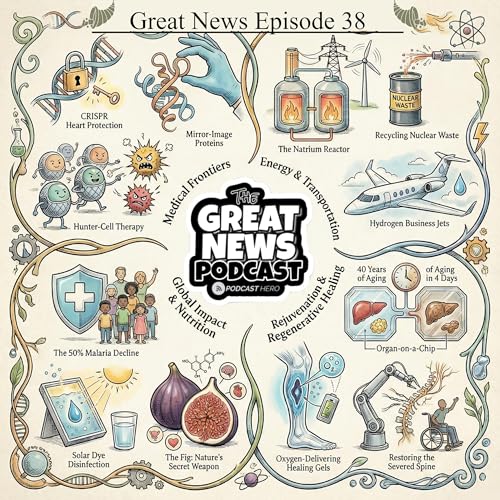
  • The Longevity Revolution: Replicating Decades of Aging and Turning Nuclear Waste into Power
    2026/04/09

    The Great News podcast is brought to you by the Daily Quote.


    Today, we have a packed episode! What if we could study forty years of human aging in just four days? That is our lead story. Plus, we’ll look at a hydrogen-powered business jet hitting major milestones, a healing gel that could prevent amputations from chronic wounds, and a solar device that makes drinking water safe in under an hour.

    Organ-on-a-Chip Replicates Decades of Aging in Days

    Hydrogen Business Jet Moves Closer to Reality

    How a New Oxygen-Delivering Gel Could Save Limbs from Chronic Wounds

    Solar-Powered Device Disinfects Water in Just One Hour


    Stick around for the speed round, where we’ll cover even more breakthroughs in medicine and energy!


    Terminating Super-Bugs in a single day!⁠

    ⁠Mirror-Image Proteins: A Novel Strategy to Combat Alzheimer’s Disease⁠

    Figs: Your Sweet Secret Weapon for Health and Wellness

    Bill Gates’ TerraPower Gets Green Light for Advanced Reactor

    Turning Nuclear Waste into Power and Reducing its Deadly Lifespan

    Miraculous Advances in Spinal Cord Injury TreatmentMalaria Vaccine Saving Children in NigeriaA New Way to Fight Alzheimer’s Disease


    続きを読む 一部表示
    9 分
  • Reversing Blindness with Cellular Rejuvenation and the Beating Heart-on-a-Chip
    2026/04/01

    This episode is brought to you by ⁠the Daily Quote⁠. The podcast designed to kickstart your day in a positive way.Today, we’re exploring how scientists are turning back the clock on aging cells, printing infrastructure beneath the ocean waves, and building a "heart-on-a-chip" to revolutionize medicine.And don't forget to stick around to the end for the speed round for even more great news!The First Epigenetic Reprogramming Therapy Enters Human TrialsThe World’s First Underwater 3D Concrete Printer

    The Tiny Chip That Could Change Heart Medicine ForeverThe Horse H12 is a Cleaner Combustion Engine

    Alright, Let's dive into the speed round for even more great news:

    The greater Bermuda snail, once feared extinct, is officially safe after conservationists bred and released over 100,000 molluscs.

    Researchers at Texas A&M have developed clay-based bandages that can be injected into deep wounds to stop severe internal bleeding, reducing clotting time by 70%.

    A new blood test can now predict when Alzheimer’s symptoms will begin—with an accuracy within three to four years—long before memory problems appear.

    Scientists are testing CAR T cell therapy to target and destroy the amyloid plaques in the brain that cause Alzheimer's, successfully reshaping the immune landscape in preclinical models.

    And my favorite quote of the day from the Daily Quote podcast this week is from James Clear who said,

    “Every action you take is a vote for the type of person you wish to become.”

    Start your day with an inspiring quote every single day with the Daily Quote - available in your favourite podcast app.

    From rejuvenating cells to printing structures underwater, today’s stories prove that those seeds of innovation are growing into a brighter world.


    I’m Andrew McGivern, and until next time, and there will be a next time, keep looking for the good in the world, because it’s everywhere.

    続きを読む 一部表示
    7 分
  • Self-Spreading CRISPR and the Sun Battery That Outperforms Lithium-Ion
    2026/03/18

    This episode is brought to you by the Daily Quote. The podcast designed to kickstart your day in a positive way.

    Today, we are diving into some truly groundbreaking advancements in medicine, biotechnology, and sustainable energy. What if a gene editor could replicate and spread like a virus to ensure it reaches every cell that needs a cure? That is our lead story today.


    Plus, we have a "rechargeable sun battery" that outperforms lithium-ion, tiny bubbles that shatter cancer’s defenses, and a city-wide success story in wiping out Dengue fever.

    CRISPR Gene Editor Replicates and Spreads Like a Virus

    New Sun Battery Beats Lithium-Ion

    Bubbles and Ultrasound Break Soften Tumour Walls for Better Treatment

    Wiping Out Dengue Fever

    And don’t forget to stick around for the speed round, where we’ll dive into even more great news.Prime C Shows Striking Survival Benefit in ALS Clinical Trial

    Inhalable Treatment Could Replace Months of Pills for TB

    Could a “Longevity Protein” Slow How We Age?An Inflammation Suppressor Decreases Mortality
    Turning Our Own DNA Against Cancer

    Until next time, keep looking for the good in the world, because it’s not only there—it’s everywhere.

    続きを読む 一部表示
    9 分
  • Cancer-Eating Bacteria, 10-Passenger Flying Taxis, and the First Moon Harvest
    2026/03/09

    This podcast is brought to you by the Daily Quote. The podcast designed to kickstart your day in a positive way!


    Today, we are exploring a medical breakthrough that uses "hungry" bacteria to fight cancer, a massive electric flying taxi taking to the skies in China, and a successful harvest of chickpeas grown in actual moon dirt
    Plus, we’ll look at a new computer chip that gives self-driving cars reflexes four times faster than the human brain

    Bacteria that eats cancer from the inside out

    China tests a "Flying Bus"!

    Moon Humus May be a Reality

    Robot Cars react 4X faster than humans


    And stick around for our speed round, where we’ll cover even more great news!


    US Forests fighting harder against climate change

    Gold Supraballs capture 90% of solar spectrum

    A few changes at home reduce asthma attacks

    New additive increases organic solar cell efficiency


    If you like the Great News Podcast, You'll love the great news letter. Because the Great News Podcast is Great! But the Great News Letter is Greater!


    The Great News Letter is FREE and includes all the good news stories.

    続きを読む 一部表示
    9 分