エピソード

  • Your Zip Code Should Not Decide Your Healthcare. This CIO Is Proving It.
    2026/09/03

    Around 400 rural hospitals in the United States are running at a loss, and for millions of people the nearest hospital is the one most likely to disappear. Michael Archuleta is doing the opposite of retreating. As the first-ever CIO of Mt. San Rafael Hospital and Clinics, a 25-bed critical access hospital in Trinidad, Colorado, he is rebuilding the organization around an AI-native core and arguing that rural health is not behind on AI, it is one of the best places in the country to prove it works.

    Archuleta joins Mike Sutten, CIO of Innovaccer, for an honest conversation about doing more with less. How a small team moves faster than a large system. Why he chose an EHR for its embedded clinical AI and treats the rollout as an operating model change rather than a software install. How radiology algorithms and real-time remote patient monitoring are already changing outcomes in a county larger than some states. And why he refuses to let technology be treated as a cost center.

    Running underneath it is a conviction Innovaccer shares. The best AI is the AI clinicians never notice, the kind that quietly handles the repetitive operational work so people can stay on the patient in front of them. Ambient documentation and charge assist that let doctors be doctors, not coders. Archuleta's way of putting it: the biggest return is not automation, it is giving clinicians time back. That is what autonomous healthcare operations look like with a human in the loop, and this episode is a field report on building it where the budget is thinnest.

    続きを読む 一部表示
    36 分
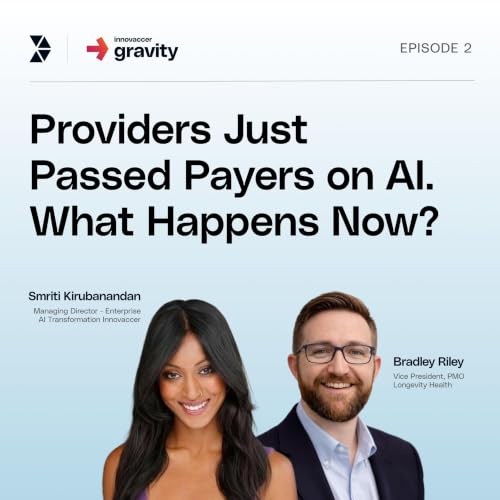
  • Providers Just Passed Payers on AI. What Happens Now? | Bradley Riley, Longevity Health
    2026/08/12

    For the first time in more than twenty years, providers are ahead of payers on technology, and Bradley Riley had a front-row seat as it happened. On this episode of the Gravity AI Podcast, he explains why that reversal should worry every plan leader, and what it says about where healthcare autonomy is really headed.

    Brad holds a seat almost no one else does. He runs analytics, medical economics, and the PMO at Longevity Health, a national Institutional Special Needs Plan built for nursing-home and long-term-care residents, and he also owns clinical delivery, the part most plans keep in a separate building. That combination lets him speak plainly about where AI is actually moving money in managed care, not where the slide decks say it is.

    Three ideas anchor the conversation. Claim intensification, the legal, AI-driven optimization of claim accuracy that is quietly inflating medical costs while reimbursement rates lag behind. Cost avoidance, the reason the highest-value AI is often the kind you can never prove worked, because the fall never happened and the admission never came. And the great reversal itself, where small, fast providers now outrun large plans because the barrier to running a machine learning model has all but disappeared.

    What connects all of it is a single conviction Innovaccer shares. The point of AI is not to replace the people doing the hard, human work. It is to take the work that never needed a person off their plate, so capacity goes back to care. That is what autonomous healthcare operations look like in practice, and it is the bar Brad measures every model against.

    続きを読む 一部表示
    44 分
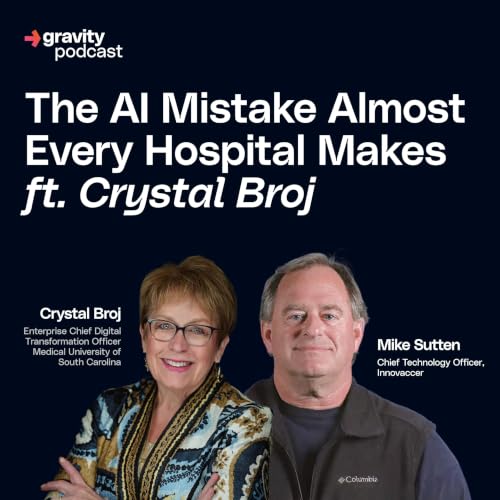
  • Transformation Starts With the Problem, Not the Tool: Crystal Broj | Gravity AI Podcast
    2026/07/09

    Everyone wants AI to fix everything. Crystal Broj has a different starting point: don’t start with the tool, start with a problem worth solving. As Enterprise Chief Digital Transformation Officer at MUSC, a 16-hospital system spanning South Carolina, she built a digital transformation office from a party of one to a team of ten, and the results are concrete. Mike Sutten, CTO at Innovaccer, talks with her about the breast cancer screening outreach that surfaced 217 abnormal findings, the voice agent that deflects a quarter of patient access calls and cut abandonment nearly in half, and why confusing technology implementation with real transformation is the trap that sinks most initiatives. Her closing point is the one to remember: the technology matters, but the trust you build putting it in matters more.

    Listen to the full episode!

    続きを読む 一部表示
    34 分
  • Welcome to Gravity AI
    2026/05/18

    In this inaugural episode, host Smriti Kirubanandan introduces Gravity AI — a new podcast for the thought leaders building the future of healthcare and intelligent enterprise. Smriti lays out the vision, teasing a glimpse of what's to come: why the most consequential conversations about AI and data transformation aren't happening in boardrooms, and what you can expect an AI future to look like.

    From strategy to architecture and most importantly, the leadership it takes to move entire organizations into the AI era—this first episode is a sampler, an appetizer, a fleeting taste of what's to come. Tune into the future, tune into Gravity.

    Subscribe so you never miss an episode!

    続きを読む 一部表示
    1 分