エピソード

  • Ben Norton: The US Is Manufacturing Consent For New War On Nicaragua | GEH W/ Radhika Desai
    2026/08/04

    Did Nicaragua really just abolish elections, as headlines from the New York Times to the BBC to the UN claimed last week? I am joined by journalist Ben Norton, host of the Geopolitical Economy Report YouTube channel, and fresh from Managua's 47th anniversary celebrations of the Sandinista Revolution, to separate fact from a deliberately distorted quote. Ben explains that Co-President Daniel Ortega's speech, stripped of context, was not a renunciation of elections but a sovereign measure barring foreign-funded parties from contesting them, following the stolen election in Honduras and Gustavo Petro's accusations of US-Israeli interference in Colombia. We trace this back through the Contra war and neoliberal privatisations to Nicaragua's present accomplishments like free healthcare and education, low crime, and Chinese-backed infrastructure, as Marco Rubio names Nicaragua next in line after Venezuela and Cuba.

    続きを読む 一部表示
    1 時間 12 分
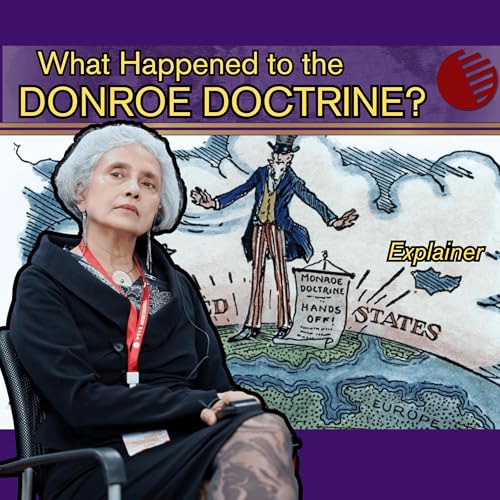
  • Geopolitical Economy Explainer: Whatever Happened to the Donroe Doctrine?
    2026/04/01

    GEOPOLITICAL ECONOMY EXPLAINER

    Just over a month ago, the world was abuzz with talk of the Donroe Doctrine? Radhika explains what the so-called "Donroe Doctrine" was supposed to be, what it really was, how it lined up with the Monroe Doctrine and the Roosevelt Corollary, and why it is hardly surprising that it was barely proclaimed before it was violated. The explanation may surprise you.

    続きを読む 一部表示
    22 分
  • Michael Hudson: The Democratic Party Must Die For Workers To Win | GEH W/ Radhika Desai
    2026/08/04

    Do the Democrats and Republicans really differ, or are they two wings of the same corporate machine? I am joined by economist Michael Hudson to examine why no progress can be made for American wage earners until the whole electoral system is changed. Michael Hudson argues that the DNC's dependence on Wall Street, Silicon Valley, and AIPAC financing has made it as captured by capital as the Republicans it claims to oppose, a capture traceable to the Clinton-era abandonment of the working class and the sidelining of Bernie Sanders. The coming midterms, they argue, are shaping up as a civil war within the Democratic establishment between an emboldened democratic-socialist left and an old guard that would rather lose with a corporate centrist than win with a candidate beholden to ordinary voters.

    続きを読む 一部表示
    1 時間 1 分
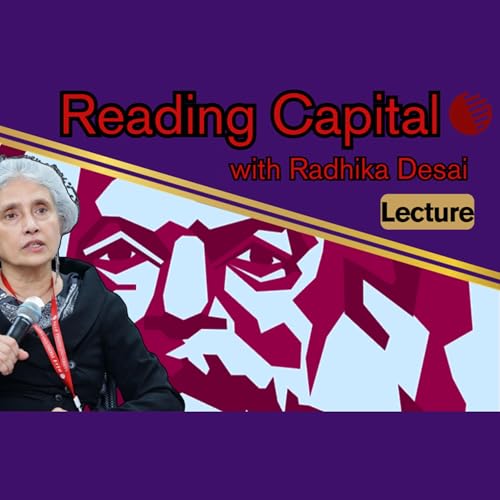
  • Reading Capital with Radhika Desai: 1. Mandel Introduction and Marx & Engels Prefaces
    2026/03/25

    Starting Sunday, 22 March 2026, Radhika Desai is leading a Capital Reading Group on line. It will consist of an hour’s lecture followed by at least an hour’s discussion.

    In her lectures, Radhika will be presenting an interpretation of Capital that she arrived at in the course of developing Geopolitical Economy, the Marxist approach to understanding the international relations of the capitalist world, which placed imperialism and anti-imperialist resistance at its centre and has required rescuing Marx’s original analysis of capitalism as contradictory value production from more than a century and a half of misinterpretation by Marxists themselves.

    In this first episode, Radhika analyses an Introduction by Ernest Mandel as well as two Prefaces by both Marx & Engels.

    続きを読む 一部表示
    1 時間
  • Cockroach Revolution: India's Jobless Generation Declares War On Modi | Rohit Azad, Utkarsh Bhardwaj
    2026/08/04

    Is India's youth uprising the beginning of the end for Modi's twelve-year rule? I am joined by Rohit Azad, economist at Jawaharlal Nehru University, and Utkarsh Bhardwaj, Delhi-based activist and former Vice President of the Students Federation of India, Delhi, both of whom have been on the ground throughout the protests, to examine the true scale and character of the movement now sweeping India. Azad and Bhardwaj describe a genuinely decentralized, largely leaderless uprising, sparked by the leak of the CBSE board exam papers and named after a dismissive remark by India's Chief Justice comparing unemployed youth to cockroaches, a label the movement has since turned into a badge of defiance. We examine why the government's repression, from the detention of Sonam Wangchuk to the shutdown of Delhi metro stations, has only swelled the crowds rather than dispersed them, why the protests draw from across the class spectrum rather than being confined to the urban elite, and the underacknowledged role of the organized left in sustaining the movement long before it captured national attention.

    続きを読む 一部表示
    1 時間 3 分
  • The West Couldn't Break North Korea And Now They're Afraid | Keith Bennett and Radhika Desai
    2026/06/16

    President Xi Jinping followed up his summits with Presidents Putin and Trump with his first foreign trip of the year. The destination – North Korea, or the Democratic People’s Republic of Korea, a nation of some 26 million normally portrayed in the Western media as a dangerously authoritarian state, an economic basket case, worthy of attention only for its nuclear weapons – may seem a surprise to many.

    However, as veteran Korea observer, Keith Bennett and Radhika Desai discuss, neither the destination nor the timing should surprise anyone with a sense of the intertwined histories of the Chinese and Korean revolutions (not to mention the Soviet) and the continuing cooperation between the two countries, founded on socialist solidarity. Nor should it surprise them that, amid the chaos unleashed on the world by a declining West, China and North Korea are quietly renewing their relations for a new phase of history, and their common history.

    Keith and Radhika discuss the socialist foundations of one of the most enduring international relationships of the modern era, the myths Western journalists and scholars perpetuate about North Korea, and the unexpected twist the matter of Korean reunification has taken.

    続きを読む 一部表示
    1 時間 5 分
  • Bikrum Gill: The West Refuses To Admit Iran Already Won | GEH With Radhika Desai
    2026/08/04

    Iran's four-month war with the US and Israel has entered a new, lower-intensity phase. But is this exhaustion, or Iran's most decisive victory yet? I am joined by Dr. Bikram Singh Gill, lecturer in international relations at Cardiff University, to examine the strategic reversals defining this war. Gill explains how the campaign meant to disarm Iran has instead disarmed US deterrence itself, with Iran now controlling the underlying equation of force in the Gulf through its command of the Strait of Hormuz. We examine why Gulf states like Saudi Arabia keep gambling on Washington even as that alliance stops serving their own capital's interests, and draw the parallel to European elites trapped in the same losing bet. We close on the popular legitimacy underwriting states like Iran and China, and the uprising now shaking India after decades of jobless neoliberal growth. The West has misread these societies before. Professor Gill argues it's doing so again.

    続きを読む 一部表示
    53 分
  • (Blocked) Paths to Dedollarization | GEH with Paolo Nogueira Batista
    2026/06/01

    What does the future look like for Dedollarization? How does BRICS play a role? Radhika takes a deep dive with co-founder of New Development Bank, Paolo Nogueira Batista.

    続きを読む 一部表示
    55 分