エピソード

  • Reclassification of Previous Year Figures
    2026/06/01

    Is your financial reporting hiding the truth in plain sight?This breakdown of Ind AS 1 reveals how "vague or unclear"language about reclassifying figures can constitute a serious compliance failure. Learn why simply stating that figures were "regrouped" is legally insufficient without disclosing the specific nature, amount, and reason for the change. Discover how scattering material details throughout your statements effectively "obscures" information, misleading users just like a misstatement would. Don't let scattered data compromise your audit—master the mandatory requirements for transparent comparative reporting today.

    続きを読む 一部表示
    42 分
  • Revenue Recognition: Switching Measurement Methods - Ind AS 115 and Ind AS 8
    2026/05/31

    Can a company change its revenue recognition method simplyto align with its international parent group? This source dives into a complex accounting case where Company A attempts to switch from the Output to the Input method for construction contracts. Discover why this shift is classified as a rectification of a prior period error rather than a mere change in estimate. Learn the strict requirements of Ind AS 115 and Ind AS 8, and why such changes demand retrospective accounting to maintain financial integrity.

    続きを読む 一部表示
    46 分
  • Common control demerger - Ind AS 103 or Ind AS 105
    2026/05/30

    Does a demerger between sister companies always qualify as a Business Combination under Common Control? This source challenges that assumption, revealing why Ind AS 103 might apply to the receiver but not the giver. Through a complex case study of an Indian demerger, you’ll discover why the transferor must pivot to Ind AS 105 instead. Learn the criticaldifference in how gains are recognised and why comparative restatements might be prohibited—essential knowledge for anyone navigating the intricate web of corporate restructuring.

    続きを読む 一部表示
    44 分
  • Accounting for Duty Free Raw Material Imports - Ind AS 20
    2026/05/29

    Is your company benefiting from duty-free imports, or areyou sitting on a deferred liability? This source breaks down a critical Ind AS 20 dilemma: whether import duty savings on raw materials qualify as government grants. Discover why these "savings" are actually grants related to income and learn the exact journal entries needed to avoid overstating profits. From initial recognition in inventory to the strategicdeferral of income tied to export obligations, this guide reveals the mandatory accounting path for complex government assistance.

    続きを読む 一部表示
    36 分
  • Preference Share Investment Splitting Fallacy - Ind AS 32, Ind AS 107 and Ind AS 109
    2026/05/28

    Can an "amortized cost" label hide a significant reporting failure? This review investigates a company’s inconsistent disclosures regarding preference share investments underInd AS. It exposes how the entity misapplied measurement principles for equity components and omitted critical fair value data required by Ind AS 107. Is material information being "obscured" by poor cross-referencing and scattered notes? Explore this expert analysis to uncover common pitfalls in Ind AS compliance and learn why accurate measurement isnon-negotiable for transparent financial reporting.

    続きを読む 一部表示
    43 分
  • Foreign Currency Risk Hedge Accounting under Ind AS 109
    2026/05/27

    What happens when a ₹1,000 foreign trade payable meets avolatile currency market? This source breaks down the high-stakes world of hedge accounting under Indian Accounting Standards. Explore the strategic choice between fair value and cash flow hedges, and learn why one method is specifically recommended for recognized monetary items. From calculating hedge effectiveness to mastering complex journal entries for reporting and settlement, this guide provides the essential blueprint for managing foreigncurrency risk. Are you ready to master the ledger?

    続きを読む 一部表示
    28 分
  • Ind AS 1 - Classification of Trade Receivables
    2026/05/26

    Can trade receivables ever be classified as non-current? This source exposes a fundamental reporting error involving IndAS 1 and the "operating cycle". While many assume that a 12-month realization window is the ultimate test for asset classification, Paragraph 68 reveals why trade receivables are almost always current. Learn how one company’s attempt to classify these as non-current assets led to a direct compliance failure. For auditors and finance teams, this case study is a vitallesson in the nuances of financial presentation—uncover the rules that prevent misleading balance sheets.

    続きを読む 一部表示
    31 分
  • Impairment of FVOCI Debt Investment
    2026/05/25

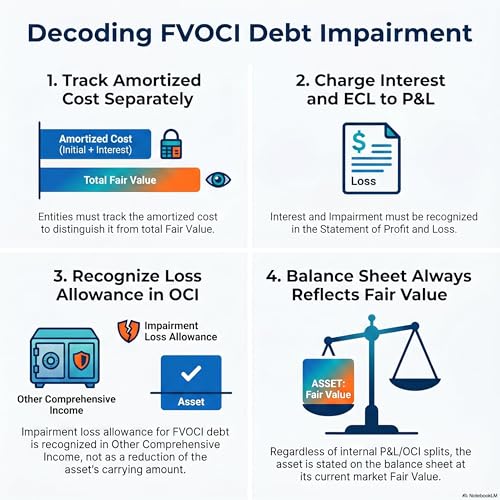
    How does an entity segregate impairment from fairvalue when the latter already incorporates credit risk? This source provides a deep dive into the accounting mechanics for FVOCI debt instruments under Ind AS 109, revealing why the change in OCI is not a "clean" fair value. Through a detailed numerical example, you will learn how to track amortised cost, record complex journal entries, and ensure that an Expected Credit Loss (ECL) is accurately reflected in profit or loss while maintaining the asset at its full fair value on thebalance sheet.

    続きを読む 一部表示
    41 分