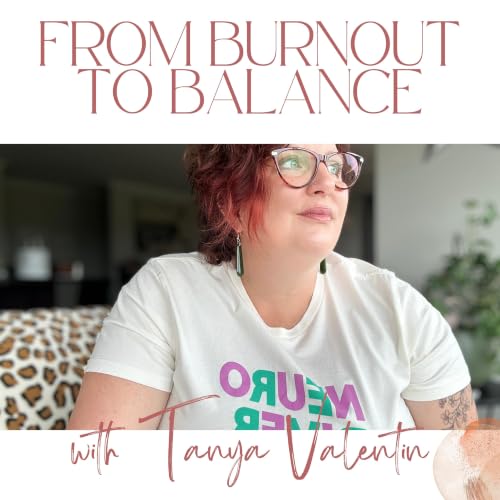
『From Burnout to Balance - Helping Parents of Find Balance in the Long Middle of Burnout Recovery』のカバーアート

From Burnout to Balance - Helping Parents of Find Balance in the Long Middle of Burnout Recovery

From Burnout to Balance - Helping Parents of Find Balance in the Long Middle of Burnout Recovery

著者: Tanya Valentin
無料で聴く

Hosted by family coach Tanya Valentin, AuDHD parent and neuroaffirming family coach. This compassionate space offers expert guidance, honest conversations, and practical tools to support both you and your child through the long middle of burnout recovery. Whether you're in the early stages or deep in recovery, you’re not alone. Tune in weekly for heartfelt stories, expert insights, and real-world strategies to move your family from burnout to balance. Join our From Burnout to Balance Parent Community: https://tanyavalentin.co/parent-community/Tanya Valentin 人間関係 子育て
エピソード
  • Low-Demand Parenting Does Not Start With Lowering Demands
    2026/08/19

    In this episode, Tanya talks about radical acceptance, one of the four foundational pillars under low-demand parenting, and why it has to come before we ever try to lower a demand.

    This is not acceptance of the surface behaviour. It isacceptance of the root belief underneath it, the belief about how things should be, and about the child we thought we were going to raise.In This Episode

    • Why the hardest part of parenting a neurodivergent child is often the unlearning, not the child
    • What radical acceptance actually means, and where the word radical comes from
    • Why a demand only becomes a pressure when it ismeasured against an expectation
    • The grief of losing the imagined parenting journey, and why that grief is not a sign of failure
    • How a demand can go quiet on the outside whilestaying loud on the inside
    • Why good has quietly come to mean least disruptive in parenting culture, and what that costs our kids
    • A gentle starting practice: noticing the wordshould
    • A reframe from Kristy Forbes for finding what islivable right now. "If this was the new normal fromhere on, what would I need to put in place to actually make this livable, right now?" Not about your whole life. Just the one demand or moment that has felt hardest to accept lately.

    Mentioned in This Episode

    Marsha Linehan, DBT Skills Training Manual, thepsychologist who named radical acceptance as a distress tolerance skill

    Tara Brach, Radical Acceptance: Embracing Your Life with the Heart of a Buddha (2004)

    Elisabeth Kubler-Ross, On Death and Dying (1969)

    Kristy Forbes, Intune Pathways, for the reframeon making a season livable

    Tanya's related Rehumanising parenting Substack piece, Does Low-Demand Parenting Mean No Boundaries?

    Next Steps

    You came for your child. Stay for yourself too. The low-demand parenting arc continues week by week inside From Burnout to Balance, the membership home for this work.

    続きを読む 一部表示
    14 分
  • Why Low Demand Parenting Works For a Neurodivergent Child in Burnout
    2026/08/10

    You probably know that lowering demands works. This episode is about why.


    Episode description

    If you're parenting a neurodivergent child in burnout, you've likely already discovered that lowering demands helps. What's less talked about is why it works, what's actually happening in the nervous system underneath the surface.

    In this episode, I walk through the physiology behind demand and stress response, why autonomy, not just fewer demands, is the piece that most parents miss, why I've come to look at burnout through a PDA lens even though my child isn't formally diagnosed, and the different, often invisible, shapes a demand can take. I also share a bit of my own story, growing up in a family where pushing through was everything, and how burnout was what finally taught me otherwise.


    In this episode

    • Why lowering demands isn't permissiveness, it's physiology
    • The low arousal approach and what happens in the brain when a demand triggers stress
    • Why autonomy is the actual mechanism behind low demand parenting, not an extra on top of it
    • Looking at burnout through a PDA lens, with or without a diagnosis
    • The five shapes a demand can take, and the ones we don't usually think to name
    • What's opening this month inside From Burnout to Balance


    Mentioned in this episode

    Kristy Forbes, InTune Pathways
    https://www.kristyforbes.com.au

    Amanda Diekman, Low Demand Parenting
    https://www.amandadiekman.com

    PDA Society, Low arousal approaches
    https://www.pdasociety.org.uk/what-helps-guides/pda-approaches/low-arousal-approaches/

    McDonnell, A. A., Page, A., Bews-Pugh, S., Morgalla, K. A., Kaur-Johal, T., & Maher, M. (2024). Families' experiences of the Low Arousal Approach: a qualitative study. Frontiers in Psychology, 15.
    https://www.frontiersin.org/journals/psychology/articles/10.3389/fpsyg.2024.1328825/full

    Full blog post with the complete reference list
    https://tanyavalentin.co/2026/08/why-low-demand-parenting-works-for-a-neurodivergent-child-in-burnout/

    This month inside From Burnout to Balance

    A new low-demand parenting channel is open, with short videos walking through everything in this episode and more. No rush and no right time to start. Come find it when you're ready.
    https://tanyavalentin.co/parent-community/


    続きを読む 一部表示
    20 分
  • How To Navigate The Stage Of Burnout Recovery That Comes After The Crash
    2026/07/29

    Part 3 of The Family Ecosystem Approach Series

    After the crash has passed, many parents expect life to start feeling easier.

    Sometimes it does.

    The house may feel quieter. The daily crises may have settled. The constant battles around school or everyday demands may have eased.

    But your body hasn't caught up yet.

    In this episode, we explore Stage Two of the Family Ecosystem Approach:

    Stabilising Safety, a stage that often looks calm from the outside while parents are still living with hypervigilance, anticipatory anxiety and overwhelming guilt.

    If you've ever found yourself lying awake at 3 a.m. replaying every decision you've made, wondering whether you missed something or could have prevented your child's burnout, this episode is for you.

    You'll discover why these thoughts are not a sign that you've failed. They are often the result of a nervous system that has spent months or years scanning for danger and hasn't yet learned that it is safe to soften.

    I explain:

    • Why relief after the crash doesn't always feel like relief.

    • What "anticipatory waiting mode" is and why so many parents experience it.

    • Why the 3 a.m. guilt spiral is a nervous system response rather than objective truth.

    • How Polyvagal Theory and neuroception help explain why your body stays on high alert.

    • Why recovery often looks like "nothing is happening," even when deep healing is taking place.

    • Why stabilising safety is an essential stage of burnout recovery rather than a sign that progress has stalled.

    • Gentle ways to support your own nervous system during this stage.

    You parented with the information you had at the time.

    Like so many families navigating neurodivergent burnout, you've learned an enormous amount along the way. Many of the professionals around you were also working with incomplete understanding.

    The guilt you've been carrying was never yours to hold alone.

    Safety doesn't always look like progress.

    The quiet, repetitive, low-demand days that can feel frustrating or unproductive are often laying the foundations for genuine healing. Recovery isn't measured only by what we can see. Some of the most important work happens beneath the surface.

    Need More Support?

    If this episode resonated with you, I'd love to invite you into From Burnout to Balance, my membership for parents supporting autistic, PDA and neurodivergent children through burnout recovery

    Inside, you'll find practical guidance, compassionate support and a community of parents who understand the unique challenges of navigating the long middle of burnout recovery.

    You don't have to carry this alone.

    続きを読む 一部表示
    14 分
adbl_web_anon_alc_button_suppression_t1
まだレビューはありません