エピソード

  • The Marketing Engineer with Nick Lafferty
    2026/09/01

    Episode #235: Nick Lafferty on Marketing Engineering, Category Creation, and Closing His Own Deals


    He was the first marketing hire at Profound, and within weeks he was shipping production code and taking sales demos himself.

    For founders making their first marketing hire and for marketers deciding what to learn next.


    Nick Lafferty is the Founding Marketing Engineer at Profound, where he joined as the first marketer on a 20-person team that has since grown to 200 and raised Series A, B, and C in 10 months. He walks through what a marketing engineer actually does, what broke as the company scaled, and why he put himself in the lead round robin and gave close to a hundred demos when there weren't enough AEs to cover pipeline. He also breaks down the system he built to connect HubSpot deal data to LinkedIn impressions, the interview question he opens with, and why he is openly against token maxing. Before Profound, Nick ran growth at Loom through its acquisition by Atlassian.


    What you'll hear

    • Why the first marketing hire should be a marketing engineer, with a product marketer as the fast follow
    • How Nick shipped a social proof quote to the live contact sales page in 15 minutes using Cursor, and the required "how did you hear about us" field that powers his attribution system
    • What broke first at speed: lead routing running through a Google Sheet, deliverability issues, and then more meetings than sales reps to take them
    • How Profound builds a category by publishing research to customers in Slack first, then LinkedIn, then email and webinars


    Chapters

    • 00:00 - Cold open: "I have contracts with real ARR tied back to my name"
    • 00:45 - Frank Growth intro: three things going wrong with marketing teams
    • 02:11 - Nick's background, from Loom to Profound
    • 03:02 - What a marketing engineer actually does
    • 03:50 - The first thing he ever shipped, and it's still live
    • 04:45 - Building the LinkedIn to HubSpot attribution system
    • 05:47 - The result: 20% of inbound lead forms from LinkedIn
    • 06:37 - What broke first at scale
    • 08:18 - Hiring the first four marketers
    • 09:14 - The interview question: show me your GitHub repo
    • 10:21 - What Loom taught him about horizontal products
    • 12:00 - Marketing a category that didn't exist 18 months ago
    • 13:23 - The research drumbeat, and giving customers early access in Slack
    • 15:04 - Why Profound turns away the self-service market
    • 15:45 - Profound University and the marketing engineer job board
    • 16:34 - From analytics product to AI agent workbench
    • 17:37 - What to look for in a first marketing hire today
    • 18:50 - Anti-token maxing, and where marketing engineers come from
    • 20:04 - Lightning round
    • 21:30 - Jason's top three takeaways and one thing to do this week


    Links & resources

    Guest

    Nick Lafferty, Founding Marketing Engineer, Profound
    LinkedIn
    X/Twitter
    Profound
    Profound on LinkedIn
    Profound Index


    About Frank Growth

    Frank Growth is a podcast about how companies actually grow: real operators, real constraints, real decisions. Hosted by Jason Shafton.


    Promotional links

    • Work with Winston Francois
    • Subscribe / Follow Jason
    続きを読む 一部表示
    24 分
  • Nobody Has The Playbook Yet with Dave Steer
    2026/08/25

    Episode #234: Dave Steer on repositioning a brand around AI in three months

    Webflow's CMO had 90 days to relaunch the website, reposition the brand, and ship an ad campaign.
    For marketing leaders whose board just told them to become AI native, and who don't have a playbook for it.

    Dave Steer is CMO at Webflow, leading brand, demand, and product marketing after two decades at GitLab, Cloudflare, Twitter, Facebook, and Mozilla. His mandate came from the board and leadership team, timed to Webflow Conf three months from his start date. We cover how he reorganized a 50-to-60-person marketing team around AI tools, why he ran positioning as an executive exercise with April Dunford rather than a marketing one, and where he draws the line between what a human writes and what an agent touches. He also walks through Webflow's AEO Maturity Index, a study of 2,000 US websites where the average site scored about two or three, and where the problem was site structure rather than content volume.


    What you'll hear

    • Why positioning is a corporate strategy activity, not a marketing activity, and who has to be in the room
    • How the team moved from a relay race of specialists to treating everyone as an orchestrator and connector
    • The two instincts that go wrong first: buying a pile of ChatGPT licenses, and optimizing for day one instead of day two
    • Where the human/agent line sits: the human owns the argument, the agent owns the permutation


    Chapters

    • 00:00 - The human owns the argument, the agent owns the permutation
    • 00:33 - Three ways marketing leaders are handling the AI mandate badly
    • 02:24 - The three things every CMO has to be expert in now
    • 03:11 - Where the three-month mandate came from
    • 05:00 - What "agentic" means when the web has two audiences
    • 06:14 - April Dunford and why positioning is an executive staff exercise
    • 07:13 - The AEO Maturity Index: 2,000 sites, average score of two or three
    • 08:40 - Rebuilt, not retooled: ending the relay race
    • 12:26 - Four human roles: strategist, orchestrator, creator, connector
    • 17:13 - The single biggest mistake CMOs are making right now
    • 18:55 - Lightning round
    • 20:49 - Top three takeaways and one thing to do this week


    Links & resources

    Guest

    Dave Steer, Chief Marketing Officer, Webflow
    Website
    Webflow Conf
    LinkedIn


    About Frank Growth

    Frank Growth is a podcast about how companies actually grow. Real operators, real constraints, real decisions. Hosted by Jason Shafton.


    Promotional links

    • Work with Winston Francois
    • Subscribe / Follow Jason
    続きを読む 一部表示
    22 分
  • Stop Writing Only for Humans with Jesus Requena
    2026/08/18
    Episode #233: Jesus Requena — Dropping SEO entirely to optimize for LLMs

    Sanity stopped producing SEO content and started building pages only machines will read. Roughly 60% of last month's signups came from LLMs.

    For B2B growth leaders watching organic traffic fall and trying to work out what replaces it.

    Jesus Requena is CMO at Sanity, and previously led growth marketing at Figma, demand gen at Unity and Algolia, and growth at Hex. After watching client SEO traffic fall to a tenth of what it had been, he stopped SEO content production entirely and rebuilt Sanity's content for LLMs to parse rather than humans to read. He walks through the three-layer playbook: fixing contradictions across 100 to 200 pages on their own site, converting roughly 1,000 FAQ pages from user-centric to LLM-centric, building five single-topic microsites excluded from Google, then correcting third-party citations that conflicted with their own story. Sanity moved from ranking 15th or 20th in LLM visibility to top five.

    What you'll hear
    • Why visibility comes from reasoning: if an LLM can reason your concepts clearly, it recommends you, which makes first-party consistency the starting point
    • How they executed it — crawling their own site to find unclear terms, writing content no human is expected to read, and partnering with AirOps to fix obsolete third-party citations
    • Why attribution breaks when signups arrive through a CLI or MCP without ever touching the website, and the self-reported "where did you find us" question they fell back on
    • Where to start from zero, in order: audit your own site, then third-party mentions, then microsites — plus the caveat that Reddit's influence is fading and LLMs are pulling more from video
    Chapters
    • 00:00 — Cold open: "We literally just stopped any SEO content"
    • 00:38 — The AEO shift: what's going wrong and what works
    • 02:12 — Meet Jesus Requena: Figma, Unity, Algolia, Hex, Sanity
    • 02:45 — The common thread in marketing to technical audiences
    • 04:30 — SEO traffic drops to a tenth, and the bet that followed
    • 06:15 — The three layers of AEO content
    • 08:22 — Citations, visibility, and going from 15th to top five
    • 10:37 — Authority, and becoming the thought leader for the LLM
    • 12:07 — 1,000 FAQ pages and five microsites excluded from Google
    • 14:23 — Why brand investment went physical: events, swag, billboards
    • 17:30 — Measuring attribution when nobody clicks
    • 19:17 — Is the growth repeatable or is it timing?
    • 20:41 — Where to start from zero
    • 22:38 — Scaling agents, and humans handling the exception
    • 23:59 — Lightning round
    • 25:14 — Jason's top three takeaways
    Links & resources

    Guest
    Jesus Requena — CMO, Sanity
    Website
    LinkedIn

    About Frank Growth

    Frank Growth is a podcast about how companies actually grow—real operators, real constraints, real decisions. Hosted by Jason Shafton.

    Promotional links
    • Work with Winston Francois
    • Subscribe / Follow Jason
    続きを読む 一部表示
    28 分
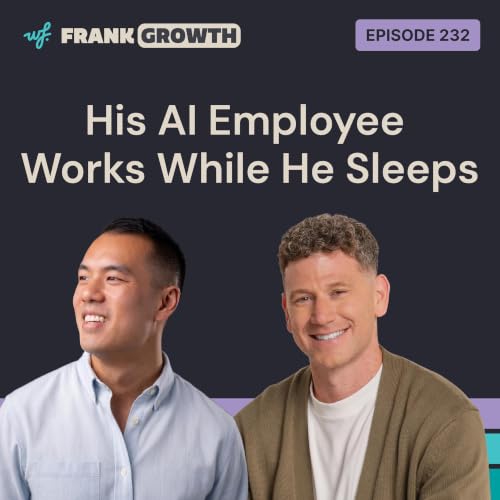
  • His AI Employee Works While He Sleeps with Andrew Mok
    2026/08/11

    Episode #232: Andrew Mok — What the CMO job becomes when AI runs the mechanics


    HeyGen doubled to $200M ARR in eight months, is cash-flow breakeven, and runs on about 130 people. Its CMO explains how marketing actually operates there.
    For marketing leaders deciding what to keep, what to cut, and what to hand to an agent.


    Andrew Mok spent 12 years at Turo building a category nobody believed in, then joined HeyGen as CMO four months ago in the middle of its fastest growth stretch. He walks through the operating details: a verticalized stack that runs inference 10x cheaper than general video models, 100 to 200 customer interviews a week piped into an internal MCP that any employee can query, and a personal agent named Mara (marketing automation and research agent) that hands him a metrics digest on his drive into the office. He's also blunt about the parts most people won't say out loud — that job replacement is real, and that it will come mostly from lean AI-native companies growing into big ones, not from big companies running layoffs. He does three to five customer interviews a week himself, and that's the metric he checks every week.


    What you'll hear

    • The three Cs he runs on — customers, company fundamentals, culture — and how customer voice became infrastructure instead of a slide: 100–200 interviews a week, curated by agents, queryable for pain points, churn reasons, and competitor chatter.
    • How Mara actually gets used: metrics digests over voice in the car, deep dives before he reaches the office, and why documents and decks went from a multi-week exercise to 30 seconds.
    • What was slowing the company down: leading with technical capability instead of the human problem, which works on AI enthusiasts and stalls with the mainstream. Plus how Turo handled its worst crisis — the New Year's terror attacks — by putting everything in the open instead of covering it.
    • Jevons paradox applied to video: lower the price and friction, and quantity goes up. HeyGen's five-person internal video team produces roughly 100x more video than a company not using AI tools, and it's the biggest video team Andrew has ever run.


    Chapters

    • 00:00 — Cold open: AI-native companies will hire far fewer people
    • 00:49 — Intro: if AI handles the mechanics, what's left of the CMO job
    • 03:29 — 12 years at Turo and what long tenure teaches you about brand
    • 04:34 — The New Year's terror attacks and handling crisis with transparency
    • 05:44 — Turo vs. HeyGen: trusting a stranger with your car vs. a company with your likeness
    • 06:52 — Who the real customer is: small business owners, skewing older, not AI enthusiasts
    • 08:26 — Why he left Turo, and the introvert founder story behind HeyGen
    • 09:51 — $200M ARR, doubled in eight months: what marketing changed at that velocity
    • 11:09 — Breakeven economics: owning the model and running inference 10x cheaper
    • 12:16 — Customers, company, culture: 100–200 interviews a week and an internal MCP
    • 13:56 — Mara, the marketing agent: morning digests, campaigns, weekly team updates
    • 15:27 — Which bottleneck disappeared first, and what's still hard
    • 16:23 — AI and jobs: replacement comes from lean new companies, not big layoffs
    • 18:21 — Jevons paradox: lower the barrier to video and demand outstrips it
    • 19:50 — Hyperframes: why HTML, and why they open sourced it
    • 21:56 — What surprised him inside an AI company: refusing deepfakes when allowing them would pay
    • 23:17 — Lightning round
    • 23:51 — The creator who kept her livelihood after long COVID
    • 24:45 — Where to find Andrew
    • 25:20 — Jason's top three and one action for this week


    Links & resources

    GuestAndrew Mok — CMO, HeyGen
    Website
    LinkedIn
    X


    MentionedHyperframes — HeyGen's open source HTML-based video rendering framework, on GitHubJulia McCoy's YouTube channel


    About Frank Growth

    Frank Growth is a podcast about how companies actually grow—real operators, real constraints, real decisions. Hosted by Jason Shafton.


    Promotional links

    • Work with Winston Francois
    • Subscribe / Follow Jason
    続きを読む 一部表示
    27 分
  • What is Growth Design? with Philip Lowe
    2026/08/04
    Episode #231: Philip Lowe - Growth creative isn't art, and the customer is the judge

    How to build creative that moves a number (a click, a conversion, a download) instead of creative that only wins the room.

    For growth marketers, creative directors, and in-house studio leads deciding what to test, what to produce, and what to kill.

    Philip Lowe runs creative, brand, and marketing operations at Quicken, and previously built Instacart's growth creative team from scratch after starting there as a creative director for CRM. He and Jason worked together at Soothe and Headspace, and this conversation covers what actually separates creative that's good from creative that performs: hiring people who understand both brand and performance, testing hooks, concepts, and narratives as a stage gate before anything gets produced, and knowing where AI helps and where it doesn't. Philip walks through the four-pillar roadmap he uses (exploration, production, learning, infrastructure) and explains why the old path of $30,000 per storyboard and a week and a half of waiting is no longer the only option. He's blunt about the limits too. An AI-generated couple reviewing their finances cycled through eight facial expressions in seconds, which is a non-starter for a brand that has built 40 years of trust.

    What you'll hear
    • Why growth creative sits at the intersection of brand and performance, and why separating the two is the biggest mistake leaders make
    • How Philip built and staffed a growth studio at Instacart, and why the asset was the vehicle and the insight was the point
    • Where AI delivers, including stylized worlds, claymation, stop motion, and surrealism, anywhere imperfection is the aesthetic, and where it falls flat on human emotion, eyes, hands, and quiet moments
    • What the job of creative becomes in CRM and lifecycle when AI is reading the inbox and open rates stop being the focus
    Chapters
    • 00:00 - Three seconds to hook, like a comedian on stage
    • 00:29 - What growth creative is, and why it's not decoration
    • 01:24 - Sooth, Headspace, and having conviction in the work
    • 04:11 - Growth creative vs. brand creative vs. design
    • 05:56 - The kangaroo video: when it clicked
    • 07:24 - Building Instacart's growth creative team from scratch
    • 09:27 - Good creative vs. creative that performs
    • 11:05 - Testing before you spend a dollar producing
    • 12:41 - Taking on ops: from tastemakers to operators with good taste
    • 14:24 - What changes when production gets cheap
    • 16:38 - The four pillars: exploration, production, learning, infrastructure
    • 18:20 - Where AI delivers a performance and where it doesn't
    • 20:31 - Real humans, real stories, and trust in finance
    • 21:56 - CRM and lifecycle when AI reads the inbox
    • 24:12 - Breaking through when agents do the browsing
    • 25:53 - Hiring for taste
    • 27:01 - The one thing leaders get wrong
    • 27:39 - Lightning round
    • 29:48 - Top three takeaways
    Links & resources

    Guest
    Philip Lowe, creative, brand, and marketing operations at Quicken
    LinkedIn
    TikTok

    About Frank Growth

    Frank Growth is a podcast about how companies actually grow: real operators, real constraints, real decisions. Hosted by Jason Shafton.

    Promotional links
    • Work with Winston Francois
    • Subscribe / Follow Jason
    続きを読む 一部表示
    32 分
  • Growth's Most Dangerous Trap With Sara Wallace
    2026/07/28
    Episode #230: Sara Wallace — Repositioning a consumer cashback app into a B2B platform

    Ibotta is known as a cashback app. It's also a white-label promotions platform for the largest retailer in the world.

    For marketers at consumer companies standing up an enterprise or platform business alongside the one that made them.

    Sara Wallace is Head of Brand Marketing at Ibotta, which runs both the consumer cashback app and the Ibotta Performance Network. Five months into the role, after building executive marketing and global AI go-to-market strategy at Google Cloud, she's working the problem of building B2B awareness for a company whose recognition lives almost entirely on the consumer side. We get into why she treats the two audiences as genuinely separate rather than migrating one into the other, the one channel where that split breaks down, how she handles AI thought leadership under legal and compliance constraints, and why she argues brand is the engine that makes performance marketing work rather than a luxury line item. She also walks through Ibotta's annual State of Spend findings, including a decline in grocery list-making as shoppers plan loosely and let promotions fill the gaps.

    What you'll hear
    • Why Ibotta doesn't try to convert cashback users into a B2B audience, and where the two narratives still collide (social media)
    • What Google Cloud taught her about selling to CIOs and CTOs: show how you support the work their org is already doing instead of proving you're the smartest in the room
    • Why public AI messaging stays stunted at most companies — legal exposure, and stories that aren't fully baked yet
    • How to make the case for brand investment when leadership is pushing for immediate ROI
    Chapters
    • 00:00 — Cold open: brand building feels like a luxury, and why it isn't
    • 00:45 — Intro: most companies die from brand confusion, not obscurity
    • 02:33 — Two distinct audiences, not one rebrand
    • 03:32 — Building awareness for the Ibotta Performance Network
    • 05:01 — Google Cloud lessons: talking to technical buyers like people
    • 05:46 — Rebuilding momentum under a new CRO after the CMO left
    • 06:33 — Talking about AI inside legal and compliance limits
    • 07:55 — Founder-led content and the CEO-hosted podcast
    • 08:46 — Enterprise marketing lessons: Walmart, Uber, DoorDash
    • 10:51 — Differentiating against Amazon DSP, Google Ads, and Meta
    • 11:37 — Denver as a hiring market outside Silicon Valley
    • 12:36 — What she hires for: ownership, fail-fast, decision-making
    • 13:23 — State of Spend: fewer lists, more promotion-driven baskets, private label
    • 15:28 — Brand as the engine for performance marketing
    • 16:44 — Brands she admires: Nike and Shopify
    • 17:52 — The overlooked story: Ibotta as a technology company
    • 18:47 — Lightning round
    • 19:29 — Jason's top three takeaways and the 10-minute action
    Links & resources

    Guest
    Sara Wallace — Head of Brand Marketing, Ibotta
    Website
    LinkedIn

    About Frank Growth

    Frank Growth is a podcast about how companies actually grow—real operators, real constraints, real decisions. Hosted by Jason Shafton.

    Promotional links
    • Work with Winston Francois
    • Subscribe / Follow Jason
    続きを読む 一部表示
    21 分
  • Longevity Medicine's Dirty Secret with Jim Donnelly
    2026/07/21
    Episode #229: Jim Donnelly — Franchising longevity medicine without losing medical quality

    How to scale a medical franchise when you can't train a local owner to interpret biomarkers.

    For operators and founders standardizing a complex, high-trust service across many locations.

    Jim Donnelly scaled Restore Hyper Wellness to 260 locations before starting Humanaut Health, a concierge longevity practice he's now bringing to market through a franchise model he describes as ten times more complex. With his third location opening in Dallas, he walks through how he splits growth across corporate sites, franchisees, and a real estate joint venture, why the company hires and trains every doctor centrally, and how it backs a results guarantee tied to a client pledge and an accountability protocol. He shares concrete numbers, including 87% of clients arriving with metabolic dysfunction showing no sign of it six months later, and a Dallas clinic set to open cash flow positive and profitable in month one. It's a tactical look at standardizing a category most people can't yet define.

    What you'll hear
    • The two rules of franchising anything: provide value constantly and remove the complexity a franchisee can't handle, plus the test that if you need exceptional operators, you don't have a franchise
    • How Humanaut centralizes doctors, tech, and supply chain while leaving franchisees local hiring, sales culture, and marketing, each backed by a playbook
    • Why most medical businesses fail by leaning too far to the medical or the business side, and the "you can't start at your PhD" progression that got Jim here
    • Reframing longevity as health optimization you feel today to drive retention, and the unit-economics bar: high AUV, 20%+ net margins, and a sub-two-year payback
    Chapters
    • 00:00 — Longevity is a bad word: reframing it as health optimization
    • 02:48 — The 25-year path to Humanaut: health clubs, Restore, cancer, a car crash
    • 05:03 — The value prop: proactive care, a focus three, and a results guarantee
    • 08:58 — Franchising health optimization: provide value, remove complexity
    • 13:37 — Unit economics: AUV, margins, and opening profitable in month one
    • 18:39 — What it actually takes, plus the lightning round
    Links & resources

    Guest
    Jim Donnelly — Co-Founder and CEO, Humanaut Health
    Website
    LinkedIn

    About Frank Growth

    Frank Growth is a podcast about how companies actually grow—real operators, real constraints, real decisions. Hosted by Jason Shafton.

    Promotional links
    • Work with Winston Francois: Work with Winston Francois
    • Subscribe / Follow Jason: Subscribe / Follow Jason on LinkedIn
    続きを読む 一部表示
    23 分
  • Your Bookkeeper Is Failing You with John Zdanowski
    2026/07/14
    Episode #228: John Zdanowski — Why you're losing money on 80% of your customers

    Most owners can tell you last month's revenue but not which customers actually make them money. This episode gives you the math to find out.

    For founders and operators—especially DTC brands—who suspect they're spending too much to acquire customers who never come back.

    John Zdanowski is co-founder and CEO of Weekly Accounting and a Harvard MBA who describes himself as a sonar engineer applying signal-processing math to business data. He previously co-founded Assembled Brands, a $100M fund that has seen the financials of 3,000+ emerging consumer brands—the vantage point where his core thesis formed: most brands optimize for revenue growth and quietly lose money on customers who only buy once. In this episode he walks through his "fourth statement" (audience to first-time customer to repeat), the sets of books every business already has or still needs, and why he runs accounting on a weekly cadence instead of monthly. He gets specific: the lifetime-gross-profit-to-CAC ratio, why a 1.7 ratio means you're grinding the engine, and how he turns a quarterly goal of $189,000 for 6,100 customers into a weekly target of $14,500 and ~470 customers.

    What you'll hear
    • The "fourth statement" framework: turning audience → first purchase → repeat into unit economics you can forecast growth and saturation from
    • How to run the numbers weekly—divide a quarterly goal by 13, compare this week to the same week last year—for 52 feedback loops a year instead of 12
    • The common mistake: optimizing for revenue growth and losing money on one-time buyers instead of optimizing for contribution
    • The first number to calculate: lifetime gross profit (purchases per customer × average order value × gross margin) ÷ CAC, and why anything near 1.7 means you're overspending to acquire
    Chapters
    • 00:00 — The fourth statement: audience, first purchase, repeat
    • 01:16 — Why most owners are flying blind on customer profitability
    • 02:44 — Assembled Brands, and optimizing for contribution over revenue
    • 03:59 — The break-even math on a first-time DTC customer
    • 05:22 — What bookkeepers actually deliver vs. what you need
    • 07:07 — Two sets of books, then a third, then a fourth
    • 08:05 — Weekly cadence: 52 feedback loops instead of 12
    • 09:53 — Daily vs. weekly vs. monthly, and troubled to world-class
    • 11:58 — The integrated financial model: weekly tied to the quarter
    • 14:45 — Warning signs your accounting is broken
    • 15:25 — Why accounting is a venture-scale opportunity
    • 17:11 — Inside the Weekly Accounting platform
    • 19:48 — The one number: lifetime gross profit to CAC
    • 20:32 — Lightning round
    • 21:59 — Takeaways and a 10-minute action
    Links & resources

    Guest
    John Zdanowski — Co-founder & CEO, Weekly Accounting
    Website
    LinkedIn

    About Frank Growth

    Frank Growth is a podcast about how companies actually grow—real operators, real constraints, real decisions. Hosted by Jason Shafton.

    Promotional links
    • Work with Winston Francois
    • Subscribe / Follow Jason
    続きを読む 一部表示
    24 分